Kenyan innovators turn e-waste to bio-robotic prosthetic / Photo: © AFP

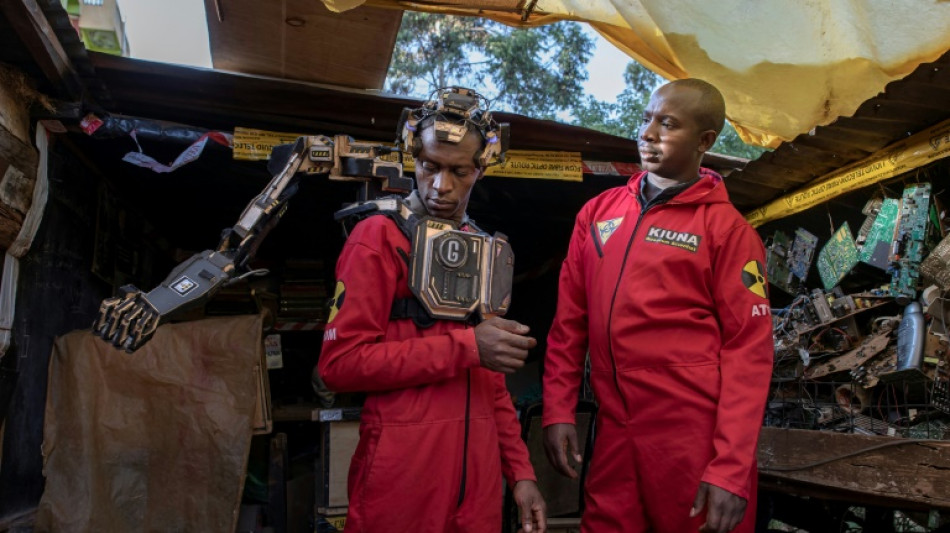
Twoportraits of Albert Einstein hang on the walls of a makeshift laboratory on Nairobi's outskirts, inspiring a pair of self-taught Kenyan innovators who have built a bio-robotic prosthetic arm out of electronic scrap.
Cousins Moses Kiuna, 29, and David Gathu30created their first prosthetic arm in 2012, after their neighbour lost a limb in an industrial accident.
But their latest invention is a significant upgrade, according to the duo.
The device uses a headset receiver to pick up brain signals and convert them to an electric current, which is then sent to a transmitter that wirelessly relays commands to the arm, prompting it into action.
It all happens in less than two seconds
"We saw people living with disabilities go through a lot of struggles and desired to make them... (feel) far more abled," Gathu told AFP.
Kiuna said their first prosthetic arm, custom-made for the neighbour, had "helped him operate around the house on his own".
The high cost of prosthetics means only one out of 10 people in need are able to access them globally, with the World Health Organization warning that such exclusion adds to the burden of disability.
"We noticed that Kenya imports prosthetics which are costly," Kiuna told AFP. "So we asked ourselves, 'How can we solve our own problems?"
- Recycling waste -
They found the answer in junkyards.
Since high school, the pair have been scouring dumping grounds around the Kenyan capital in search of discarded gadgets that they have repurposed to create over a dozen inventions.
Although conventional education did little to feed their curiosity, with Gathu dropping out of school at 17 and Kiuna quitting college a couple of years later, their appetite for learning has not dimmed.
The shelves in the bare-bones lab next to their grandmother's house are stacked with science books and the sheet metal walls are covered with charts detailing human anatomy or the periodic table.
"We studied neurophysiology by reading books and sitting with doctors to explain concepts to us," Gathu said, explaining how they came up with the prosthetic arm.
It is just one of the inventions conjured up by the cousins.
When Covid-19 struck, they built a device to sterilise banknotes using infrared technology, and later, a green-energy generator that converts oxygen into electricity, aimed at tackling climate change.
- 'Drive the future' -
"These two are proof that Africans can make a significant contribution to technology and science as we know it," said Mukuria Mwangi, the founder of the Jasiri Mugumo school in Nairobi, which caters to youths up to 10-years-old.
Mwangi, who regularly invites Gathu and Kiuna to mentor children at the school, told AFP that Kenya's education system did little to encourage innovation.
"Invention is not a discipline harnessed in our schools, yet innovation is what will drive the future," Mwangi said.
Other challenges such as a lack of funds also prevent innovation from taking centre stage in the East African nation, as reflected by the number of inventions gathering dust in Gathu and Kiuna's lab.
The pair hope to turn their prosthetic arm and other innovations into a thriving business.
"We have many other ideas that we can make viable commercially, but we lack finances and support," Gathu said.
S.Jordan--TFWP