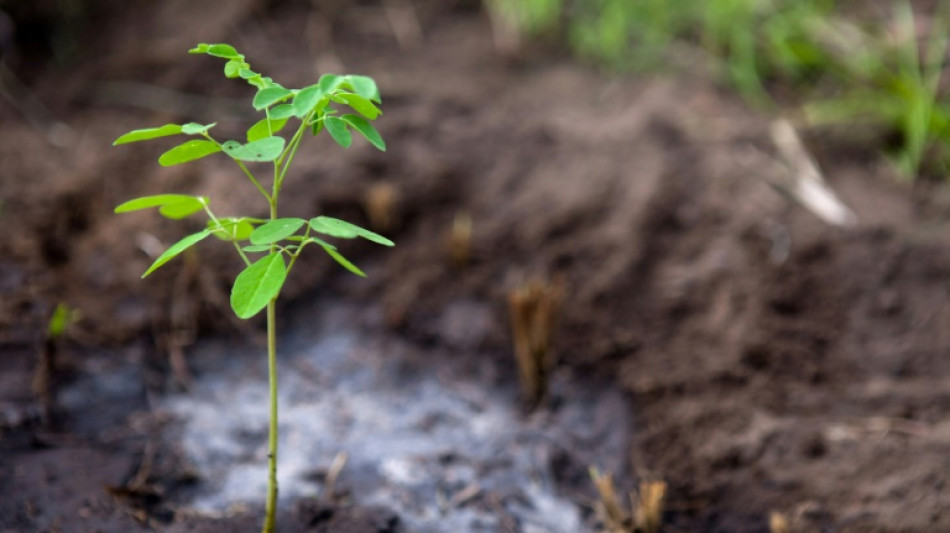
Fighting for their lives: the world's forests in figures / Photo: © AFP/File

Forests are central to biodiversity and the fight against climate change, as well as being a big money spinner for national economies.
But they are in critical danger.
As politicians, including French President Emmanuel Macron, prepare to descend on the West African nation of Gabon for an international summit on forests, AFP looks at how green our globe really is.
- One-third of the globe -
Forests cover almost a third, or 31 percent, of the global land area, according to a 2022 report by the United Nations' Food and Agriculture Organization (FAO).
They span some four billion hectares (9.9 billion acres), or close to the combined surface area of Canada, Russia, the United States and all 27 members of the European Union.
More than one-third is primary forest, which the FAO defines as being "naturally regenerated forests of native species, where there are no visible indications of human activities and the ecological processes are not significantly disturbed".
Brazil, Canada, China, Russia and the United States account for more than half of all forest area.
Seven percent of the world's forests have been planted by humans.
Forests can be found in many climates but three-quarters are either in the tropics (45 percent) or in a ring around the North Pole (27 percent).
- Two-thirds of all mammals -
Forests, especially rainforests, are critical for biodiversity on land.
Four-fifths of the world's amphibian species live in forests, as do three-quarters of bird species, 68 percent of mammal species and many of the 60,000 kinds of trees found on Earth.
Three-quarters of the fungi species, two-thirds of the plant species and nearly half (45 percent) of the animal species considered vulnerable, endangered or extinct are found in forests.
Among the amphibians in critical danger of extinction are the Montseny brook newt in Spain and Lanza's Alpine salamander, which lives in the Franco-Italian Alps.
- A carbon sink -
Forests typically act as carbon sinks, absorbing more carbon from the atmosphere than they emit.
They contain 662 billion tonnes of carbon, more than half of all the carbon found in soil and vegetation.
Deforestation and climate change have had some impact on that function, though replanting and better forest management have helped.
According to the FAO, forests absorbed more carbon than they emitted in 2011–2020, thanks to reforestation, improved management and other factors.
But it warns in its latest report on forests (2022) that they could start emitting carbon rather than absorbing it if deforestation is not halted.
"Unless additional action is taken, an estimated 289 million hectares of forests would be deforested between 2016 and 2050 in the tropics alone, resulting in the emission of 169 gigatonnes of CO2 equivalent."
- Source of money and jobs -
The forestry sector pumped more than $1.52 trillion into the world economy in 2015, directly and indirectly.
Whether working in wood putty and paper industries, forestry or solid wood products such as furniture, around 33 million people, or one percent of the world's workforce, are dependent on forests for a livelihood.
- Under threat -
Even though the rate of deforestation has slowed, it continues to occur "at an alarming rate" according to the FAO, which says 10 million hectares of forests were wiped out each year between 2015 and 2020.
The losses were not compensated by replanting and natural forest expansion, which is estimated at five million hectares per year.
Brazil, Canada, Indonesia, Russia and the United States lost the most forest cover between 2001 and 2021, according to Global Forest Watch (GFW).
The situation is most critical in Brazil and Indonesia, where the loss of primary forest to mining, agriculture and urban expansion is in most cases irreversible.
W.Matthews--TFWP