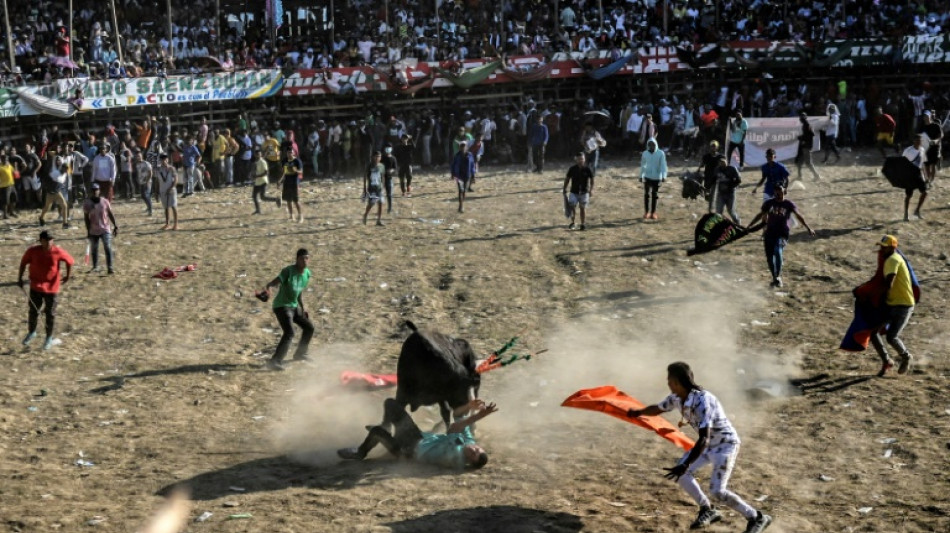
Colombia's bull fighting custom under fire for animal abuse / Photo: © AFP

Eliecer Molina climbs the stands to receive his monetary prize after excelling in a corraleja in Colombia's Caribbean north.
This form of bull-fighting -- a relic of Colombia's colonial Spanish heritage -- is hugely popular but some politicians want it banned and have submitted a bill to parliament looking to do so.
Unlike regular Spanish-style bull-fighting, which takes place elsewhere in Colombia, the animals are not killed and spectators are invited into the ring to engage with the bulls.
"This is the risk of a bull-fighter," said Molina, nursing a cut close to his left eye, the result of a miscalculation.
A 37-year-old odd-job man who goes by the nickname "coconut brain," Molina is one of many such bull-fighters who take part in these corraleja shows at the start of every year.
In Guaranda, a town of 15,600 in the northern Sucre department, the bullring has been custom-made for the occasion and 58 bulls borrowed from wealthy local ranchers.
Some young people make a name for themselves by going from town to town defying death in corralejas.
Manuel laborer Ricardo Rodriguez says he takes part for pleasure and "out of necessity."
He is a banderillero, who tries to stick little flags in the bull's shoulders.
He was gored in the leg.
Two weeks ago he suffered another injury and required a total of 36 stitches for both.
But while the corralejas are steeped in Colombian traditions, many lawmakers are trying to get them banned over the cruelty to animals.
- 'Violent and cruel' –
That rattle of gun fire warns participants that the bulls are about to be released.
They enter the ring and immediately chase furiously after people, some of whom bravely face up to the animals, while others tear away in terror to hide under the stands.
The corralejas last almost a week while local politicians sponsor the entertainment, providing musical bands and alcohol in return for having their names emblazoned inside the arena, which in Guaranda holds 3,000 people.
It takes 12 days to assemble the bullring, which is then dismantled and taken to another town.
But locals in Guaranda are worried that their festival could be derailed by animal rights initiatives.
Senator Andrea Padilla sponsored a bill in Congress demanding the banning of "cruel shows with animals."
The corralejas are "violent and cruel to ... sentient beings," Padilla told AFP.
The bill originally asked that bullfights, cock fights and corralejas be banned.
But the mention of corralejas was dropped after some lawmakers expressed concerns that they were too rooted in local culture.
Padilla, who is backed by President Gustavo Petro, now wants to tighten regulations around corralejas, in relation to the use of sharp objects, consumption of alcohol and children's access.
Petro has asked mayors to suspend events in which "there is animal abuse" but in 2018 Colombia's top court recognized corralejas as a cultural tradition.
There is no official data on the number of people killed or injured by gorging, nor on the victims of frequent stand collapses.
In 1980, more than 500 people died when the arena in Sincelejo, the capital of Sucre, collapsed.
- 'Last cartridges' –
The stands are full of food sellers and even spectators relaxing in hammocks tied to whatever posts they could find.
Dionisio Suarez, the organizer of the Guaranda events, says the corralejas are a tradition that run in the local inhabitants' blood.
To ban the most eagerly anticipated event of the year would mean "happiness is ending ... we are entering in sadness .... the people are hungry," said Suarez.
The local economy is heavily reliant on livestock and the corralejas.
Children are as enthusiastic about them as adults.
Pedro Chaves, 57, took his grand children, aged two and eight, to see the corralejas.
"We have to inculcate in them our same culture ... This is passed down from one generation to the next," he said. But he warned that: "You have to make the most of the last remaining" corralejas.
For Padilla, this is not about traditions but rather a barbaric act that needs to be stopped, much like the the spectacles put on in Rome's Colosseum 2,000 years ago.
"The similarity with the Roman Colosseum is very clear," she said. "It is using some defenseless poor ... whether they are, humans or animals, for the entertainment of a few elites."
In Latin America, bullfights are already barred in Brazil, Argentina, Uruguay, Chile and Guatemala.
Costa Rica puts on a similar kind of show to the corralejas, but in which no animals are hurt.
W.Matthews--TFWP