The Fort Worth Press - Clock ticking down on vital UN nature talks

USD -
AED 3.672499
AFN 66.000266
ALL 80.778943
AMD 366.25005
AOA 918.00007
ARS 1496.513997
AUD 1.420596
AWG 1.8025
AZN 1.698249
BAM 1.694243
BBD 2.013626
BDT 123.754743
BHD 0.376996
BIF 2988.071622
BMD 1
BND 1.281981
BOB 12.092258
BRL 5.108601
BSD 0.999753
BTN 95.145446
BWP 13.521485
BYN 2.960018
BYR 19600
BZD 2.010681
CAD 1.402805
CDF 2260.999588
CHF 0.81057
CLF 0.023103
CLP 912.480449
CNY 6.749509
CNH 6.748385
COP 3165.55
CRC 454.762008
CUC 1
CUP 26.5
CVE 95.518807
CZK 21.01155
DJF 178.03342
DKK 6.48206
DOP 58.256128
DZD 133.025013
EGP 49.694994
ERN 15
ETB 161.364703
EUR 0.86707
FJD 2.21295
FKP 0.742819
GBP 0.74295
GEL 2.615034
GGP 0.742819
GHS 11.751814
GIP 0.742819
GMD 73.496998
GNF 8780.470902
GTQ 7.628337
GYD 209.158083
HKD 7.844705
HNL 26.796086
HRK 6.532399
HTG 130.718954
HUF 316.080502
IDR 17901
ILS 3.007702
IMP 0.742819
INR 95.254898
IQD 1309.701703
IRR 1374800.000067
ISK 123.469731
JEP 0.742819
JMD 158.474679
JOD 0.70901
JPY 158.299704
KES 129.359593
KGS 87.450107
KHR 4056.705519
KMF 426.999942
KRW 1422.689712
KWD 0.30959
KYD 0.833171
KZT 468.495939
LAK 22589.41952
LBP 89528.70601
LKR 335.825291
LRD 180.459725
LSL 16.307022
LTL 2.95274
LVL 0.60489
LYD 6.373118
MAD 9.327951
MDL 17.39541
MGA 4298.392651
MKD 53.301108
MMK 2099.443841
MNT 3595.840223
MOP 8.078327
MRU 40.080389
MUR 46.939481
MVR 15.44974
MWK 1733.55625
MXN 17.20344
MYR 4.089799
MZN 63.909904
NAD 16.306951
NGN 1362.697181
NIO 36.790312
NOK 9.54857
NPR 152.231048
NZD 1.701795
OMR 0.384511
PAB 0.999749
PEN 3.37939
PGK 4.41709
PHP 60.704966
PKR 277.55765
PLN 3.72759
PYG 5946.889469
QAR 3.654602
RON 4.556702
RSD 101.731974
RUB 81.528891
RWF 1468.660802
SAR 3.755132
SBD 8.068348
SCR 14.493758
SDG 600.501
SEK 9.49685
SGD 1.28296
SLE 24.602353
SOS 571.386496
SRD 37.866495
STD 20697.981008
STN 21.223422
SVC 8.747553
SZL 16.293454
THB 33.080966
TJS 9.222706
TMT 3.5
TND 2.932323
TRY 47.594983
TTD 6.768972
TWD 32.253504
TZS 2654.998012
UAH 44.766628
UGX 3724.060864
UYU 40.264038
UZS 11914.620835
VES 754.21125
VND 26235
VUV 119.344278
WST 2.729216
XAF 568.230703
XAG 0.016229
XAU 0.000234
XCD 2.70255
XCG 1.801841
XDR 0.705886
XOF 568.233164
XPF 103.310868
YER 236.875004
ZAR 16.31955
ZMK 9001.201261
ZMW 19.020435
ZWL 321.999592
  • CMSC

    0.0800

    21.81

    +0.37%

  • RYCEF

    0.6000

    21

    +2.86%

  • RBGPF

    0.0000

    69.74

    0%

  • CMSD

    -0.0230

    22.017

    -0.1%

  • NGG

    -0.1600

    80.26

    -0.2%

  • GSK

    0.5900

    52.05

    +1.13%

  • RIO

    -1.6200

    99.89

    -1.62%

  • BCE

    0.8200

    22.88

    +3.58%

  • VOD

    0.6650

    15.975

    +4.16%

  • BTI

    -0.4000

    58.87

    -0.68%

  • BP

    0.8550

    42.065

    +2.03%

  • RELX

    -1.0700

    35.54

    -3.01%

  • AZN

    -1.4900

    160.01

    -0.93%

  • JRI

    0.0000

    12.67

    0%

  • BCC

    -0.2100

    84.59

    -0.25%

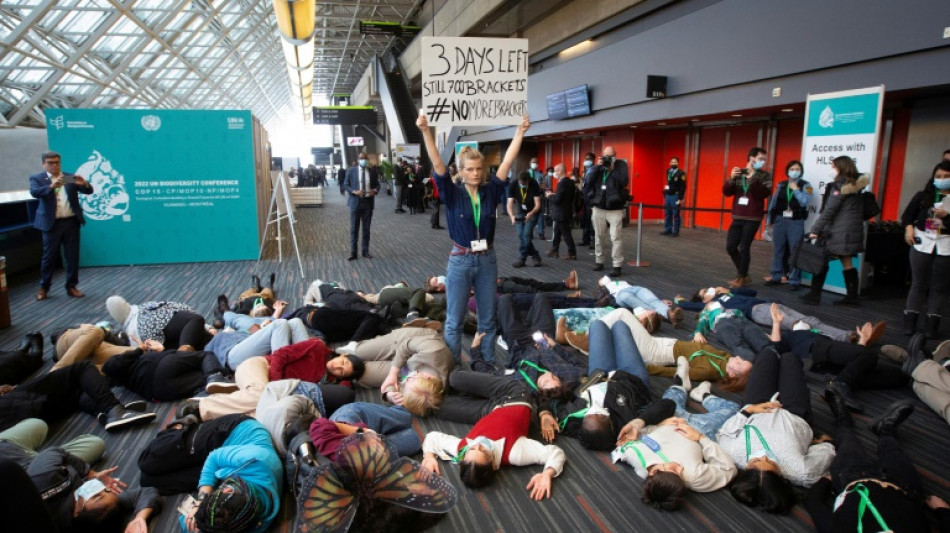
Clock ticking down on vital UN nature talks
Clock ticking down on vital UN nature talks / Photo: © AFP

Clock ticking down on vital UN nature talks

Crucial UN talks aimed at sealing a "peace pact for nature" were entering their final stages Saturday, officially the last day the world's environment ministers are gathered in Montreal for the COP15 meeting.

Text size:

Whether they deliver a deal for biodiversity that is as ambitious as the Paris accord for climate, endorse a watered-down text, or fail to agree on anything at all remains to be seen, though there are strong signs the negotiations set to last until December 19 will run beyond the allotted time.

With the clock ticking down, over 3,000 scientists wrote an open letter to policymakers, calling for immediate action to stop the destruction of critical ecosystems.

"We owe this to ourselves and to future generations -- we can't wait any longer," they said.

At stake is the future of the planet and whether humanity can roll back habitat destruction, pollution and the climate crisis, which are threatening an estimated million plant and animal species with extinction.

The text is meant to be a roadmap for nations to follow that carries them through until 2030, after the last 10-year plan signed in Japan failed to achieve any of its objectives, widely blamed on its lack of monitoring mechanisms.

Major draft goals include a cornerstone pledge to protect 30 percent of the world's land and oceans by 2030, which is compared to the Paris deal commitment to hold long-term planetary warming by 1.5 degrees Celsius or at least to 2C.

In all, there are more than 20 targets, including reducing environmentally destructive subsidies of agriculture, obliging businesses to assess and report on their biodiversity impacts, and tackling the scourge of invasive species.

The thorny issue of how much money the global north will send to the global south to help preserve their ecosystems has emerged as the biggest sticking point.

Several countries have announced new commitments either at the COP or recently, with Europe emerging as a key leader. The European Union has committed seven billion euros for the period until 2027, double its prior pledge.

But these commitments are still well short of what observers say is needed, and what developing countries are seeking.

Brazil has led that charge, proposing flows of $100 billion annually, compared to the roughly $10 billion at present.

But France has hit back, saying developed countries will only step up funding if developing countries agree to more ambitious plans, including on reducing pesticide use that agro industries in the global south use heavily.

"We cannot have on hand some tears for species but no real commitments at the end of this COP," French environment minister Christophe Bechu said Friday.

Whether international aid is delivered via a new fund, an existing mechanism called the Global Environment Facility, or a halfway solution involving a new "trust fund" within the GEF, is still up for debate.

T.Mason--TFWP