The Fort Worth Press - Japan approves stem-cell treatment for Parkinson's in world first

USD -
AED 3.672503
AFN 62.99987
ALL 82.629116
AMD 376.411435
ANG 1.789731
AOA 916.999481
ARS 1407.505101
AUD 1.421353
AWG 1.8025
AZN 1.701804
BAM 1.683872
BBD 2.013518
BDT 122.265366
BGN 1.647646
BHD 0.377461
BIF 2966.70986
BMD 1
BND 1.276675
BOB 6.907655
BRL 5.265401
BSD 0.999694
BTN 91.668927
BWP 13.449567
BYN 2.936897
BYR 19600
BZD 2.010676
CAD 1.36611
CDF 2260.000206
CHF 0.780935
CLF 0.022949
CLP 906.170053
CNY 6.8975
CNH 6.90969
COP 3791.6
CRC 471.223347
CUC 1
CUP 26.5
CVE 94.933685
CZK 21.00397
DJF 178.026699
DKK 6.43686
DOP 59.460414
DZD 130.833985
EGP 50.097399
ERN 15
ETB 155.064768
EUR 0.86158
FJD 2.210502
FKP 0.75091
GBP 0.748685
GEL 2.704971
GGP 0.75091
GHS 10.777768
GIP 0.75091
GMD 73.493572
GNF 8766.665662
GTQ 7.667704
GYD 209.158261
HKD 7.82195
HNL 26.461864
HRK 6.491977
HTG 131.076968
HUF 334.189765
IDR 16940
ILS 3.082601
IMP 0.75091
INR 91.683501
IQD 1309.672948
IRR 1319072.505074
ISK 124.679906
JEP 0.75091
JMD 156.269507
JOD 0.708978
JPY 157.823496
KES 129.149521
KGS 87.443398
KHR 4012.208824
KMF 424.000353
KPW 900.009268
KRW 1473.675007
KWD 0.30772
KYD 0.833114
KZT 492.197085
LAK 21412.212426
LBP 89527.479056
LKR 310.82105
LRD 182.445899
LSL 16.495355
LTL 2.95274
LVL 0.60489
LYD 6.37218
MAD 9.286289
MDL 17.290754
MGA 4131.043093
MKD 53.115534
MMK 2099.899945
MNT 3569.0757
MOP 8.053984
MRU 39.919582
MUR 47.376658
MVR 15.46025
MWK 1733.530215
MXN 17.68805
MYR 3.951499
MZN 63.904973
NAD 16.495426
NGN 1385.205048
NIO 36.790219
NOK 9.667899
NPR 146.676769
NZD 1.693155
OMR 0.384495
PAB 0.999664
PEN 3.410548
PGK 4.305843
PHP 59.005499
PKR 279.37363
PLN 3.681495
PYG 6546.127685
QAR 3.645646
RON 4.3866
RSD 101.163527
RUB 78.679401
RWF 1461.098364
SAR 3.753485
SBD 8.05166
SCR 13.909979
SDG 601.496121
SEK 9.223759
SGD 1.278602
SHP 0.750259
SLE 24.507217
SLL 20969.49935
SOS 570.319126
SRD 37.716971
STD 20697.981008
STN 21.094413
SVC 8.747799
SYP 110.821403
SZL 16.500855
THB 31.795503
TJS 9.587041
TMT 3.51
TND 2.9295
TOP 2.40776
TRY 44.0711
TTD 6.763243
TWD 31.677501
TZS 2572.501049
UAH 43.805863
UGX 3678.974399
UYU 39.233918
UZS 12168.852078
VES 425.142005
VND 26250
VUV 119.29626
WST 2.726253
XAF 564.771773
XAG 0.011922
XAU 0.000195
XCD 2.70255
XCG 1.801838
XDR 0.702398
XOF 564.771773
XPF 102.678456
YER 238.596439
ZAR 16.610203
ZMK 9001.200322
ZMW 19.244909
ZWL 321.999592
  • RBGPF

    0.1000

    82.5

    +0.12%

  • BCC

    -1.0100

    77.31

    -1.31%

  • GSK

    -1.5600

    55.27

    -2.82%

  • CMSD

    -0.0900

    23.21

    -0.39%

  • BCE

    -0.4700

    25.98

    -1.81%

  • NGG

    -0.6900

    89.74

    -0.77%

  • RIO

    -2.8800

    93.37

    -3.08%

  • AZN

    -4.0100

    197.52

    -2.03%

  • CMSC

    -0.1990

    23.29

    -0.85%

  • BTI

    -2.4200

    58.59

    -4.13%

  • RELX

    1.0000

    35.18

    +2.84%

  • JRI

    -0.1100

    12.8

    -0.86%

  • RYCEF

    -0.7700

    17.2

    -4.48%

  • VOD

    -0.4100

    14.62

    -2.8%

  • BP

    0.4600

    39.3

    +1.17%

Japan approves stem-cell treatment for Parkinson's in world first
Japan approves stem-cell treatment for Parkinson's in world first / Photo: © AFP

Japan approves stem-cell treatment for Parkinson's in world first

Japan has approved ground-breaking stem-cell treatments for Parkinson's and severe heart failure, one of the manufacturers and media reports said Friday, with the therapies expected to reach patients within months.

Text size:

Pharmaceutical company Sumitomo Pharma said it received the green light for the manufacture and sale of Amchepry, its Parkinson's disease treatment that transplants stem cells into a patient's brain.

Japan's health ministry also gave the go-ahead to ReHeart, heart muscle sheets developed by medical startup Cuorips that can help form new blood vessels and restore heart function, media reports said.

The treatments could be on the market and rolled out to patients as early as this summer, reports said, citing the health ministry, becoming the world's first commercially available medical products using (iPS) cells.

Japanese scientist Shinya Yamanaka won the Nobel Prize in 2012 for his research into iPS, which have the potential to develop into any cell in the body.

"I hope this will bring relief to patients not only in Japan but around the world," health minister Kenichiro Ueno told a press conference.

"We will promptly carry out all necessary procedures to ensure it reaches all patients without fail."

In a statement, Sumitomo Pharma said it had obtained "conditional and time-limited approval" for the manufacture and marketing of Amchepry under a system which is reportedly designed to get these products to patients as quickly as possible.

The approval is a kind of "provisional license", the Asahi newspaper said, after the safety and efficacy of the treatment was judged based on data from fewer patients than in ordinary clinical trials for drugs.

A trial led by Kyoto University researchers indicated that the company's treatment was safe and successful in improving symptoms.

The study involved seven Parkinson's patients aged between 50 and 69, with each receiving a total of either five million or 10 million cells implanted on both sides of the brain.

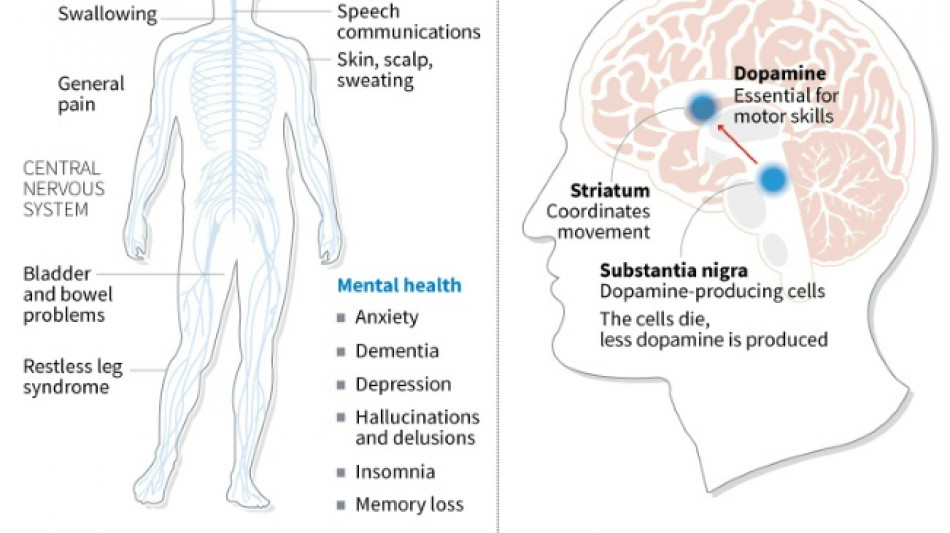
The iPS cells from healthy donors were developed into the precursors of dopamine-producing brain cells, which are no longer present in people with Parkinson's disease.

The patients were monitored for two years and no major adverse effects were found, the study said. Four patients showed improvements in symptoms.

Parkinson's disease is a chronic, degenerative neurological disorder that affects the body's motor system, often causing shaking and other difficulties in movement.

Worldwide, about 10 million people have the illness, according to the Parkinson's Foundation.

Currently available therapies "improve symptoms without slowing or halting the disease progression," the foundation says.

iPS cells are created by stimulating mature, already specialised, cells back into a juvenile state -- basically cloning without the need for an embryo.

The cells can be transformed into a range of different types of cells, and their use is a key sector of medical research.

K.Ibarra--TFWP