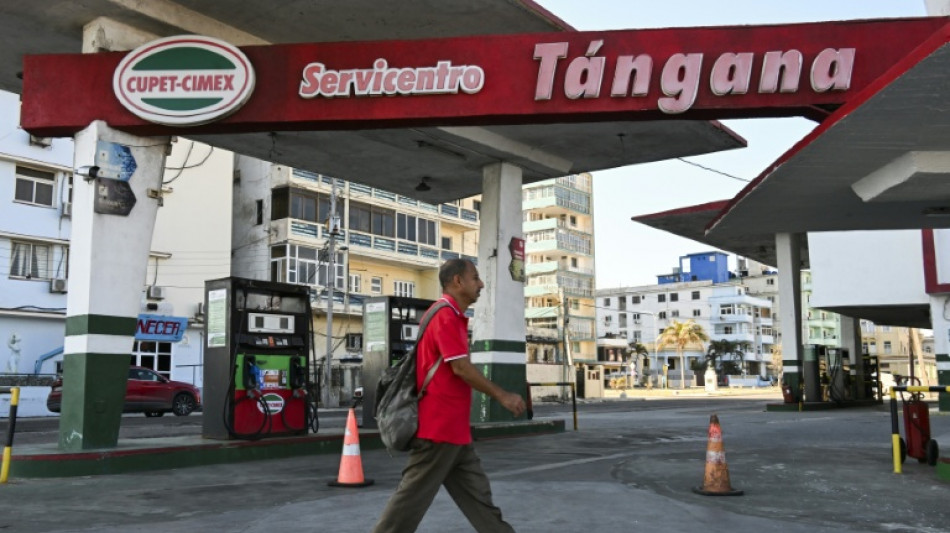
Starved of fuel, Cubans scramble to make ends meet / Photo: © AFP

The US-imposed oil blockade on Cuba is upending the lives of everyday workers, who are switching jobs and ditching their cars to make due amid rolling blackouts and fuel shortages.
Yixander Diaz jettisoned both his ride and his work when the father of two, a taxi driver, turned to bricklaying.
"Times are tough," the 27-year-old, who now commutes by bicycle from his Havana suburb to the city center, told AFP.
Since toppling Venezuela's leftist leader Nicolas Maduro in January, the United States has stopped the new authorities in Caracas from shipping oil to Cuba and threatened to sanction any other country that does.
The result is a crushing energy crisis in a country that has for years battled extended power cuts and shortages of fuel, medicine and food.
Vehicle owners have access to 20 liters of gasoline through a mobile application that organizes distribution -- but it can take months.
Due to the fuel shortage, Diaz had to "park the motorcycle, park the car" and return to his former profession "to survive."
Communist-run Cuba, which has faced a US trade embargo since 1962, has said it would maintain public sector salaries for the time being, but has instituted a four-day work week as transportation woes bite.
Diesel sales are banned and gasoline sales are restricted under the emergency measures instituted by the government to deal with the crisis.
- Goods stuck at port -
Many self-employed, private sector and informal workers are barely hanging on.
"I could lose my job at any moment, and I don't know how I'm going to feed my family," Alexander Callejas, a parking attendant at a restaurant, told AFP.
At the Havana eatery where he works, the number of customers arriving by car has dramatically decreased, he said.
According to research by the private consulting firm Auge, 96.4 percent of the country's small and medium-sized private businesses are feeling "severe" or "catastrophic" impacts from the fuel shortage.
Local crude production, at roughly 40,000 barrels per day, barely allows the country's power plants to operate.
The lack of diesel has pinched electric generators that previously supplemented production.
Solar has increased since early 2026 among those who can afford it -- while others turn to charcoal or cook over open fires.
Even before the US blockade, an AFP analysis of official statistics found that the island generated only half the electricity it needed last year.
"They cut off the power here every day," said Havana resident Eduardo, who told AFP whether the lights are on or not affects when he can cook his meals that day.
The crisis has trickled down to fruit and vegetable vendors in a country that imports 80 percent of its food.
"We start work at nine in the morning and by noon we have to close," said Yordan Gonzalez, 20, who works in a small shop in central Havana.
By the afternoon, "there's no merchandise," she said -- and "no diesel" to bring in more.
Meanwhile, at the Mariel commercial port, outside the capital, containers are piling up.
There's not enough diesel to distribute the goods inside.
J.P.Cortez--TFWP