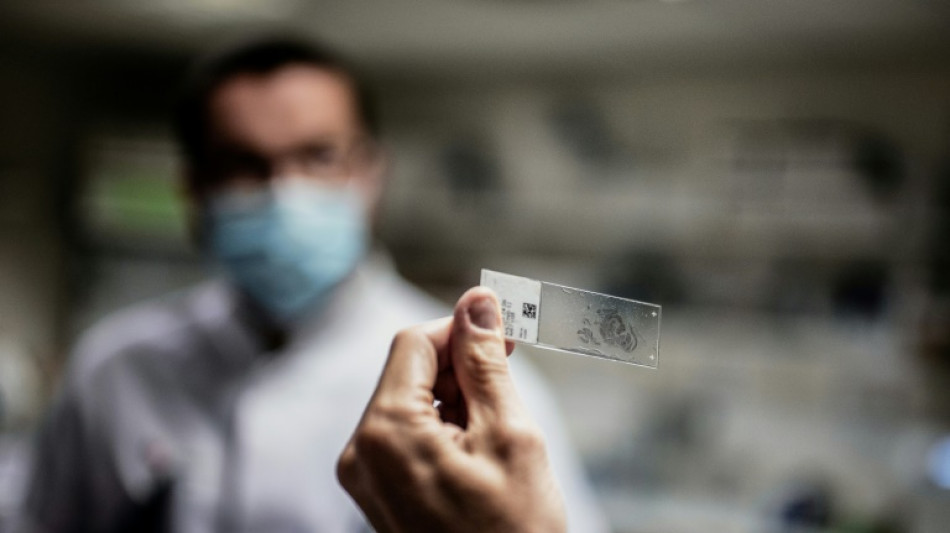
The search to discover why 'outliers' survive deadliest cancers / Photo: © AFP/File

When Herve found out he had glioblastoma -- the most aggressive form of brain cancer -- at the age of 40, he made a deal with himself.
"I said to myself: it is serious, but you are at war -- and you're going to win," the French teacher, who did not want to give his surname, told AFP.
"For my wife and children, I forbade myself to die."
Eight years later, following surgery to remove the tumour, radiotherapy and chemotherapy, Herve is still winning his war.
He is just one of the thousands of people across the world to have survived an extremely deadly cancer for which there is no known cure.
Herve eagerly volunteered for research being conducted by a biotech start-up aiming to find out what makes these exceptional cases different, in the hope of reproducing their unlikely tales of survival on a grand scale.
"We call them outliers," said Nicolas Wolikow, the CEO and co-founder of the Paris-based firm Cure51.
"For unknown reasons, when these people face an illness they take a completely different trajectory from other people," he told AFP.
The start-up is working on creating "the first global clinical and molecular database of exceptional survivors" of cancer, according to its website.
The project will involve patients who lived for more than three or five years after being diagnosed with three of the deadliest cancers: glioblastoma, metastatic pancreatic cancer and small cell lung cancer.
"They are very aggressive cancers for which real new treatments have not been developed over the last 15 years," Wolikow said.
Yet the rare few -- tens of thousands of people worldwide -- still defy what for most would be a death sentence. The question is why.
- Search for 'molecular signature' -
One problem has been that almost all research has been based on North American or Western European patients, Wolikow said.
So the firm has partnered with 50 cancer centres around the world to get data from a wider variety of survivors.
So far, the firm has found 1,300 patients to be part of the project.
Once the data is collected "we will begin analysing medical reports, images, tumour cells," Wolikow said.
The patients will also fill out questionnaires about their lifestyle, sleep, diet and the roles of people around them.
Algorithms deploying artificial intelligence will also be used to seek out the patients' common traits, comparing them to those of people who succumbed to their cancer.
On Wednesday, Cure51 announced it has raised 15 million euros ($16 million) for the project. Eventually, it hopes to be financed through collaborations with other biotech firms or pharmaceutical labs.
Olivia Le Saux, an oncologist in the French city of Lyon who is supervising the project, said the team was hoping to discover a "molecular signature which would explain the exceptional survival of these patients".
The ultimate goal is to create new drugs or treatments that mimic the molecular characteristics of those few who do survive these killer cancers.
For Herve, there was some satisfaction in seeing the surprise on the face of his doctor when his tumour kept failing to return in his regular MRI scans.
"At each appointment I could see the relief on his face," said the teacher in southeastern French department of Isere.
So Herve has happy to volunteer for the Cure51 project.
"I am well aware of having extraordinary luck," he said.
"I told myself that if I wanted to make a contribution, now was the time."
T.M.Dan--TFWP