The Fort Worth Press - New treatment shows promise against fatal neurological disease: study

USD -
AED 3.672503
AFN 64.49594
ALL 81.815223
AMD 360.349649
ANG 1.790403
AOA 916.999769
ARS 1580.028975
AUD 1.509798
AWG 1.8
AZN 1.700372
BAM 1.783887
BBD 2.013554
BDT 124.390611
BGN 1.77347
BHD 0.37715
BIF 3005
BMD 1
BND 1.290167
BOB 11.7514
BRL 5.929795
BSD 0.999663
BTN 92.837337
BWP 14.241413
BYN 2.988407
BYR 19600
BZD 2.010617
CAD 1.43668
CDF 2284.999535
CHF 0.84142
CLF 0.025836
CLP 1016.83011
CNY 6.66465
CNH 6.665835
COP 3525.78
CRC 447.472592
CUC 1
CUP 23.992813
CVE 101.502057
CZK 22.388797
DJF 177.719561
DKK 6.85328
DOP 59.774989
DZD 137.428718
EGP 54.243299
ERN 15
ETB 161.521425
EUR 0.916902
FJD 2.313297
FKP 0.764341
GBP 0.767145
GEL 2.605002
GGP 0.764341
GHS 11.825003
GIP 0.764341
GMD 73.501294
GNF 8859.999778
GTQ 7.642423
GYD 209.142815
HKD 7.842625
HNL 27.060256
HRK 6.831965
HTG 131.196585
HUF 338.112502
IDR 18196
ILS 3.300995
IMP 0.764341
INR 92.91515
IQD 1514
IRR 1948959.999954
ISK 125.788329
JEP 0.764341
JMD 158.459279
JOD 0.709001
JPY 158.894501
KES 130.019818
KGS 87.449947
KHR 4075.999925
KMF 452.000112
KPW 900.00035
KRW 1339.904985
KWD 0.31203
KYD 0.833079
KZT 455.416917
LAK 22525.000308
LBP 89549.999755
LKR 332.477483
LRD 166.625016
LSL 17.409814
LTL 2.95274
LVL 0.604891
LYD 6.464996
MAD 10.035006
MDL 18.223939
MGA 4590.00007
MKD 56.443625
MMK 2100.263653
MNT 3609.734672
MOP 8.073312
MRU 40.679878
MUR 46.780108
MVR 15.409711
MWK 1736.999976
MXN 19.186201
MYR 4.124993
MZN 63.905021
NAD 17.409802
NGN 1355.249903
NIO 36.701793
NOK 9.846905
NPR 148.53974
NZD 1.835615
OMR 0.3845
PAB 0.999653
PEN 3.456499
PGK 4.499504
PHP 63.729045
PKR 276.498147
PLN 4.075585
PYG 6392.769029
QAR 3.643497
RON 4.9029
RSD 107.86398
RUB 81.924641
RWF 1477
SAR 3.744381
SBD 8.17048
SCR 13.95626
SDG 601.504372
SEK 10.27711
SGD 1.291225
SHP 0.767312
SLE 22.999859
SLL 20969.503664
SOS 572.485566
SRD 37.414503
STD 20697.981008
STN 22.7
SVC 8.746927
SYP 13002.000337
SZL 17.409987
THB 33.976496
TJS 9.207209
TMT 3.51
TND 3.05496
TOP 2.40776
TRY 50.60672
TTD 6.785968
TWD 32.863101
TZS 2670.007986
UAH 45.187915
UGX 4233.914182
UYU 40.514596
UZS 12024.999608
VES 918.6729
VND 25785
VUV 120.821201
WST 2.823282
XAF 601.448144
XAG 0.023153
XAU 0.000275667771
XCD 2.70255
XCG 1.801748
XDR 0.707052
XOF 601.448144
XPF 109.711502
YER 236.549674
ZAR 17.418665
ZMK 9001.198684
ZMW 20.624236
ZWL 321.999592
SSP 5775.741752
MXV 2.149034
  • RIO

    -0.3300

    97.04

    -0.34%

  • CMSC

    -0.0400

    20.67

    -0.19%

  • RELX

    0.0000

    33.41

    0%

  • RBGPF

    0.0000

    67.95

    0%

  • BCE

    -0.0700

    21.99

    -0.32%

  • BCC

    -0.0300

    75.66

    -0.04%

  • GSK

    0.8600

    51.08

    +1.68%

  • JRI

    -0.0300

    11.52

    -0.26%

  • NGG

    -0.1200

    76.68

    -0.16%

  • CMSD

    0.0900

    20.54

    +0.44%

  • BTI

    -0.0800

    55.75

    -0.14%

  • AZN

    2.0200

    168.1

    +1.2%

  • BP

    -1.4200

    43.16

    -3.29%

  • RYCEF

    0.4600

    19.7

    +2.34%

  • VOD

    0.0700

    17.02

    +0.41%

New treatment shows promise against fatal neurological disease: study
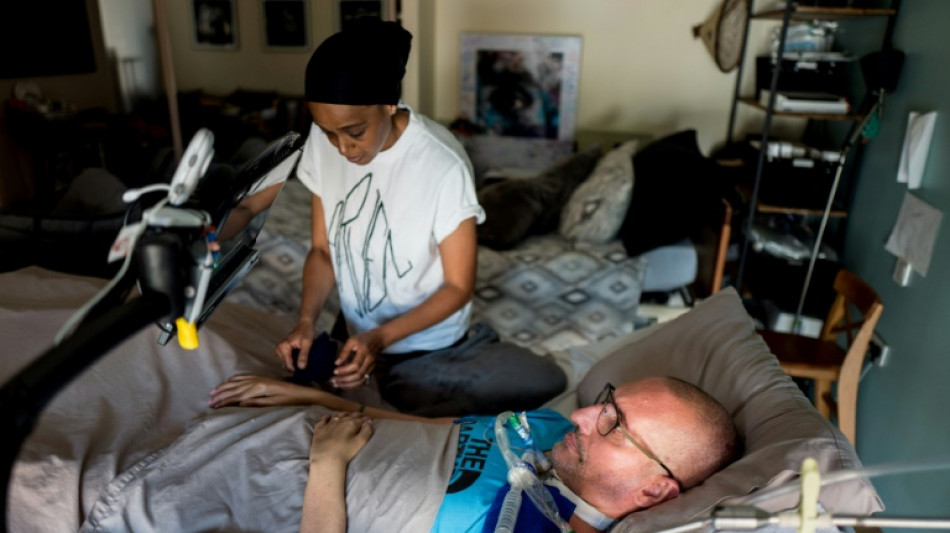
New treatment shows promise against fatal neurological disease: study / Photo: © AFP/File

New treatment shows promise against fatal neurological disease: study

A new treatment shows promise against the deadly neurodegenerative disease ALS, a study based on mice showed Tuesday.

Text size:

Amyotrophic lateral sclerosis, sometimes called Lou Gehrig's disease after the famous baseball player, devastates nerve cells in the brain and spinal cord.

It affects about 30,000 Americans at any given time, causing progressive loss of motor and cognitive function. Most patients die within five years of their diagnosis.

In the new research, published in the journal PLOS Biology, a team led by Jeffrey Agar of Northeastern University investigated a way to target and stabilize an abundant enzyme that keeps cells safe from the toxic byproducts of consuming food and breathing oxygen.

Inherited mutations to the gene responsible for production of this protein, called SOD1, are involved in many cases of ALS, and at other times such mutations can occur without family history.

A malfunctioning SOD1 gene causes the protein to assemble into the wrong shape. This prevents it from doing its tasks, but can also trigger a build up of protein clumps that are also a hallmark of Alzheimer's, Parkinson's, and other diseases.

Agar told AFP that over the course of 12 years, he and colleagues had discovered and tested a "molecular stabilizer," S-XL6, that acts like a "stitch" and forces the protein to remain in the correct configuration.

A major challenge involved finding a molecular stitch that would only target the SOD1, not "off target" proteins, which would poison the host.

The team tested their molecule in mice that were genetically modified to have a form of ALS disease, and found it not only restored the protein's function, but stopped its secondary toxic effects too. Safety was also proven in rats and dogs.

It successfully stabilized 90 percent of SOD1 proteins in blood cells, and 60-70 percent in brain cells.

They are hoping to soon get permission to move the molecule to clinical trials in humans, and an investor has purchased the rights to a patent.

Eventually, if it proves out, Agar said he hoped it might become a co-treatment for Biogen's Qalsody, a breakthrough regimen that received accelerated approval by the Food and Drug Administration in 2023, which works by reducing the number of SOD1 gene copies the body produces.

J.M.Ellis--TFWP