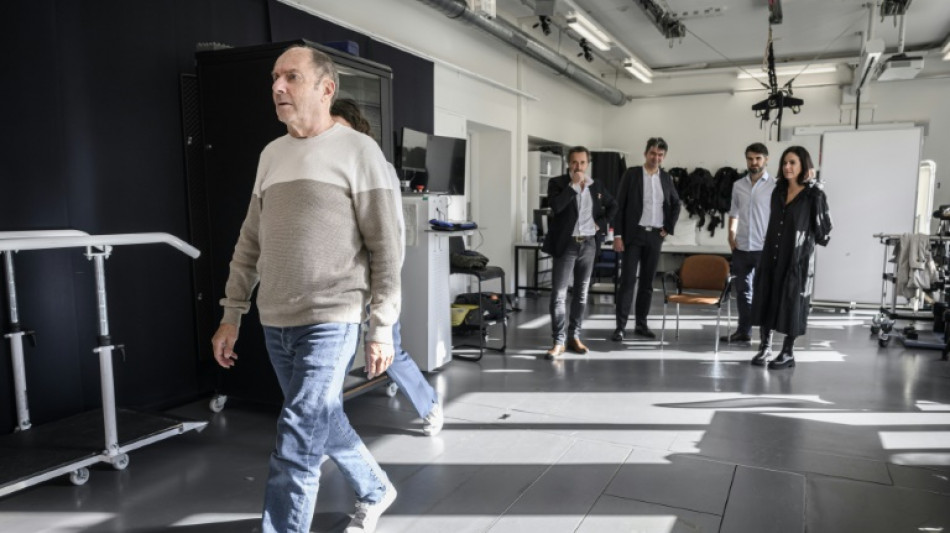
Spinal implant allows Parkinson's patient to walk again / Photo: © AFP

A man with advanced Parkinson's disease is now able to walk almost normally again thanks to electrodes implanted in his spinal cord, researchers said on Monday.
The medical first was achieved by Swiss researchers who had previously pioneered similar breakthroughs to help paraplegic people walk again.
"This could be a game-changing technology to help restore movement in people with advanced Parkinson's," said David Dexter, research director at Parkinson's UK, emphasising that the procedure is invasive and more research was needed.
Marc, the 62-year-old patient who lives in France, has suffered from the debilitating brain disorder for about 30 years.
Like more than 90 percent of people with advanced Parkinson's, Marc has had great difficulty walking.
What are known as "freezing" episodes -- during which patients are temporarily unable to move, putting them at risk of falling -- are particularly "awful", Marc told AFP.
"If you have an obstacle or if someone passes in front of you unexpectedly, you start to 'freeze' and you fall," said Marc, who asked not to reveal his last name.
Much remains unknown about Parkinson's disease, making treatment difficult. But the symptoms can seriously affect the lives of patients, sometimes confining them to bed or a wheelchair.
When the opportunity arose to undergo surgery in Switzerland, Marc leapt at the chance.
- 'I can go do whatever I want' -
"Now I can walk from one point to another without worrying about how I'm going to get there," he said.
"I can go for a walk, go out shopping by myself -- I can go do whatever I want."
The Swiss team, led by surgeon Jocelyne Bloch and neuroscientist Gregoire Courtine, implanted a complex system of electrodes called a "neuroprosthesis" at crucial points along Marc's spinal cord.
The pair had previously introduced the use of spinal cord implants to enable paraplegic patients to walk again.
The latest research, published in the journal Nature Medicine, works roughly along the same principle.
For Marc and other Parkinson's patients, communication between the brain and the spinal cord has been impaired by the progressive disappearance of neurons which generate the neurotransmitter dopamine.
Therefore, the neuroprosthesis has to not only send electrical stimulation to prompt walking, but also assume the role of the brain by properly timing the stimulation, so the resulting movements correspond to the patient's wishes.
"The idea is that we are going to measure residual movements -- so, the intention to walk -- with small sensors which are located in the legs," Courtine told AFP.
"Thanks to this, we know if the person wants to oscillate or stop, and we can adjust the stimulation accordingly," said Courtine, a researcher at the Swiss Federal Institute of Technology Lausanne.
- 'Major potential advance' -
The neuroprosthesis was first tested on primates, then implanted in Marc, who has used it for roughly eight hours a day over nearly two years.
Marc said he can now walk much more easily -- he is even planning a trip to Brazil -- but emphasised that it still requires concentration, particularly when climbing up stairs.
The Swiss team has expanded their experiment to a group of six Parkinson's patients, aiming to know how it could help others, given the disease affects people in different ways.
Treatment using the invasive implant could be quite expensive, potentially limiting how many patients would have access.
Bloch and Courtine have launched a startup called Onward looking at future marketing.
But even reaching this point represents "a major potential advance," Dexter said.
N.Patterson--TFWP