The Fort Worth Press - From Covid to cancer: High hopes for Nobel mRNA vaccines

USD -
AED 3.672503
AFN 64.000378
ALL 81.719319
AMD 368.120328
ANG 1.790403
AOA 913.115986
ARS 1429.260602
AUD 1.41299
AWG 1.801525
AZN 1.697505
BAM 1.684662
BBD 2.014307
BDT 122.763646
BGN 1.69088
BHD 0.377198
BIF 2989.857226
BMD 1
BND 1.282253
BOB 6.910839
BRL 5.078301
BSD 1.000134
BTN 94.672782
BWP 13.41861
BYN 2.768827
BYR 19600
BZD 2.011413
CAD 1.39823
CDF 2295.000232
CHF 0.793599
CLF 0.022681
CLP 892.650219
CNY 6.7715
CNH 6.759475
COP 3492.51
CRC 454.982019
CUC 1
CUP 26.5
CVE 94.978251
CZK 20.818983
DJF 177.719854
DKK 6.44282
DOP 58.780714
DZD 133.064977
EGP 50.349403
ERN 15
ETB 161.237628
EUR 0.86196
FJD 2.237202
FKP 0.746148
GBP 0.74475
GEL 2.655019
GGP 0.746148
GHS 11.101445
GIP 0.746148
GMD 73.000119
GNF 8761.079479
GTQ 7.62406
GYD 209.236521
HKD 7.83485
HNL 26.744076
HRK 6.494499
HTG 130.714732
HUF 301.863003
IDR 17704
ILS 2.902595
IMP 0.746148
INR 94.572302
IQD 1310.156512
IRR 1375877.497294
ISK 124.460444
JEP 0.746148
JMD 158.526028
JOD 0.708973
JPY 160.269503
KES 129.398158
KGS 87.450511
KHR 4019.208821
KMF 426.000074
KPW 900.00035
KRW 1514.220217
KWD 0.30815
KYD 0.833473
KZT 489.555787
LAK 22021.999604
LBP 89562.850473
LKR 332.536555
LRD 182.018649
LSL 16.177014
LTL 2.95274
LVL 0.60489
LYD 6.359584
MAD 9.24575
MDL 17.396473
MGA 4155.30719
MKD 53.139347
MMK 2099.090156
MNT 3576.689019
MOP 8.070461
MRU 39.92506
MUR 47.119898
MVR 15.459816
MWK 1734.220557
MXN 17.20605
MYR 4.050304
MZN 63.900812
NAD 16.176944
NGN 1358.26011
NIO 36.806698
NOK 9.534545
NPR 151.476624
NZD 1.71552
OMR 0.384502
PAB 1.00006
PEN 3.401239
PGK 4.380015
PHP 60.294503
PKR 278.247736
PLN 3.66395
PYG 6123.407023
QAR 3.646058
RON 4.512497
RSD 101.176013
RUB 72.451568
RWF 1469.173289
SAR 3.752094
SBD 8.045573
SCR 13.696826
SDG 600.499
SEK 9.384235
SGD 1.282575
SHP 0.746601
SLE 24.649833
SLL 20969.503664
SOS 571.527015
SRD 37.518031
STD 20697.981008
STN 21.103498
SVC 8.750743
SYP 110.532098
SZL 16.174171
THB 32.55404
TJS 9.270929
TMT 3.51
TND 2.926901
TOP 2.40776
TRY 46.281703
TTD 6.788552
TWD 31.536701
TZS 2629.998015
UAH 44.83735
UGX 3715.140944
UYU 40.562483
UZS 11980.705457
VES 581.95784
VND 26290
VUV 119.50104
WST 2.743493
XAF 565.02961
XAG 0.014272
XAU 0.000231
XCD 2.70255
XCG 1.802434
XDR 0.703376
XOF 565.02961
XPF 102.727985
YER 238.593065
ZAR 16.198399
ZMK 9001.207781
ZMW 17.580733
ZWL 321.999592
  • RBGPF

    0.0000

    60.72

    0%

  • AZN

    -1.9900

    176.76

    -1.13%

  • RIO

    0.6600

    106.01

    +0.62%

  • BCE

    -0.1619

    24.115

    -0.67%

  • NGG

    0.0000

    81.84

    0%

  • GSK

    -0.6550

    52.385

    -1.25%

  • RELX

    -0.9000

    32.84

    -2.74%

  • BCC

    1.0500

    72.19

    +1.45%

  • CMSC

    0.0100

    22.34

    +0.04%

  • RYCEF

    1.1600

    18.2

    +6.37%

  • JRI

    0.0985

    12.765

    +0.77%

  • BP

    -1.0810

    41.699

    -2.59%

  • CMSD

    0.0010

    22.261

    0%

  • BTI

    -1.0050

    61.315

    -1.64%

  • VOD

    -0.4550

    15.075

    -3.02%

From Covid to cancer: High hopes for Nobel mRNA vaccines
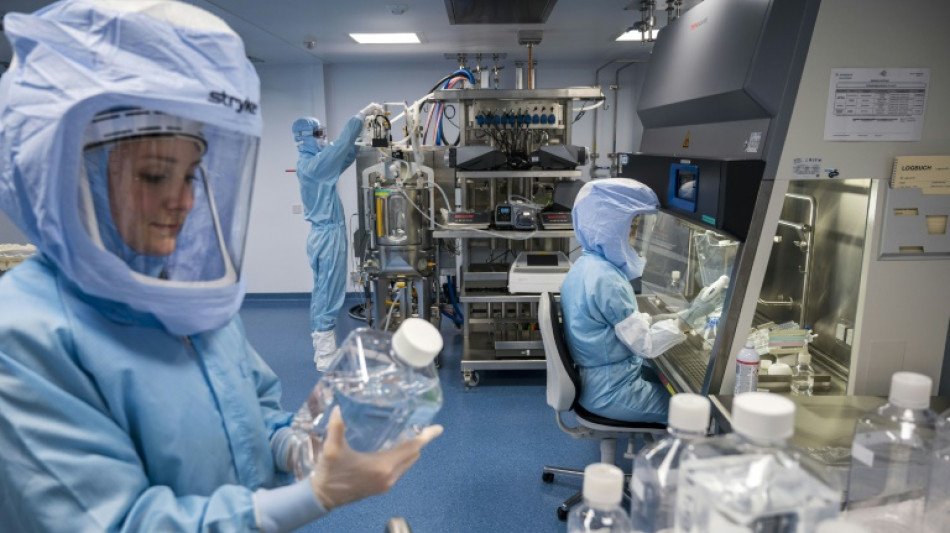
From Covid to cancer: High hopes for Nobel mRNA vaccines / Photo: © AFP/File

From Covid to cancer: High hopes for Nobel mRNA vaccines

The coronavirus pandemic brought global renown to the mRNA technology that underpins vaccines from Pfizer/BioNTech and Moderna, and on Monday earned a Nobel Prize for two scientists who have been key to its development.

Text size:

Katalin Kariko of Hungary and Drew Weissman of the United States won the Nobel Medicine Prize for their work on "nucleoside base modifications that enabled the development of effective mRNA vaccines against COVID-19".

These types of jabs are new but researchers have been working for decades to try to figure out how to use messenger RNA (ribonucleic acid) for other vaccinations and to treat illnesses from AIDS to cancer.

- How does it work? -

Messenger RNA's job in the body is to help deliver specific instructions from DNA to cells.

In the case of the Pfizer/BioNTech and Moderna jabs, lab-generated mRNA tells human cells to create antigens -- proteins that are similar to ones found in the Covid-19 virus.

Thanks to those antigens, a person's immune system learns how to fight the virus and neutralise Covid if it enters the body.

After the cells create these proteins, the body breaks down the mRNA instructions and gets rid of them.

Such direct communication with cells is revolutionary -- classic vaccines aimed to provoke an immune response by injecting a neutralised form of a virus or antigens into the system.

- Where did this come from? -

The first big breakthrough, in the late 1970s, was in using mRNA to make test-tube cells produce proteins.

A decade later, scientists were able to get the same results in mice, but mRNA still had two major drawbacks as a medical tool.

For one thing, cells in live animals resisted synthetic mRNA, provoking a dangerous immune response.

On top of that, mRNA molecules are fragile, making them difficult to deliver to the system without altering them.

In 2005, Kariko and Weissman of Penn State University published a groundbreaking study showing that a lipid -- or fat molecule -- envelope could safely deliver mRNA without negative effects.

The research caused a buzz in the pharmaceutical community and start-ups dedicated to mRNA therapies began to pop up around the world.

- What else can mRNA do? -

Scientists have worked on developing mRNA jabs for illnesses like seasonal flu, rabies and Zika, as well as those that have remained vaccine-resistant until now, including malaria and AIDS.

Researchers have also started testing personalised treatments on cancer patients, using samples of the proteins in their tumours to create specialised mRNA.

This then triggers the immune system to target specific cancer cells.

"The mRNA platform is versatile," University of Pennsylvania biochemist Norbert Pardi told AFP. "Any protein can be encoded as mRNA so there are many potential applications."

A.Nunez--TFWP