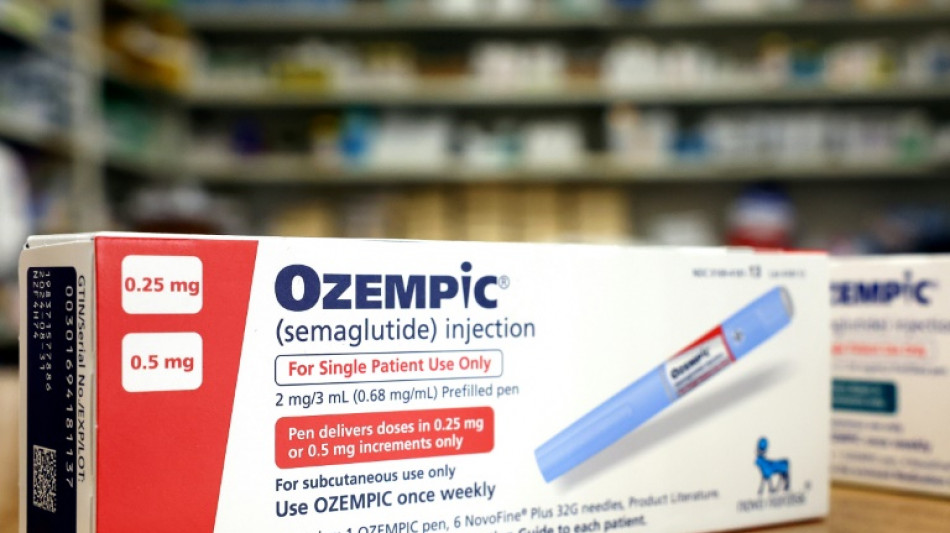
Obesity drugs give Danish economy a major boost / Photo: © GETTY IMAGES NORTH AMERICA/AFP/File

Massive demand for diabetes and weight loss drugs made by Danish pharmaceutical group Novo Nordisk have turned it into Europe's most valuable company, giving Denmark's economy a major makeover.
"If it wasn't for Novo Nordisk there wouldn't have been any growth" in the first six months of the year, Danske Bank chief economist Las Olsen told AFP.
The company's earnings have ballooned thanks to two in-demand prescription medications: type 2 diabetes drug Ozempic -- made famous by US celebrities for its weight loss side effects -- and obesity drug Wegovy.
In the first half of 2023, Denmark's economy grew by 1.7 percent year-on-year, official data showed.
Excluding the pharma industry, it shrank by 0.3 percent.
"We've never seen anything like it, it's changing the picture of the economy," said Statistics Denmark analyst Jonas Petersen.
Industrial production in Denmark "is up 40 percent compared to pre-pandemic levels," noted Palle Sorensen, chief economist at Nykredit bank.
By comparison, "in the eurozone in general and in the US it's pretty much at the same level as before the pandemic," he said.
That "also means that the recovery from the pandemic has been stronger."
The Novo Nordisk effect is seen in the state's coffers -- the company is the country's biggest taxpayer -- as well as in Denmark's trade balance and employment figures.
- Ramping up production -
Already the world's biggest insulin maker, Novo Nordisk saw sales of its obesity treatments soar by 157 percent in the first half of the year.
The World Health Organization says more than a billion people suffer from obesity. More than 530 million have diabetes, according to the International Diabetes Federation.
On the back of its strong first-half sales, the company raised its full-year forecast and now expects 2023 sales to grow by 30 percent from last year's 177 billion kroner ($25.5 billion).
Novo Nordisk's market capitalisation has soared to 2.98 trillion kroner, dethroning French luxury goods maker LVMH to become Europe's biggest listed company on September 1.
Denmark's gross domestic product reached 2.83 trillion kroner in 2022 and is expected to grow by 1.2 percent this year.
The injectable drug Ozempic has grown hugely popular for its weight loss properties, though it is officially only prescribed for diabetes.
Wegovy, an anti-obesity treatment launched in the United States two years ago and now also available in Denmark, Germany, Norway and the UK, saw its sales soar by 344 percent in the first half of the year.
"We are serving more patients than ever before," chief executive Lars Fruergaard Jorgensen said when the company released its earnings report in August
The drugmaker is currently unable to meet the surge in demand and plans to build a new plant in Denmark to ramp up production.
- Stabilising effect -
Experts warned that the company's success should not overshadow difficulties in the Danish economy.
"Other industrial firms in Denmark have a similar path to those of the rest of Europe and the US," Palle Sorensen said.
The Confederation of Danish Industry says the country's economy is "heavily influenced by a few select companies".
In 2022, another Danish titan, global shipping leader Maersk, posted record profits on the back of soaring freight prices.
"Denmark's total industrial production has increased by 11 percent over the past year, but if we disregard the pharmaceutical industry, industrial production has fallen by 11 percent," the Confederation's chief economist Allan Sorensen said.
Analysts say Novo Nordisk's rapid growth poses few risks and will likely have a stabilising effect on the economy.
"When the Danish economy becomes more dependent on pharmaceuticals, we are actually less exposed to the global business cycle because demand is quite steady over the business cycle," Palle Sorensen said.
"So that stabilises the Danish economy."
The company's success has also led to large foreign currency flows.
"There is a very large currency inflow coming from Novo Nordisk selling all this medicine outside of the country, but there's also a currency off-flow from the surpluses that Novo Nordisk is making, because the vast majority of the shareholders are in other countries," Olsen said.
To prevent the euro-pegged Danish krone from soaring too high, the central bank has kept its key interest rate below that of the European Central Bank, currently at 3.35 percent compared to the ECB's 3.75 percent.
S.Rocha--TFWP