The Fort Worth Press - Hazardous 'forever chemicals' detected in nearly half of US tap water

USD -
AED 3.672504
AFN 66.265317
ALL 82.40468
AMD 381.537936
ANG 1.790403
AOA 917.000367
ARS 1449.250402
AUD 1.508523
AWG 1.8025
AZN 1.70397
BAM 1.670125
BBD 2.014261
BDT 122.309039
BGN 1.670704
BHD 0.377951
BIF 2957.004398
BMD 1
BND 1.292857
BOB 6.910892
BRL 5.541304
BSD 1.000043
BTN 89.607617
BWP 14.066863
BYN 2.939243
BYR 19600
BZD 2.011357
CAD 1.37965
CDF 2558.50392
CHF 0.79556
CLF 0.023213
CLP 910.640396
CNY 7.04095
CNH 7.033604
COP 3808
CRC 499.466291
CUC 1
CUP 26.5
CVE 94.159088
CZK 20.779904
DJF 178.088041
DKK 6.380104
DOP 62.644635
DZD 130.069596
EGP 47.704197
ERN 15
ETB 155.362794
EUR 0.853804
FJD 2.283704
FKP 0.746974
GBP 0.747496
GEL 2.68504
GGP 0.746974
GHS 11.486273
GIP 0.746974
GMD 73.000355
GNF 8741.72751
GTQ 7.663208
GYD 209.231032
HKD 7.78155
HNL 26.346441
HRK 6.434404
HTG 131.121643
HUF 330.190388
IDR 16697
ILS 3.20705
IMP 0.746974
INR 89.57735
IQD 1310.106315
IRR 42100.000352
ISK 125.630386
JEP 0.746974
JMD 160.018787
JOD 0.70904
JPY 157.75804
KES 128.909953
KGS 87.450384
KHR 4013.492165
KMF 420.00035
KPW 899.985447
KRW 1475.760383
KWD 0.30723
KYD 0.83344
KZT 517.535545
LAK 21660.048674
LBP 89556.722599
LKR 309.636651
LRD 177.012083
LSL 16.776824
LTL 2.95274
LVL 0.60489
LYD 5.420776
MAD 9.166901
MDL 16.930959
MGA 4548.055164
MKD 52.559669
MMK 2099.831872
MNT 3551.409668
MOP 8.015542
MRU 40.023056
MUR 46.150378
MVR 15.450378
MWK 1734.170189
MXN 18.033704
MYR 4.077039
MZN 63.903729
NAD 16.776824
NGN 1460.160377
NIO 36.804577
NOK 10.138704
NPR 143.372187
NZD 1.737016
OMR 0.385423
PAB 1.000043
PEN 3.367832
PGK 4.254302
PHP 58.571038
PKR 280.195978
PLN 3.59225
PYG 6709.363392
QAR 3.641038
RON 4.335404
RSD 100.004038
RUB 80.695957
RWF 1456.129115
SAR 3.750651
SBD 8.146749
SCR 15.161607
SDG 601.503676
SEK 9.268304
SGD 1.293304
SHP 0.750259
SLE 24.050371
SLL 20969.503664
SOS 570.513642
SRD 38.441504
STD 20697.981008
STN 20.921395
SVC 8.750267
SYP 11057.107339
SZL 16.774689
THB 31.425038
TJS 9.215661
TMT 3.5
TND 2.927287
TOP 2.40776
TRY 42.746504
TTD 6.787925
TWD 31.518904
TZS 2495.196618
UAH 42.285385
UGX 3577.131634
UYU 39.263908
UZS 12022.543871
VES 282.15965
VND 26312.5
VUV 121.400054
WST 2.789362
XAF 560.144315
XAG 0.014892
XAU 0.000231
XCD 2.70255
XCG 1.8024
XDR 0.69664
XOF 560.144315
XPF 101.840229
YER 238.403589
ZAR 16.77901
ZMK 9001.203584
ZMW 22.626703
ZWL 321.999592
  • SCS

    0.0200

    16.14

    +0.12%

  • RBGPF

    0.0000

    80.22

    0%

  • CMSC

    -0.1200

    23.17

    -0.52%

  • CMSD

    -0.0300

    23.25

    -0.13%

  • BCC

    -2.9300

    74.77

    -3.92%

  • NGG

    -0.2800

    76.11

    -0.37%

  • RIO

    0.6900

    78.32

    +0.88%

  • RELX

    0.0800

    40.73

    +0.2%

  • RYCEF

    0.2800

    15.68

    +1.79%

  • JRI

    -0.0500

    13.38

    -0.37%

  • VOD

    0.0400

    12.84

    +0.31%

  • BCE

    -0.0100

    22.84

    -0.04%

  • GSK

    0.3200

    48.61

    +0.66%

  • AZN

    0.7500

    91.36

    +0.82%

  • BTI

    -0.5900

    56.45

    -1.05%

  • BP

    0.6300

    33.94

    +1.86%

Hazardous 'forever chemicals' detected in nearly half of US tap water
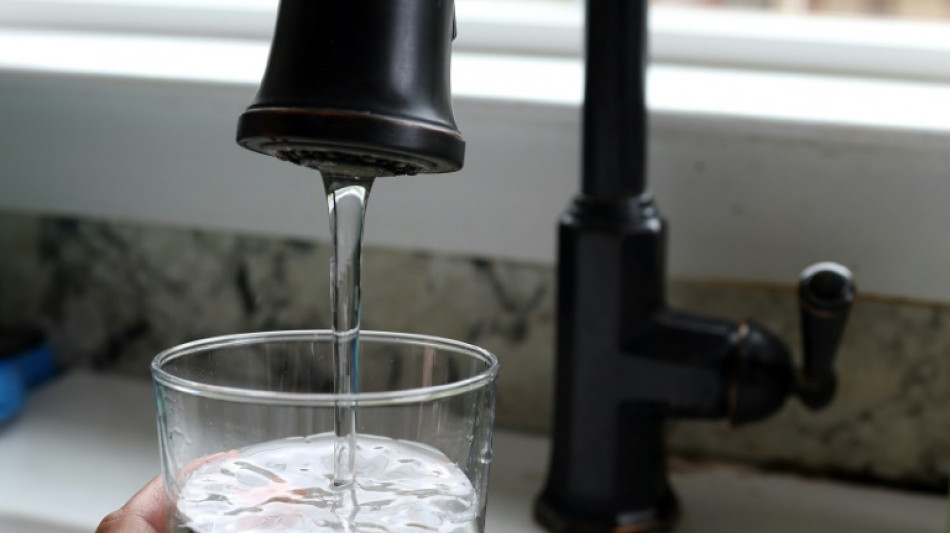
Hazardous 'forever chemicals' detected in nearly half of US tap water / Photo: © GETTY IMAGES NORTH AMERICA/AFP/File

Hazardous 'forever chemicals' detected in nearly half of US tap water

At least 45 percent of the United States' tap water is contaminated with toxic "forever" chemicals, according to a study by a government agency.

Text size:

Found in everyday products such as non-stick frying pans, polyfluoroalkyl substances (PFAS) can linger in the environment for a long time and have been linked to serious health conditions including cancer and birth defects.

The chemicals can reach water supplies through industrial discharges and leaching from landfill sites.

"This USGS study was the first to compare PFAS in tap water from both private and public supplies on a broad scale throughout the country," Kelly Smalling, a USGS scientist and the study's lead author, told AFP on Friday.

The paper was published this week in the journal Environment International, and found exposure to PFAS was similar in samples collected from unregulated private wells and regulated public supply.

Overall, the study estimated the probability of PFAS being observed in the water at 75 percent in cities and 25 percent in rural areas.

- Filters recommended, not bottled water -

There are more than 12,000 types of PFAS, not all of which are detectable by current testing. For the purposes of the current research, USGS tested for only 32 types.

The team collected samples from 716 nationally representative locations.

Most exposures occurred in urban areas or places with known high concentrations of PFAS, such as industrial and waste sites.

These included the Great Plains, which runs down the middle of the country, the Great Lakes in the mid-east, as well as cities along the East and West Coasts.

Concerned residents can look up PFAS levels in the zip code via a website maintained by the nonprofit Environmental Working Group (www.ewg.org).

The Environmental Protection Agency (EPA) offers advice for in-home treatment options. Filters, including those that reverse osmosis technology, activated carbon, and ion exchange have been shown to be highly effective at removing them.

Bottled water may not be a good alternative. A 2022 study by USGS found bottled water was frequently contaminated with inorganic and organic compounds, with arsenic, lead, and uranium among the most common.

Last month, US industrial conglomerate 3M announced it would pay as much as $12.5 billion to settle numerous claims from US public water systems that accused the company of tainting their supplies.

The company has also agreed to large settlements in the Netherlands and Belgium, and announced in December it would stop manufacturing PFAS substances by the end of 2025.

US chemicals giant DuPont and its spinoffs Chemours and Corteva also announced in June they would pay nearly $1.2 billion to settle claims they contaminated water sources serving "the vast majority of the United States population" with PFAS.

The EPA proposed new standards on PFAS chemicals in March, requiring public water utilities to monitor for six compounds and reduce PFAS levels in the water supply.

President Joe Biden's Bipartisan Infrastructure Law passed in 2021 invests $9 billion over five years to help communities reduce PFAS contamination levels in drinking water.

J.Barnes--TFWP