The Fort Worth Press - Possible antidote discovered for deadliest mushroom: study

USD -
AED 3.67315
AFN 63.498275
ALL 82.650415
AMD 377.19471
ANG 1.790083
AOA 917.000229
ARS 1377.505902
AUD 1.436111
AWG 1.80225
AZN 1.701294
BAM 1.686202
BBD 2.015182
BDT 122.789623
BGN 1.709309
BHD 0.379025
BIF 2967.5
BMD 1
BND 1.279061
BOB 6.913944
BRL 5.229898
BSD 1.000522
BTN 94.115213
BWP 13.635619
BYN 2.965482
BYR 19600
BZD 2.012485
CAD 1.379739
CDF 2277.502679
CHF 0.790703
CLF 0.023154
CLP 914.269798
CNY 6.892699
CNH 6.90198
COP 3706.14
CRC 465.236584
CUC 1
CUP 26.5
CVE 95.375
CZK 21.115896
DJF 178.186662
DKK 6.45292
DOP 60.000173
DZD 132.290034
EGP 52.479301
ERN 15
ETB 157.49948
EUR 0.86359
FJD 2.24525
FKP 0.747226
GBP 0.747235
GEL 2.704982
GGP 0.747226
GHS 10.934981
GIP 0.747226
GMD 73.498776
GNF 8777.491204
GTQ 7.657854
GYD 209.347342
HKD 7.818102
HNL 26.520293
HRK 6.5016
HTG 131.207187
HUF 333.452993
IDR 16855
ILS 3.11639
IMP 0.747226
INR 93.76695
IQD 1310
IRR 1313024.999795
ISK 123.660217
JEP 0.747226
JMD 157.605908
JOD 0.708983
JPY 159.115502
KES 129.69594
KGS 87.449203
KHR 4009.999988
KMF 425.999541
KPW 900.014346
KRW 1498.609943
KWD 0.306096
KYD 0.833829
KZT 482.773486
LAK 21574.999721
LBP 89549.999921
LKR 314.680461
LRD 183.650407
LSL 17.050185
LTL 2.95274
LVL 0.60489
LYD 6.370113
MAD 9.326012
MDL 17.495667
MGA 4160.000087
MKD 53.209766
MMK 2100.167588
MNT 3569.46809
MOP 8.057787
MRU 40.129468
MUR 46.490528
MVR 15.460178
MWK 1735.999991
MXN 17.753905
MYR 3.965053
MZN 63.910271
NAD 17.050345
NGN 1381.549601
NIO 36.72028
NOK 9.686675
NPR 150.586937
NZD 1.71826
OMR 0.384501
PAB 1.000578
PEN 3.458501
PGK 4.311505
PHP 59.943
PKR 279.074975
PLN 3.69062
PYG 6510.184287
QAR 3.6445
RON 4.398796
RSD 101.422005
RUB 81.020779
RWF 1459
SAR 3.751543
SBD 8.041975
SCR 13.646466
SDG 600.999912
SEK 9.31405
SGD 1.27975
SHP 0.750259
SLE 24.601206
SLL 20969.510825
SOS 571.499295
SRD 37.3405
STD 20697.981008
STN 21.47
SVC 8.755292
SYP 110.948257
SZL 17.049844
THB 32.559758
TJS 9.58109
TMT 3.51
TND 2.902056
TOP 2.40776
TRY 44.3549
TTD 6.803525
TWD 31.926009
TZS 2570.058989
UAH 43.92958
UGX 3702.186911
UYU 40.504889
UZS 12205.000225
VES 458.87816
VND 26350
VUV 119.508072
WST 2.738201
XAF 565.560619
XAG 0.013743
XAU 0.00022
XCD 2.70255
XCG 1.803352
XDR 0.702492
XOF 564.51917
XPF 103.450284
YER 238.593347
ZAR 16.922695
ZMK 9001.193009
ZMW 18.736367
ZWL 321.999592
  • RIO

    0.9400

    87.71

    +1.07%

  • CMSC

    0.0500

    22.92

    +0.22%

  • BTI

    0.5700

    58.33

    +0.98%

  • BCE

    -0.1900

    25.64

    -0.74%

  • NGG

    1.8900

    84.22

    +2.24%

  • CMSD

    0.1750

    22.805

    +0.77%

  • BCC

    0.5500

    74.12

    +0.74%

  • BP

    0.4650

    45.255

    +1.03%

  • RYCEF

    0.3000

    15.9

    +1.89%

  • GSK

    1.7790

    54.729

    +3.25%

  • RBGPF

    -13.5000

    69

    -19.57%

  • AZN

    2.5200

    188.3

    +1.34%

  • JRI

    0.3120

    12.172

    +2.56%

  • VOD

    0.1020

    14.762

    +0.69%

  • RELX

    -0.3000

    32.16

    -0.93%

Possible antidote discovered for deadliest mushroom: study
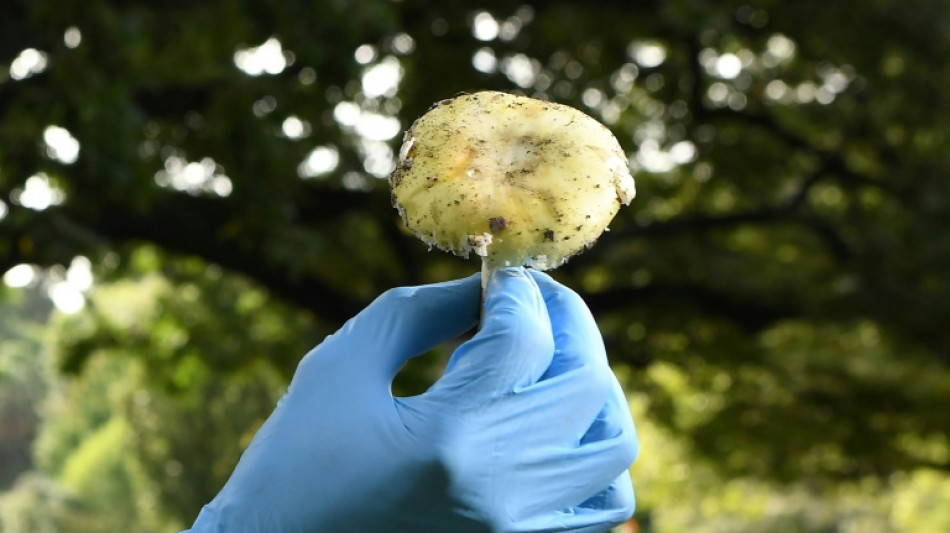
Possible antidote discovered for deadliest mushroom: study / Photo: © AFP/File

Possible antidote discovered for deadliest mushroom: study

Researchers said on Tuesday that an already widely used medical dye reduces the poisonous effects of death cap mushrooms in mice, raising hopes of the first targeted antidote for the world's deadliest mushroom.

Text size:

The China-led team said the dye, which has yet to be tested as an antidote on humans but has already been approved by the US Food and Drug Administration (US FDA) for other uses, has the potential to "save many lives".

Amanita phalloides, commonly known as death caps, are estimated to cause more than 90 percent of all deaths from mushroom poisoning worldwide.

They often resemble other species of mushrooms that people like to pick in the wild -- but eating just half of one can cause deadly failure of the liver or kidneys.

While originally native to Europe, death caps have spread across the world, causing more than 38,000 illnesses and nearly 800 deaths in China alone between 2010 and 2020.

For a new study published in the journal Nature Communications, the researchers sought to target alpha-amanitin, the main toxin produced by the mushrooms.

They used genome-wide CRISPR screening, a relatively new technique that has helped researchers understand the role specific genes play in infections and poisonings.

The team had previously used the technology to find a potential antidote for the box jellyfish, one of the world's most venomous animals.

The CRISPR screening identified that the protein STT3B was a key culprit in the toxic effects of death cap poisoning.

The team searched through a database of drugs already approved by the US FDA and found one that could potentially block the protein.

- 'Unexpected connection' -

It is a fluorescent dye called indocyanine green, which is administered intravenously. It has been widely used for decades in the US, Europe and elsewhere for diagnostic imaging, allowing doctors to measure liver and heart function.

Qiaoping Wang, a researcher at China's Sun Yat-sen University and senior author of the study, told AFP that "upon discovering this unexpected connection, the research team was understandably taken aback".

The team tested the antidote first on liver cells in a petri dish, then on mice.

In both cases, it "demonstrated significant potential in mitigating the toxic impact" of mushroom poisoning, Wang said.

"This molecule holds immense potential for treating cases of human mushroom poisoning and could mark the first-ever specific antidote with a targeted protein," he said.

"It could save many lives if it is as effective in humans as in mice."

The team now intends to conduct trials on humans using the dye as a death cap antidote.

An extract from milk thistle seeds called silibinin has previously been used to treat death cap poisoning, but exactly how it works has remained unclear.

W.Lane--TFWP