The Fort Worth Press - No new variants in weeks after China ended zero-Covid: study

USD -
AED 3.672497
AFN 64.000039
ALL 82.087167
AMD 368.450607
ANG 1.790403
AOA 917.999777
ARS 1429.274902
AUD 1.413398
AWG 1.801525
AZN 1.69855
BAM 1.689603
BBD 2.013822
BDT 122.983888
BGN 1.69088
BHD 0.37683
BIF 2970.152477
BMD 1
BND 1.283746
BOB 6.909421
BRL 5.060199
BSD 0.99987
BTN 95.052482
BWP 13.460326
BYN 2.766446
BYR 19600
BZD 2.010971
CAD 1.397215
CDF 2294.999995
CHF 0.793715
CLF 0.022857
CLP 899.590078
CNY 6.771502
CNH 6.75731
COP 3492.53
CRC 454.839964
CUC 1
CUP 26.5
CVE 95.257224
CZK 20.770598
DJF 178.057103
DKK 6.43833
DOP 58.710207
DZD 133.20241
EGP 51.120401
ERN 15
ETB 157.556391
EUR 0.8613
FJD 2.237201
FKP 0.745885
GBP 0.743725
GEL 2.654985
GGP 0.745885
GHS 11.098441
GIP 0.745885
GMD 72.99991
GNF 8759.016889
GTQ 7.622133
GYD 209.191828
HKD 7.835905
HNL 26.736642
HRK 6.488699
HTG 130.733014
HUF 302.665007
IDR 17681
ILS 2.888797
IMP 0.745885
INR 94.596499
IQD 1309.835428
IRR 1375877.500068
ISK 124.210305
JEP 0.745885
JMD 158.489914
JOD 0.709036
JPY 160.0745
KES 129.429759
KGS 87.450319
KHR 4017.105093
KMF 426.000041
KPW 900.00035
KRW 1510.649968
KWD 0.308169
KYD 0.833312
KZT 488.937843
LAK 22017.191482
LBP 89543.518639
LKR 335.207982
LRD 181.97918
LSL 16.286467
LTL 2.95274
LVL 0.60489
LYD 6.372943
MAD 9.260766
MDL 17.462745
MGA 4172.605935
MKD 53.097155
MMK 2098.945404
MNT 3577.889929
MOP 8.070062
MRU 39.65617
MUR 47.120161
MVR 15.45976
MWK 1733.834392
MXN 17.17857
MYR 4.046003
MZN 63.899521
NAD 16.286467
NGN 1360.710079
NIO 36.793227
NOK 9.489197
NPR 152.084143
NZD 1.70866
OMR 0.384508
PAB 0.99987
PEN 3.400458
PGK 4.378213
PHP 60.464503
PKR 278.191957
PLN 3.65206
PYG 6122.413719
QAR 3.65522
RON 4.509801
RSD 101.078825
RUB 72.505976
RWF 1468.359898
SAR 3.7538
SBD 8.045573
SCR 14.816665
SDG 600.485792
SEK 9.36835
SGD 1.281545
SHP 0.746601
SLE 24.650132
SLL 20969.503664
SOS 571.465595
SRD 37.509498
STD 20697.981008
STN 21.165392
SVC 8.74865
SYP 110.532098
SZL 16.273163
THB 32.579497
TJS 9.318906
TMT 3.51
TND 2.933437
TOP 2.40776
TRY 46.265199
TTD 6.791931
TWD 31.539101
TZS 2621.559974
UAH 44.803507
UGX 3749.298086
UYU 40.387024
UZS 11975.292644
VES 581.95784
VND 26287.5
VUV 118.173796
WST 2.743491
XAF 566.677033
XAG 0.014293
XAU 0.000232
XCD 2.70255
XCG 1.801996
XDR 0.703376
XOF 566.677033
XPF 103.027947
YER 238.596572
ZAR 16.17416
ZMK 9001.207442
ZMW 17.467928
ZWL 321.999592
  • RBGPF

    0.0000

    60.72

    0%

  • CMSC

    -0.0200

    22.33

    -0.09%

  • GSK

    0.1800

    53.04

    +0.34%

  • RIO

    1.7100

    105.35

    +1.62%

  • AZN

    -3.5300

    178.75

    -1.97%

  • BCC

    0.4800

    71.14

    +0.67%

  • BCE

    0.0200

    24.59

    +0.08%

  • NGG

    0.3200

    81.84

    +0.39%

  • BTI

    0.9300

    62.32

    +1.49%

  • CMSD

    -0.0400

    22.26

    -0.18%

  • RELX

    0.6300

    33.74

    +1.87%

  • RYCEF

    0.4600

    17.5

    +2.63%

  • BP

    0.1000

    42.78

    +0.23%

  • VOD

    0.2700

    15.53

    +1.74%

  • JRI

    -0.0300

    12.8

    -0.23%

No new variants in weeks after China ended zero-Covid: study
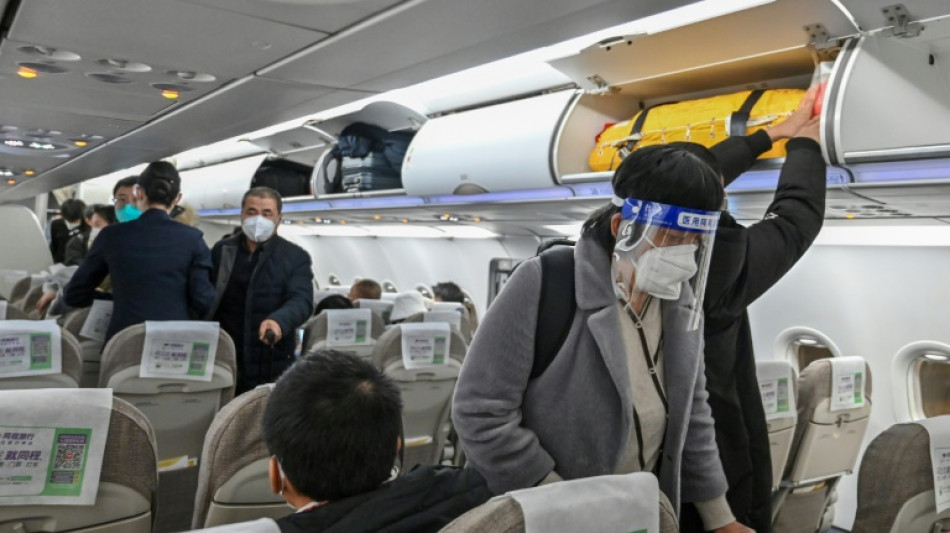
No new variants in weeks after China ended zero-Covid: study / Photo: © AFP/File

No new variants in weeks after China ended zero-Covid: study

No new variants of Covid-19 emerged in Beijing in the weeks after China ended its zero-Covid policy late last year, a new study said on Wednesday.

Text size:

China saw an explosion of infections after starting to lift its strict pandemic measures from early December, sparking fears the world's most populous country could become a fertile breeding ground for new, more transmissible or severe strains.

More than a dozen countries promptly imposed fresh restrictions on travellers from China, also citing a lack of transparency about the scale of the outbreak, sparking Beijing's ire.

But the new study by Chinese researchers, which analysed 413 samples from Beijing sequenced between November 14 and December 20, said "there is no evidence that novel variants emerged" during that time.

Instead, more than 90 percent of the cases were BF.7 and BA5.2, Omicron subvariants which were already present in China and have been overtaken by more transmissible subvariants in Western nations.

BF.7 accounted for three quarters of the samples, while more than 15 percent were BA5.2, according to the study published in The Lancet journal.

"Our analysis suggests two known Omicron sub-variants -- rather than any new variants -- have chiefly been responsible for the current surge in Beijing, and likely China as a whole," lead study author George Gao, a virologist at the Institute of Microbiology at the Chinese Academy of Sciences, said in a statement.

Wolfgang Preiser and Tongai Maponga, virologists at South Africa's Stellenbosch University not involved in the research, cautioned that it only covered a few weeks after China lifted its zero-Covid measures.

"If new lineages were to emerge in the course of the surge, the study was probably too early to find them," they said in a Lancet comment piece.

China has also dramatically cut back on its testing, potentially affecting the results, which also only cover Beijing and not the whole nation, they added.

However the virologists welcomed the "much-needed data from China".

"Although the fairly mild travel-related measures imposed by some countries for travellers from China once again might be viewed as punitive, one can but hope that this paper heralds more openness and prompt exchange of data going forward," they said.

G.Dominguez--TFWP