The Fort Worth Press - French aristocrat's golden dental secret revealed 400 years on

USD -
AED 3.672501
AFN 62.506089
ALL 82.669181
AMD 376.230888
ANG 1.790083
AOA 917.000205
ARS 1397.419905
AUD 1.435039
AWG 1.80225
AZN 1.698168
BAM 1.684191
BBD 2.010067
BDT 122.460754
BGN 1.709309
BHD 0.377554
BIF 2964.056903
BMD 1
BND 1.276953
BOB 6.911428
BRL 5.232697
BSD 0.997972
BTN 93.511761
BWP 13.674625
BYN 2.954524
BYR 19600
BZD 2.007225
CAD 1.37798
CDF 2277.502199
CHF 0.790095
CLF 0.023245
CLP 917.859895
CNY 6.892698
CNH 6.89933
COP 3705.32
CRC 464.994123
CUC 1
CUP 26.5
CVE 94.953305
CZK 21.086056
DJF 177.721517
DKK 6.448165
DOP 59.786189
DZD 132.455879
EGP 52.712803
ERN 15
ETB 154.279108
EUR 0.86298
FJD 2.24025
FKP 0.747226
GBP 0.747695
GEL 2.705024
GGP 0.747226
GHS 10.903627
GIP 0.747226
GMD 73.494926
GNF 8747.24442
GTQ 7.642594
GYD 208.863457
HKD 7.826905
HNL 26.426305
HRK 6.498703
HTG 130.855608
HUF 336.068985
IDR 16911
ILS 3.12835
IMP 0.747226
INR 93.932503
IQD 1307.361768
IRR 1313025.000474
ISK 124.089799
JEP 0.747226
JMD 157.486621
JOD 0.70901
JPY 159.030989
KES 129.699735
KGS 87.448502
KHR 4005.063378
KMF 425.999908
KPW 900.014346
KRW 1499.749794
KWD 0.30638
KYD 0.831676
KZT 481.782876
LAK 21486.820464
LBP 89375.339068
LKR 313.699656
LRD 183.13807
LSL 17.013787
LTL 2.95274
LVL 0.60489
LYD 6.362944
MAD 9.303745
MDL 17.455028
MGA 4166.899883
MKD 53.155845
MMK 2100.167588
MNT 3569.46809
MOP 8.04266
MRU 39.802636
MUR 46.459912
MVR 15.460083
MWK 1730.481919
MXN 17.755035
MYR 3.95603
MZN 63.909826
NAD 17.013787
NGN 1375.60972
NIO 36.726715
NOK 9.71795
NPR 149.61272
NZD 1.72145
OMR 0.384501
PAB 0.997963
PEN 3.451997
PGK 4.309899
PHP 60.082988
PKR 278.8205
PLN 3.68605
PYG 6511.920293
QAR 3.639338
RON 4.396498
RSD 101.327022
RUB 80.505242
RWF 1459.995436
SAR 3.753487
SBD 8.041975
SCR 14.903229
SDG 600.999956
SEK 9.33675
SGD 1.279698
SHP 0.750259
SLE 24.60458
SLL 20969.510825
SOS 570.306681
SRD 37.340034
STD 20697.981008
STN 21.09741
SVC 8.732681
SYP 110.948257
SZL 17.012336
THB 32.747502
TJS 9.575933
TMT 3.51
TND 2.927264
TOP 2.40776
TRY 44.35175
TTD 6.780508
TWD 31.967501
TZS 2567.558971
UAH 43.82926
UGX 3737.239351
UYU 40.671515
UZS 12175.463071
VES 458.87816
VND 26349.5
VUV 119.508072
WST 2.738201
XAF 564.849586
XAG 0.013713
XAU 0.00022
XCD 2.70255
XCG 1.798634
XDR 0.702492
XOF 564.869043
XPF 102.697908
YER 238.598421
ZAR 16.971984
ZMK 9001.199646
ZMW 18.887324
ZWL 321.999592
  • RBGPF

    -13.5000

    69

    -19.57%

  • BCE

    0.0700

    25.83

    +0.27%

  • NGG

    0.2700

    82.33

    +0.33%

  • BCC

    1.6900

    73.57

    +2.3%

  • BTI

    -0.1600

    57.76

    -0.28%

  • GSK

    0.9600

    52.95

    +1.81%

  • RIO

    0.9300

    86.77

    +1.07%

  • CMSD

    -0.1100

    22.63

    -0.49%

  • RELX

    -1.3500

    32.46

    -4.16%

  • CMSC

    -0.0100

    22.87

    -0.04%

  • AZN

    1.7100

    185.78

    +0.92%

  • JRI

    0.1800

    11.86

    +1.52%

  • VOD

    0.1800

    14.66

    +1.23%

  • RYCEF

    -0.2800

    15.69

    -1.78%

  • BP

    1.2200

    44.79

    +2.72%

French aristocrat's golden dental secret revealed 400 years on
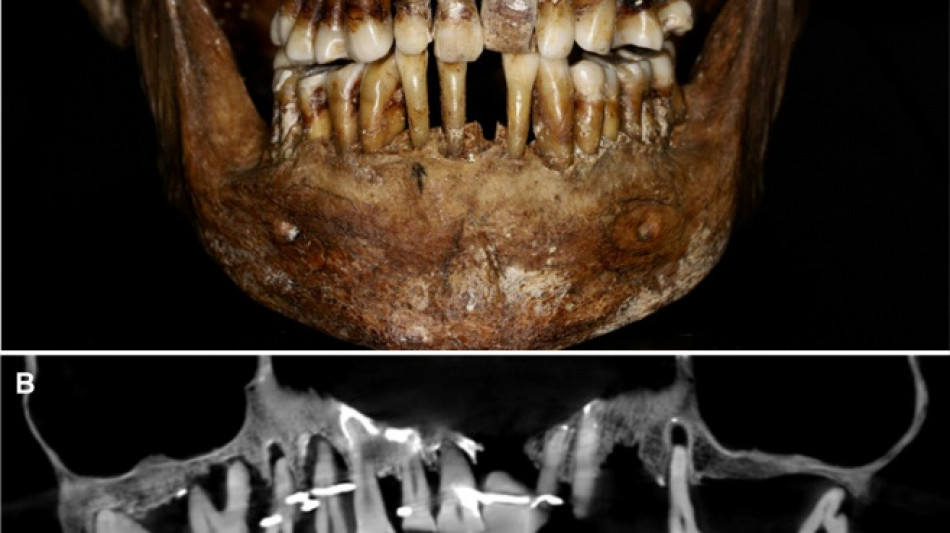
French aristocrat's golden dental secret revealed 400 years on / Photo: © INRAP/Rozenn Colleter/AFP/File

French aristocrat's golden dental secret revealed 400 years on

Scientists have discovered the long-buried secret of a 17th-century French aristocrat 400 years after her death: she was using gold wire to keep her teeth from falling out.

Text size:

The body of Anne d'Alegre, who died in 1619, was discovered during an archaeological excavation at the Chateau de Laval in northwestern France in 1988.

Embalmed in a lead coffin, her skeleton -- and teeth -- were remarkably well preserved.

At the time the archaeologists noticed that she had a dental prosthetic, but they did not have advanced scanning tools to find out more.

Thirty-five years later, a team of archaeologists and dentists have identified that d'Alegre suffered from periodontal disease that was loosening her teeth, according to a study published in the Journal of Archaeological Science: Reports this week.

A "Cone Beam" scan, which uses X-rays to build three-dimensional images, showed that gold wire had been used to hold together and tighten several of her teeth.

She also had an artificial tooth made of ivory from an elephant -- not hippopotamus, which was popular at the time.

But this ornate dental work only "made the situation worse", said Rozenn Colleter, an archaeologist at the French National Institute for Preventive Archaeological Research and lead author of the study.

The gold wires would have needed repeated tightening over the years, further destabilising the neighbouring teeth, the researchers said.

D'Alegre likely went through the pain for more than just medical reasons. There was huge pressure on aristocratic women at a time when appearance was seen as related to value and rank in society.

Ambroise Pare, a contemporary of D'Alegre's who was the doctor for several French kings and designed similar dental prosthetics, claimed that "if a patient is toothless, his speech becomes depraved", Colleter told AFP.

A nice smile was particularly important for d'Alegre, a "controversial" twice-widowed socialite "who did not have a good reputation," Colleter added.

- War and widowhood -

D'Alegre lived through a troubled time in French history.

She was a Huguenot, Protestants who fought against Catholics in the French Wars of Religion in the late 1500s.

By the age of 21, she was already widowed once and had a young son, Guy XX de Laval.

When the country plunged into the Eighth War of Religion, D'Alegre and her son were forced to hide from Catholic forces while their property was seized by the king.

Her son then converted to Catholicism and went to fight in Hungary, dying in battle at the age of 20.

After being widowed a second time, D'Alegre died of an illness aged 54.

D'Alegre's teeth "shows that she went through a lot of stress," Colleter said.

The researcher said she hopes that the research "goes a little way towards rehabilitating her".

Severe periodontal diseases are estimated to affect nearly a fifth of the world's adults, according to the World Health Organization.

B.Martinez--TFWP