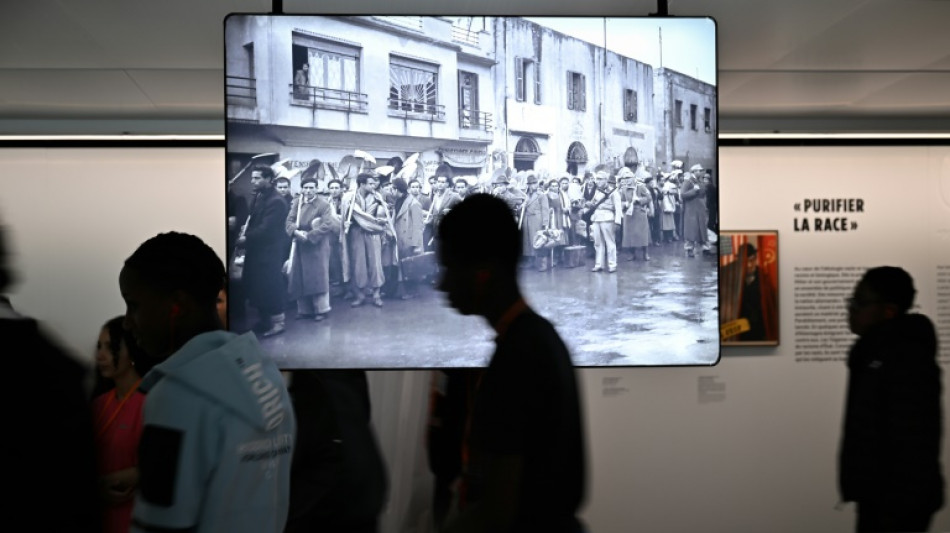
Museums rethink how the Holocaust should be shown / Photo: © AFP

Historians are rethinking the way the Holocaust is being presented in museums as the world marks the 80th anniversary of the liberation of the last Nazi concentration camps this month.
Shocking images of the mass killings of Jews were "used massively at the end of World War II to show the violence of the Nazis," historian Tal Bruttmann, a specialist on the Holocaust, told AFP.
But in doing so "we kind of lost sight of the fact that is not normal to show" such graphic scenes of mass murder, of people being humiliated and dehumanised, he said.
Up to this year, visitors to the Memorial de Caen war museum in northern France were plunged into darkened rooms with life-sized photographs showing the horror of what happened in the camps and the mass executions earlier in the war.
"The previous generation of Holocaust museums used these images because it reinforces the horror," said James Bulgin, who is in charge of the Holocaust galleries at London's Imperial War Museum.
The difficulty with that is that it "denies the people within the images any capacity for agency or respect or identity," he added.
"The other problem with Holocaust narratives is that they tend to relate the history of what the Nazis and their collaborators did, not what Jewish people experienced," argued the British historian.
Some six million were murdered in the Nazi's attempt to wipe out European Jews.
- 'No photos of killings' -
Which is why "there are no photographs of killings" in the new, "almost clinically white" galleries dedicated to the Shoah at the Memorial de Caen, said Bruttmann, the scientific adviser on the project which opened this month.
"To show this absolute negation of human beings, there is no obligation to show images of such unprecedented violence," said the memorial's director Kleber Arhoul.
Historians at the Imperial War Museum had the same debate, but drew different conclusions.
They decided to still use graphic imagery. "The images exist as part of the historical record, we can't suppress their existence," said Bulgin. "But what we can do is meaningfully integrate them into the historical narrative."
He said they did consider not using them but felt it could lead to misinformation. "All of that stuff exists on YouTube and Vimeo... but without us mediating it, shaping it, informing it, giving it context," he added.
The curator said they "spoke to an enormous range" of Jewish groups and the "almost overwhelming consensus was that we should use the footage".
However, graphic images of the genocide are shown in smaller formats, often on panels that carry a warning and that you have to turn over to see. Distinctions are also made between photos taken by Jews themselves and those taken by the Nazis in the Warsaw ghetto.
Israeli historian Robert Rozett argued that "we need these memorials to be aware of what human beings are capable of, and where open hatred can lead."
At the Yad Vashem memorial in Jerusalem, "there are pictures that show mass executions. They are not gigantic but they are there," he said.
"The hardest pictures are not highlighted in any way," he said. For example, those showing the massacre of Babi Yar, near Kyiv, in 1941 do not show the moment of the killings but the aftermath. And those of the mass graves do not show the bodies but the clothes of the victims strewn on the ground.
- 'You want them to identify' -
Museums have also tended to concentrate on representing the ruthless, systematic efficiency of the Nazi death machine, experts say.
The first Holocaust memorials were "dark, oppressive spaces with a highly industrialised architecture that very much centres on Auschwitz," Bulgin said.
That was "enormously problematic and potentially slightly dangerous, because it has none of the human character that actually allowed it to happen."
Which is why the London museum has tried to concentrate on this being a genocide "done by people, to people", he said.
The new galleries in the Memorial de Caen have two distinct rooms. One on death camps like Auschwitz, the mass executions of the "Holocaust by bullets" and the mobile gas vans. The other deals with the concentration and work camps where prisoners were enslaved, brutalised and worked to death or died from hunger or disease.
But museums also have a duty to evoke the Jewish communities that were wiped out, Rozett insisted. "If you're teaching the Holocaust, you have to talk about what happened before, about what was destroyed," he said.
The first Holocaust room at the Imperial War Museum addresses this by showing a film called "The Presence of Absence". At Yad Vashem, the visit begins with a sound and light show to draw people deep into those lost worlds.
"When you're teaching, you want somebody's mind and their heart," it says. "You want them to identify. It's not enough just intellectual engagement. There has to be something emotional, but not overriding emotional."
G.George--TFWP