iPhone factory lockdown shows risks of China dependence, analysts say / Photo: © AFP/File

The lockdown of Foxconn's Zhengzhou factory, the world's biggest producer of iPhones, has highlighted some of the risks of relying on zero-Covid China's manufacturing sector, analysts told AFP.
Foxconn, Apple's principal subcontractor, has seen a surge in Covid-19 cases at its Zhengzhou site, leading the company to lock down the vast complex in a bid to keep the virus in check.
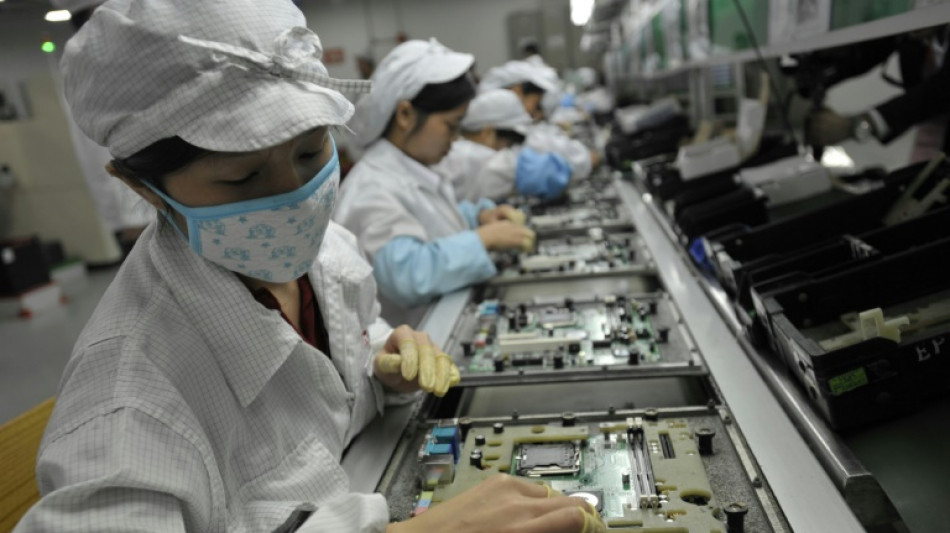
Images then emerged of panicking workers fleeing the site on foot in the wake of allegations of poor conditions at the facility, which employs hundreds of thousands of workers.
Foxconn is China's biggest private sector employer, with over a million people working across the country in its around thirty factories and research institutes.
But Zhengzhou is the Taiwanese giant's crown jewel, churning out iPhones in quantities not seen anywhere else.
"In a normal situation, almost all the iPhone production is happening in Zhengzhou," said Ivan Lam, an analyst with specialist firm Counterpoint.
- Risk of 'strong dependence' -
Apple manufactures more than 90 percent of its products in China, which is also one of its most important markets.
"For Apple, it is once again a bad example in terms of the stability of production chains," Alicia Garcia Herrero, Asia-Pacific manager for Natixis bank, told AFP.
Experts say the company’s heavy dependence on China "brings potential risks, especially when the US-China trade war shows no signs of de-escalating," according to Dezan Shira & Associates, a consulting firm.
Opened in 2010, the Zhengzhou factory employs up to 300,000 people who live on-site all year round -- creating a sprawling tech hub known as "iPhone city".
It is made up of three factories, one of which produces the iPhone 14 -- Apple's newest handset model.
Apple did not respond to AFP's request for comment on how exactly the lockdown will affect its production.
Analyst Lam estimates the partial stopping of work at the site resulted in a loss of "10 to 30 percent" of output, but said part of the production has also been temporarily moved to other Foxconn sites in China.
According to Foxconn, the site is currently operating a "closed loop" with the workers avoiding all contact with the outside world, while their daily bonuses have been quadrupled.
"This incident may have a limited impact," on worldwide iPhone production, estimated analyst Ming-Chi Kuo, who specialises in Apple products.
"But suppliers in China must learn to improve closed-loop production efficiency in response to the zero-Covid policy," he added.
- Looking elsewhere -
China is the last major economy committed to a zero-Covid strategy, persisting with snap lockdowns, mass testing and lengthy quarantines in a bid to stamp out emerging outbreaks.
But new variants have tested local officials' ability to snuff out flare-ups faster than they can spread, causing much of the country to live under an ever-changing mosaic of Covid curbs.
Apple has already begun outsourcing part of its production to India and is eyeing Vietnam in a bid to wean itself off Chinese manufacturing -- a trend accelerated by Covid.
But that's not so simple -- last year, nearly 7.5 million iPhones were made in India, just three percent of Apple's total production.
"Increasing the capacity of factories (in India) is difficult," Lam said.
T.Dixon--TFWP