Gas crisis fears recede for now as Europe stockpiles / Photo: © AFP/File

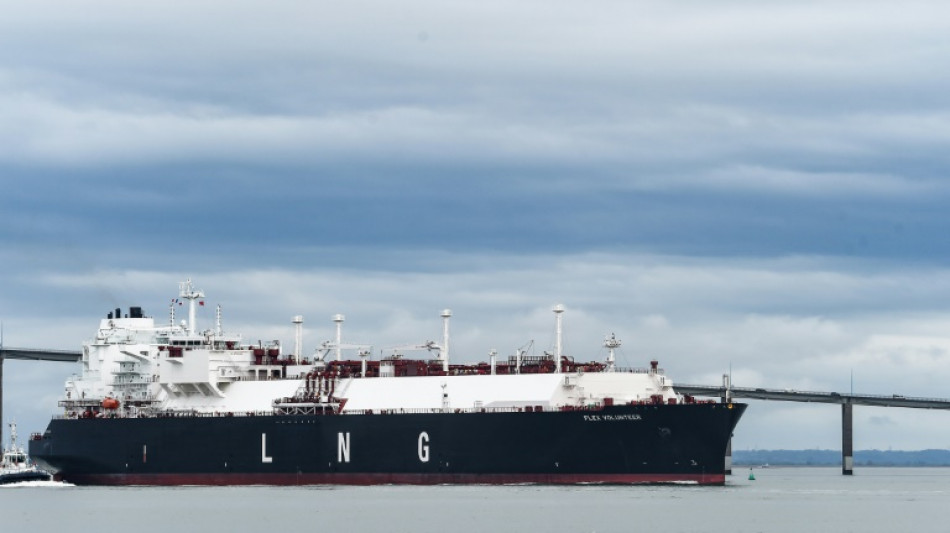
With prices falling and ports clogged with liquefied natural gas tankers, fears of a winter heating crisis in Europe have eased but experts are warning against complacency.
For over a week now, there have been bottlenecks at Spanish ports of ships bringing in LNG, indicating Europe is at full capacity.
Spanish gas regulator Enagas says the backlog at ports is expected to last at least until this week.
The Dutch TTF, a leading European benchmark price, is now close to its lowest level since June, at under 100 euros per megawatt hour at the end of October.
Its price has fallen more than 60 percent since a massive surge in August when Russia's disruptions to its supply via the Nord Stream pipelines alarmed markets.
TTF's short-term futures price even briefly went negative last week, for the first time since October 2019. In the United States, gas prices have also fallen sharply.
The days of stratospheric price rises of up to 350 euros per megawatt hour in Europe in March, a few days after Russia's invasion of Ukraine began, seem to be well and truly in the past.
Since then Europe has made efforts to fill its storage facilities to reduce dependence on Russian gas and sought alternative suppliers, holding crisis meetings and calling for a cut in domestic usage.
- 'Not out of woods' -
The strategy has paid off with Europe's storage reserves now at over 90 percent.
"Since Q1 2022, the EU has benefited from very strong LNG inflow primarily from the US," analysts at broker Marex said in a note.
Georgi Slavov, head of research at Marex, told AFP that Europe is currently seeing an oversupply of gas but "it is premature to declare victory on that front".
He said the current abundance is down to factors including unusually warm temperatures, which mean Europeans are not using gas for heating.
In addition the "economic slowdown is limiting gas use," Slavov said, and "self-imposed restrictions on gas consumption also help enormously".
A cold winter and industry shifting back to higher energy use could quickly reverse the trend.
"The continent is not out of the woods yet," said Nikoline Bromander, an analyst for Rystad Energy.
"With Russian flows continuing to decline, winter 2023 will be even tougher."
The price for European natural gas is still fluctuating at a very high level, up more than 80 percent since the start of the year.
- Short-term imbalance -
And "the price curve will not fall into negative in the US or in Europe", said Eli Rubin of EBW Analytics Group.
A similar situation happened to US crude at the height of the Covid-19 pandemic when demand plummeted and the glut in supply led to a frantic race to stock up.
"Storage, which is the balancing mechanism between supply and demand, normally mops up the excess supply," said Slavov.
The benchmark WTI crude oil prices then plummeted into negative values as investors were ready to pay not to have barrels of oil due to lack of storage space.
But with gas "we are talking about short-term imbalances that have a short-term effect on the price," mainly concerning immediate deliveries, said Rubin.
Spain is seeing the same situation, with the waiting tankers indicating a temporary bottleneck, not a fundamental imbalance between too abundant supply versus demand.
This happens "every year" as winter approaches and is a localised issue off the coast of Spain, said Vincent Demoury, general delegate of GIGNL, the International Group of Liquefied Natural Gas Importers.
Spain has six LNG terminals, more than any other European country, where 108 ships unload every week.
Spain also has 44 percent of the EU's gas storage capacity, according to Enagas.
Demoury say the fall in gas consumption and the high level of gas stocks for winter mean there are no more "available slots in Europe in November" to unload ships.
It is not the case that Europe is drowning in oversupply, since the LNG tankers are simply used as temporary floating storage "waiting for consumers to need gas and for prices to be more attractive," Demoury said.
P.Navarro--TFWP