The Fort Worth Press - Nepal rescuers drill through debris towards trapped tunnel workers

USD -
AED 3.672504
AFN 65.000368
ALL 79.685814
AMD 366.492599
ANG 1.789783
AOA 917.000367
ARS 1499.143585
AUD 1.392952
AWG 1.8
AZN 1.70397
BAM 1.688145
BBD 2.025118
BDT 123.948038
BGN 1.696366
BHD 0.379095
BIF 3000.388417
BMD 1
BND 1.27789
BOB 11.789737
BRL 5.193604
BSD 1.005481
BTN 95.851711
BWP 13.472876
BYN 3.032411
BYR 19600
BZD 2.022269
CAD 1.39095
CDF 2273.000362
CHF 0.80871
CLF 0.023681
CLP 932.018471
CNY 6.72675
CNH 6.731305
COP 3173.535885
CRC 453.756851
CUC 1
CUP 26.5
CVE 95.175003
CZK 20.838504
DJF 179.0514
DKK 6.453404
DOP 59.030685
DZD 132.198869
EGP 50.526002
ERN 15
ETB 164.23961
EUR 0.863104
FJD 2.198804
FKP 0.737808
GBP 0.738144
GEL 2.603861
GGP 0.737808
GHS 11.261491
GIP 0.737808
GMD 74.000355
GNF 8838.6345
GTQ 7.675111
GYD 210.366406
HKD 7.84175
HNL 26.971646
HRK 6.505404
HTG 131.54374
HUF 315.250388
IDR 17757.4
ILS 2.976204
IMP 0.737808
INR 95.380504
IQD 1317.250011
IRR 1374575.000352
ISK 121.390386
JEP 0.737808
JMD 159.38026
JOD 0.70904
JPY 160.07504
KES 130.162703
KGS 87.450384
KHR 4068.879202
KMF 425.00035
KPW 900.000294
KRW 1377.220383
KWD 0.30892
KYD 0.837944
KZT 465.970394
LAK 22548.87575
LBP 90041.776358
LKR 329.748392
LRD 181.994735
LSL 16.085538
LTL 2.95274
LVL 0.60489
LYD 6.372621
MAD 9.290751
MDL 17.384662
MGA 4337.318199
MKD 53.105175
MMK 2099.727459
MNT 3597.739732
MOP 8.119632
MRU 40.451426
MUR 46.870378
MVR 15.460378
MWK 1743.558759
MXN 17.034504
MYR 4.025904
MZN 63.910377
NAD 16.085538
NGN 1341.580377
NIO 37.00315
NOK 9.375804
NPR 153.362393
NZD 1.681662
OMR 0.381045
PAB 1.005481
PEN 3.369298
PGK 4.459022
PHP 62.270375
PKR 278.9486
PLN 3.74735
PYG 5958.309956
QAR 3.665271
RON 4.539504
RSD 101.299038
RUB 86.012688
RWF 1478.054465
SAR 3.737562
SBD 8.000184
SCR 13.757714
SDG 601.503676
SEK 9.57835
SGD 1.273504
SHP 0.740866
SLE 24.625038
SLL 20969.499227
SOS 574.597557
SRD 37.74037
STD 20697.981008
STN 21.147124
SVC 8.798067
SYP 13001.999906
SZL 16.07354
THB 33.108038
TJS 9.300764
TMT 3.51
TND 2.93289
TOP 2.40776
TRY 48.237504
TTD 6.824047
TWD 31.638704
TZS 2662.03444
UAH 44.800397
UGX 3790.945579
UYU 40.490268
UZS 11882.093997
VES 790.677104
VND 26085
VUV 118.250696
WST 2.707834
XAF 566.187907
XAG 0.015062
XAU 0.000224
XCD 2.70255
XCG 1.812179
XDR 0.707052
XOF 566.187907
XPF 102.939019
YER 236.525037
ZAR 16.17371
ZMK 9001.203584
ZMW 19.028959
ZWL 321.999592
  • JRI

    -0.0500

    12.35

    -0.4%

  • CMSC

    -0.0200

    21.29

    -0.09%

  • CMSD

    0.0000

    21.18

    0%

  • BCC

    -0.0200

    78.75

    -0.03%

  • AZN

    -1.8200

    162.7

    -1.12%

  • BCE

    0.0600

    23.46

    +0.26%

  • GSK

    0.5500

    50.82

    +1.08%

  • RIO

    -1.4800

    103.3

    -1.43%

  • RBGPF

    0.0800

    70.77

    +0.11%

  • VOD

    0.1600

    16.04

    +1%

  • BP

    -0.1900

    42.15

    -0.45%

  • BTI

    -0.1500

    56.13

    -0.27%

  • RELX

    0.2400

    36.54

    +0.66%

  • NGG

    -0.0800

    79.35

    -0.1%

  • RYCEF

    -0.2500

    20.5

    -1.22%

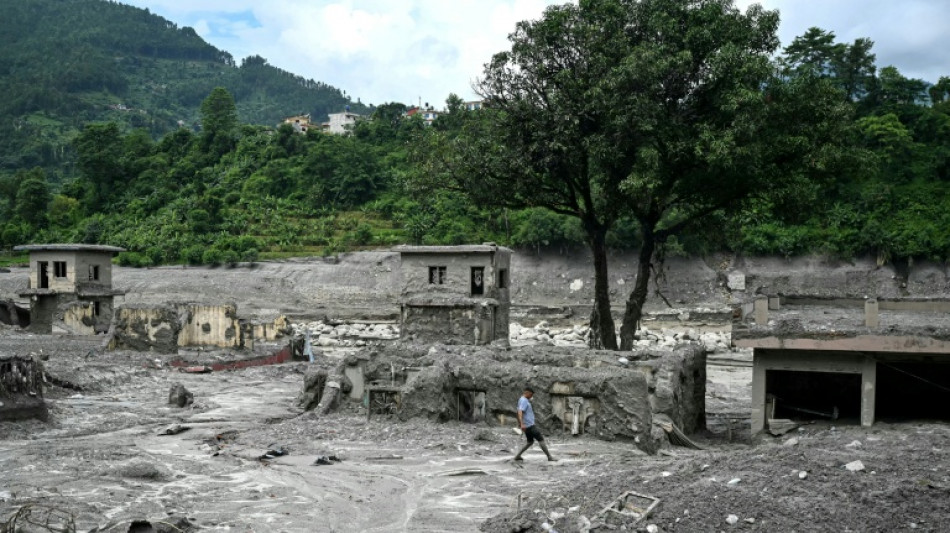
Nepal rescuers drill through debris towards trapped tunnel workers
Nepal rescuers drill through debris towards trapped tunnel workers / Photo: © AFP

Nepal rescuers drill through debris towards trapped tunnel workers

Nepali rescuers trying to reach hydropower workers believed trapped in tunnels swamped by flood debris deployed heavy machinery on Sunday, after rain and rising river waters hampered earlier efforts.

Text size:

"Drilling of four holes has been completed... preparations are now underway to enter the tunnel directly... and proceed with search and rescue operations," Nepal's energy ministry said in an update.

Rescue operations entered their fifth day since the floods, with teams battling difficult conditions at the disaster sites.

Nepal's government says more than 100 workers may still be alive and trapped inside multiple tunnels at hydropower projects, with key rescue efforts focused on the Trishuli 3A and 3B sites in the Himalayan river valley.

They are among 933 hydropower workers missing since a wall of mud and debris swept down on Wednesday morning, according to the National Disaster Risk Reduction and Management Authority.

Army rescue teams using drills at Trishuli 3A first broke through into the upper part of a mud-swamped tunnel on Saturday evening, and began pumping air and sending in a camera.

Overnight rain and rising river levels hampered efforts early on Sunday, filling the excavation area with water, before conditions eased.

The Nepal Army said teams then resumed efforts "using drilling machines, excavators, hydraulic cutters, and other equipment".

Photographs shared by the disaster office showed workers wading through churned mud and navigating vast boulders left by the floods.

Nepal's prime minister's office said teams faced "difficult conditions" but were "making tireless efforts to search for and rescue those who may be trapped".

The rescue teams are using advanced search cameras and specialised monitors, it said.

- 'Submerged with slush' -

The US Geological Survey said the disaster on the China-Nepal border was caused by a glacial collapse.

Specialised Indian and Chinese tunnel-rescue teams have also joined the efforts.

Nepal's expert mountain rescue teams -- who regularly aid climbers on the world's highest peaks, including Everest -- are also joining the search for missing people at another damaged hydropower site.

Flood survivors from other hydropower sites described a terrifying rush of water that had engulfed them within minutes.

Hydropower worker Surendra Dowluri, 33, from India's Andhra Pradesh state, described how raging water swamped the Upper Trishul-1 site where he was working.

"We heard a very loud sound... and saw that the turbine floor was submerged with slush, and six workers were stuck in that," Dowluri told AFP in Kathmandu on Sunday after being rescued the day before.

"We managed to rescue five of them, but one person lost his life," he said, describing how some workers reached higher ground or construction areas out of reach of the torrent.

That represents about 10 percent of Nepal's installed electricity generation capacity, according to the authority.

Another 15 power projects under construction, with a combined planned capacity of 470 megawatts, have also been damaged.

S.Rocha--TFWP