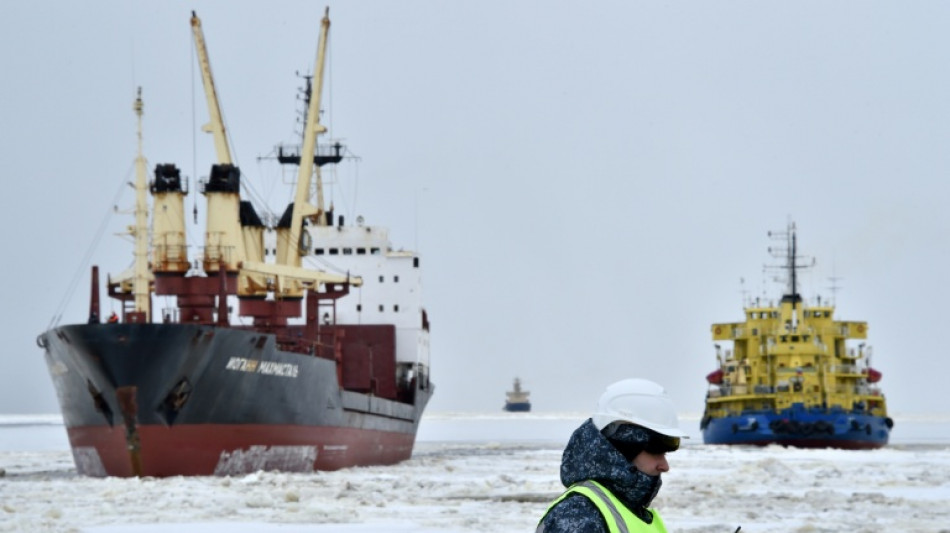
Arctic shipping a daunting prospect in hotly contested region / Photo: © AFP

With Gulf turmoil slashing Suez Canal traffic, shipping firms are tempted to try the Arctic for quicker trips between Europe and Asia -- but commercial prospects are unlikely to match countries' strategic ambitions for the North Pole.
Container ships from China and South Korea aim to transit the Northern Sea Route in Russian territorial waters in the coming weeks, testing its viability as climate change keeps the passage free of ice longer each year.
Industry experts remain sceptical, saying that even if more vessels start going through, the bulk of global shipping will remain along established lines for the foreseeable future.
- Shorter, cheaper, harder -
Houthi rebels in Oman have disrupted traffic through the Bab al-Mandab Strait by attacking vessels heading to and from the Suez Canal.
Many operators now avoid the passage and send ships instead around South Africa's Cape of Good Hope, vastly prolonging the journey between Asia and Europe and driving up fuel costs and emissions.
By contrast, the Northern Sea Route (NSR) could cut the distance by 30 to 40 percent compared to using the Suez Canal, and by nearly half from going around the southern tip of Africa, the credit insurance group Coface said in April.
But what looks good on spreadsheets ignores daunting constraints.
"The Arctic link can only be seasonal, from August to October," said Paul Tourret, director of the Higher Institute of Maritime Economics (ISEMAR) in Saint-Nazaire, France.
"And you need ice-class ships, which cost more," he told AFP.
That rules out Supramax and other hulking container ships that make up a major share of global traffic, since they can offer hugely competitive rates.
By contrast, the capacity of the Chinese container ship "Dubai Tower" that embarked on the NSR from Ningbo to Europe this month, is one-tenth the size, said Jerome de Ricqles, a sea freight specialist at Upply, a French-based transport management firm.
- Real but limited potential -
Most container ships using the NSR need to be escorted by Russia's fleet of nuclear-powered icebreakers.
Last year, a record 23 vessels made the passage, up from 15 in 2024, according to a recent study by insurance group Allianz Commercial.
That's fewer than the number using the Suez Canal each day.
Even with conflicts in the Middle East, some 35 ships a day transited the Egyptian canal in the first half of this year, down from more than 50 a day before the Houthis started their attacks in 2023.
The northern route is "a temporary and minuscule solution with regards to the overall needs", De Ricqles said.
According to Coface, just 3.5 percent of the current traffic between East Asia, northern Europe and North America could actually shift to Arctic routes.
Looking out to 2030, viability "remains extremely limited and mainly only concerns raw materials", Eve Barre, an economist who piloted the Coface study, said in a statement.
Even so, the NSR could attract bulk liquid vessels carrying oil and liquefied natural gas, who could see their costs slashed by 45 to 50 percent in some cases, the study found.
Dry bulk ships might also start using it, especially if they can operate with icebreaker escorts.
But the prospect also carries environmental risks if increased traffic accelerates Arctic melting, with soot emissions that settle on the ice cap trapping heat from sunlight.
Fuel spills are also a concern, and several big Western shipping firms including France's CMA-CGM, Switzerland's MSC and Germany's Hapag-Lloyd have already pledged they will not use the Northern Sea Route.
All in all, the route "isn't likely to upend the major balances of global trade", Barre said, noting that the interest in Arctic shipping "is less commercial than political" at a time of tense rivalries between Russia, China and the United States.
Tourret at the French marine institute agreed, calling the trips by the Chinese and South Korean vessels a sideshow.
"One swallow does not a summer make, and one Chinese container ship doesn't create a Polar Silk Road," he said, referring to Beijing's Belt and Road Initiative aiming to knit together a trading network between Asia, Europe and Africa.
W.Knight--TFWP