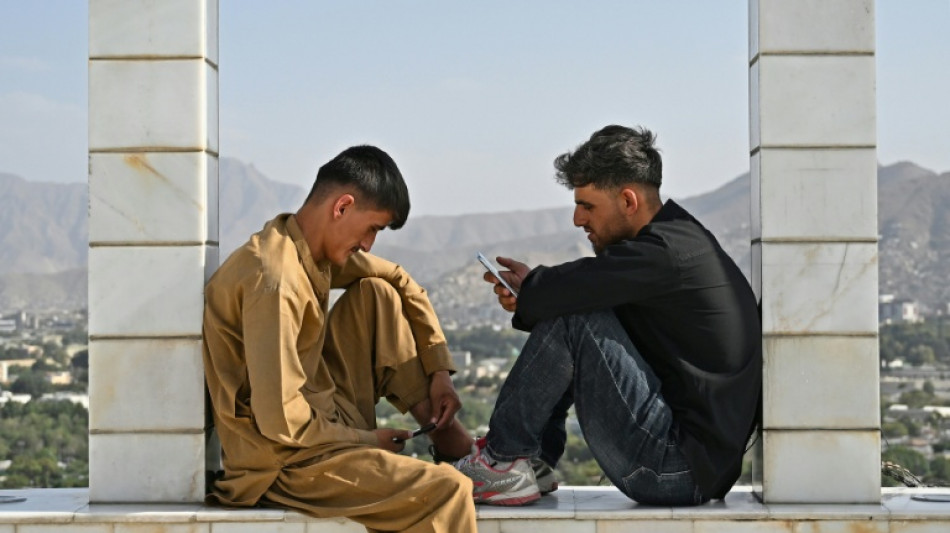
Afghan students divided over smartphone ban at universities / Photo: © AFP

Forced to leave their smartphones off campus, Afghan university students are divided over whether the new anti-tech rule has disrupted their studies or done wonders for their concentration.
Soon after Supreme Leader Hibatullah Akhundzada ordered government workers to stop using smartphones in June, the ban was also imposed in the world of academia.
A 29-year-old student in the capital Kabul said a staffer had "visited the classrooms and announced that from now onwards, we are not allowed to bring smartphones to the university".
In the western city of Herat, notices posted on the walls of a university and its dorm warned that anyone caught with a smartphone on campus would face "legal action".
No reason was given to students who spoke to AFP, some of whom requested anonymity for security reasons.
At Kandahar University in southern Afghanistan, spokesman Nazir Ahmad Qadari said the move aimed to ensure students "pay attention to their lectures, studies and practical work".
Fifty-eight percent of countries ban mobile phones in schools, citing classroom distraction and risks to wellbeing, according to a March report by UNESCO which made no mention of university bans.
The Taliban authorities have ruled for nearly five years, according to a strict interpretation of Islamic law, and have taken steps to control Afghans' access to technology without saying why.
Last year, broadband access was restricted in several provinces for weeks, before the government unexpectedly cut off the internet and phone networks nationwide for two days.
Despite this, smartphones are widely used and billboards in cities advertise the latest internet deals.
- 'Can't study properly' -
At universities, the ban has restricted access to online research and course materials, with one Herat student saying he had used his phone to help with about half the syllabus.
"If the explanation was not good, we used our phones to take photos and videos of the slides or the writing on the board, so we could review them later," the 21-year-old said.
That view was shared in the northern city of Mazar-i-Sharif, where a 22-year-old journalism student told AFP: "We can't study properly without smartphones".
The human rights director for the United Nations mission in Afghanistan (UNAMA), Fiona Frazer, said there "may be sound reasons to manage students' use of technology".
However, UNAMA had concerns about government restrictions that limit "access to information, freedom of expression" and the ability to participate fully in daily life.
Back in Kabul, the 29-year-old student said time-saving artificial intelligence tools are now out of reach, while people now have to carry dozens of physical books around campus instead of using e-books.
There is no ban on laptops, but many students cannot afford one.
The student, who is also a freelance translator, has also found it hard to concentrate on lectures knowing he could be missing out on work opportunities.
"I need to check my emails and WhatsApp every other minute, because I receive messages from my clients... if I don't answer, I can lose the offer," he said.
Although he can pay the 10 Afghanis ($0.15) fee to store his smartphone at the university entrance, he said it's difficult for others "because most of the students are not financially stable".
- Improved grades -
A second Kabul student, 28, said he had bought a basic phone which he was allowed to use on campus to make calls.
But he complained of the extra expense and being "deprived of the current technology".
However, not everyone opposes the ban.
In Kandahar, home of the supreme leader, medical student Sanaullah Yousufzai said the rule had improved relations between teachers and students.
"We can better focus on the lessons and lectures; there are no more interruptions due to calls," said Yousufzai.
But the 25-year-old remained worried that he might not be able to reach his family in an emergency.
For journalism student Mohammad Hakim Haqmal, 22, the change had seen his score improve from 75 to 80 percent.
Although his classmates had been using their phones to get information for their studies, they were also wasting time on social media.
After the ban, "they tried harder, studied well, and got better results".
strs-ash/rsc/kaf/ane
S.Palmer--TFWP