Afghans come home but risk exclusion without any ID / Photo: © AFP

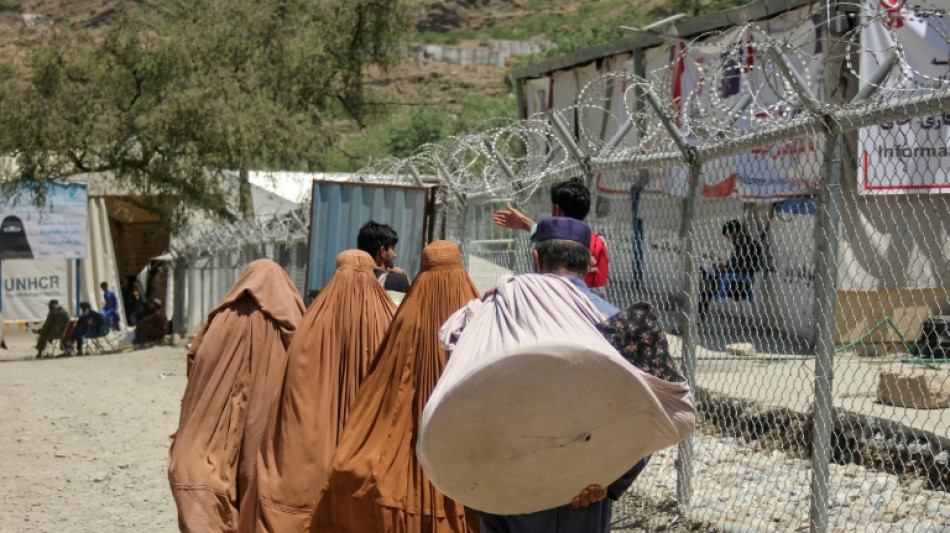
Lugging suitcases across the border after packing up in Pakistan, Afghans are returning home with their worldly possessions but often lack one key item to restart their lives: an identity card.
On the Afghan side of the Torkham border crossing, children and adults wheeled their luggage or carried belongings atop their heads, as they moved from desk to desk to log their arrival.
"I don't know how and where to get the ID card; now I'll go and check," said 17-year-old Abdulrehman Sudais, standing beside a crate of chickens he had carried across the border for his mother.
The Pakistan-born teenager had been to Afghanistan just once before, but his cousin had already told him he would need ID to access work or education.
Out of 6.1 million Afghan returnees who have arrived from Pakistan and Iran since September 2023, more than 86 percent are listed as undocumented by the International Organization for Migration (IOM).
At the crossing point, which still bears the shrapnel marks of this year's war between the neighbouring countries, officials and aid workers were taking down everyone's details.
While border officials contact authorities nationwide to verify the identity of those who don't have any form of ID, the process for newly arrived Afghans can be bewildering.
Sardar Khan, 41, was sitting in a large tent at Omari camp near the crossing, where people get a return certificate and are fingerprinted.
"We are blind; we don't know what to do," he told AFP, as his son fell asleep at his side.
"We've never been to Afghanistan before; we'll get to know the importance of ID cards," he said.
As well as a requirement for getting a job or school place, an ID card is essential for Afghans trying to prove they own land or a home, claiming inheritance, accessing state benefits, and travelling through the myriad of checkpoints across the country.
Outside the tent, as the temperature hit 40C, people waiting to be processed huddled in the limited shade available.
Ziad Salih, regional coordinator at IOM, described the ID card as "one of the essential pieces of the puzzle" for Afghans.
"Many returnees are arriving without a valid ID document and this is placing them at risk of administrative and social exclusion," he told AFP at the agency's Torkham transit centre.
Afghanistan's Ministry of Refugees and Repatriation Affairs did not respond to AFP's request to comment on the documentation issue.
- 'Difficult decisions' -
Near the Torkham crossing, colourful trucks were piled high with families' furniture and other possessions from Pakistan.
Once Afghans reach their destination -- often the places their relatives fled years ago -- organisations have helplines and projects to support them with their paperwork.
Murat Khan Safi, an octogenarian who returned a few months ago, found rooms to rent on the outskirts of Jalalabad, the closest city to the border crossing.
"We were given a number at Torkham, then we contacted WADAN, and we made the ID cards," he told AFP, referring to the Welfare Association for the Development of Afghanistan that works with the UN refugee agency (UNHCR).
Surrounded by sons and grandsons under a clattering ceiling fan, Safi showed the tattered identity document he has kept since fleeing the Soviet occupation more than four decades ago.
Processing the new ID cards only took a couple of days, he said, but paying a fee of 500 Afghanis ($7.80) for each relative was hard.
"I made some difficult decisions... I had to sell household belongings," said Safi, his white beard matching the colour of his clothes.
The family has been reimbursed for the ID card fees by the Welfare Association, and is due to receive additional support.
In June, the United Nations launched an initiative that aims to help Afghans get 1.5 million identity documents over the next three years.
Arafat Jamal, UNHCR's representative for Afghanistan, described the lack of documentation as an "almost invisible" phenomenon.
"The absence of documentation is a serious impediment to continuing your lives," he told AFP in the capital Kabul.
The UN appeal comes as global aid cuts hit hard in Afghanistan, with those crossing the border entering a country where jobs are scarce and support has been shrinking.
At Omari camp, Nazamin Baloch didn't know how to get an ID card but knew from other Afghans that it was "important for everything".
"This is the first time I am coming to Afghanistan," said Baloch, in her sixties.
"No one in the family has an ID card... We have not even seen our country before."
M.Delgado--TFWP