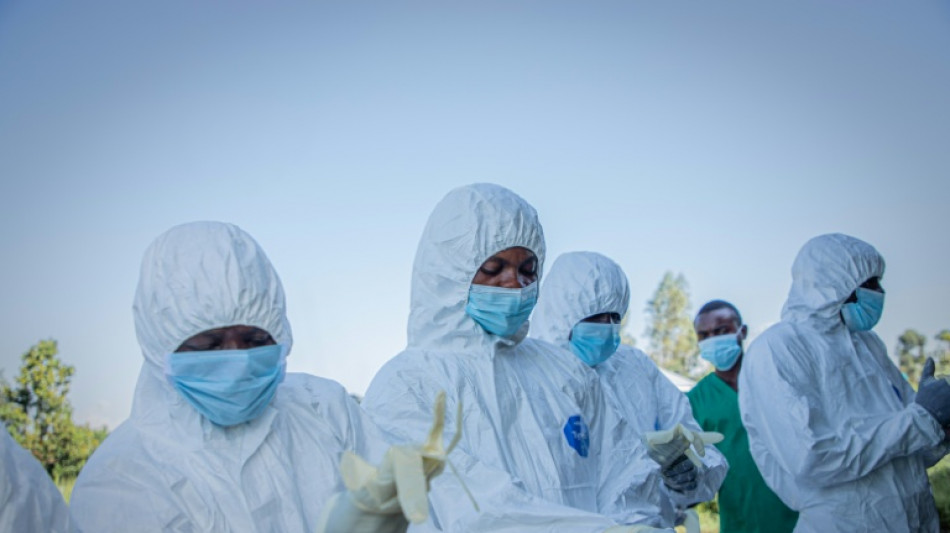
No vaccine, conflict, mistrust: Ebola's return to DR Congo / Photo: © AFP

Ebola is spreading again in the eastern Democratic Republic of Congo, where conflict, mistrust and the lack of a vaccine have made the outbreak hard to contain.
The virus, transmitted through close contact and bodily fluids, can cause a fatal haemorrhagic fever and has killed more than 15,000 people in Africa over the past 50 years.
Here is a look back at developments during the latest outbreak:
- How did it begin? -
The DRC's 17th Ebola outbreak was officially declared on May 15 but is believed to have been spreading under the radar for weeks.
The World Health Organization had already been alerted on May 5 to a mysterious and deadly illness in the mining town of Mongbwalu, where four health workers died within days.
In northeastern Ituri province, locals told AFP of unexplained deaths that had been fuelling rumours of a "mystical illness" as far back as March.
Health authorities initially struggled to identify the virus. Early cases were mistaken for more common diseases like malaria, typhoid or yellow fever.
Initial lab tests in Bunia, Ituri's capital, also came back negative because local facilities could only detect the Zaire strain of Ebola -- not the Bundibugyo strain responsible for this outbreak.
By May 15, 246 suspected cases, including 80 deaths, had already been recorded in conflict-weary Ituri, the epicentre of the outbreak.
The same day, neighbouring Uganda reported a related death involving a Congolese traveller, raising fears of a cross-border spread.
Now, at 19 confirmed cases and two deaths, the country has closed its border with the DRC.
The scale and speed of the outbreak alarmed experts, and the WHO swiftly declared a global health emergency, warning the outbreak could last months.
Africa CDC, the African Union's health agency, has warned that up to 10 countries in the region could be at risk.
- A vaccine? -
The Bundibugyo strain of the virus has no approved vaccine or specific treatment.
Existing Ebola vaccines, developed between 2018 and 2019, are only effective against the Zaire strain, which caused previous major outbreaks.
Health workers must rely on basic measures such as isolating patients and tracing contacts -- a challenge in one of the DRC's most unstable regions.
The nature of the disease also makes it hard to detect, as symptoms first resemble malaria, with haemorrhagic signs showing later.
"Doctors were confused," said Congolese virologist Jean‑Jacques Muyembe, who helped discover Ebola in 1976.
But Africa CDC says a vaccine targeting Bundibugyo could be available by the end of the year, with clinical trials under consideration.
- Challenges on the ground? -
The outbreak is unfolding in Ituri, a region plagued by militia violence and weak state presence.
Armed groups linked to the Islamic State and old local militias regularly carry out attacks, forcing thousands to flee into displacement camps, where disease can spread quickly.
Africa CDC says there have been more than 200 confirmed deaths so far, though testing capacity is weak and aid groups say the toll is likely higher.
Ituri is also marked by high mobility linked to mining, which makes tracking and tracing infections even harder.
Many hospitals in the region still lack essential equipment, especially isolation tents for patients.
In Bunia, AFP reporters saw patients with haemorrhagic symptoms arriving on the back of motorbike taxis, often without protective equipment.
Insecurity has stunted the health response, with overstretched medical teams struggling to access affected areas.
Authorities temporarily suspended flights to and from Bunia, slowing the delivery of aid and medical teams to the area.
NGO Doctors Without Borders has criticised the sluggish response, warning of gaps in coordination.
- Can it be contained? -
Health authorities say it can, but major obstacles remain.
The Congolese government has pushed back against what it called "alarmist" reactions, insisting the situation is under control.
But in a region where the state is largely absent, health workers are shunned by local communities, who prefer traditional healers.
Incidents in hospitals have seen families trying to take the bodies of relatives who died of the virus, increasing transmission risks.
And experts warn the true extent of the outbreak remains unclear, especially as it has spread across three provinces and into neighbouring Uganda.
Travel measures, including border closures, flight suspensions and visa restrictions, have been introduced by several countries.
For now, containing the outbreak will depend on traditional measures in communities where fear of disease and scepticism of health authorities run deep.
But WHO chief Tedros Adhanom Ghebreyesus recently struck an optimistic tone, saying: "With continued collaboration, I am confident this outbreak can be brought under control."
A.Williams--TFWP