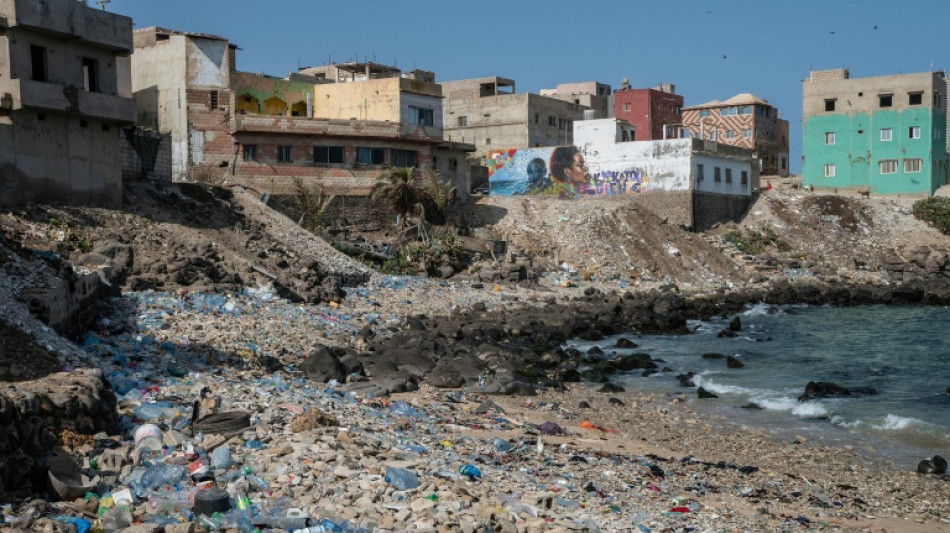
UN warns of 'deepening crisis' in oceans, urges action / Photo: © AFP/File

Oceans are in a "deepening crisis" that demands urgent global action, a major UN report warned Monday, with seas warming and rising faster, ice cover shrinking and marine ecosystems under mounting strain.
The culmination of five years of work by 600 international scientists, the 1,352-page tome details the growing toll of climate change, pollution and overfishing in our oceans, which cover more than 70 percent of the planet.
"The ocean is the foundation of life on Earth. But its health is at grave risk as ecosystems and habitats approach or surpass critical tipping points," the United Nations' third World Ocean Assessment (WOA) said.
Oceans play a critical role for the planet, regulating the climate and feeding billions of people.
But the WOA warned of "a deepening crisis, as climate change, pollution, overfishing and biodiversity loss put ocean systems under severe strain".
The findings "demand urgent action, through stronger multilateral cooperation, greater ambition and decisions grounded in the best available science".
The WOA welcomed the entry into force in January of a UN treaty to protect and sustainably use marine life in international waters, saying it "marks a historic milestone for ocean stewardship and multilateral cooperation".
"We cannot keep treating the ocean as limitless," UN Secretary-General Antonio Guterres said in a statement.
"We must build a new relationship with the ocean: Grounded in science. Framed by international law. And built on shared responsibility," he said.
- Warming and rising faster -
The report, which mostly covers the period between 2018-2023, paints a stark picture of the state of the oceans.
Around 16 percent of the total increase in ocean heat content recorded since 1955 has occurred since 2018 alone, the assessment found.
The oceans have absorbed more than 90 percent of the excess heat and 30 percent of the CO2 released into the atmosphere by the burning of fossil fuels.
As waters warm, they expand, helping drive sea-level rise alongside meltwater from glaciers and ice sheets.
"The sea level continues to rise at increasing rates," the report said, more than doubling from less than 2.0 millimetres per year before 2015 to 4.3 mm in 2023.
While millimetres might seem small, they "multiply up really quickly", Ian Butler, an Australia-based marine ecologist and joint coordinator of the WOA's group of experts, told AFP.
- Melting ice -
The Arctic Ocean could become ice-free in September by the middle of the century, with the earliest such conditions possible in the 2030s under all emissions scenarios, the report said.
"We're seriously looking at an ice-free Arctic Ocean for parts of the year within 10 or 20 years," Butler said.
The ice melt in the northern pole is also reshaping geopolitics, opening previously inaccessible shipping routes and heightening competition among major powers including the United States, Russia and China.
In the South Pole, Antarctic sea ice, which had gradually increased between 1979 and 2015, has "rapidly declined" since 2016.
- Marine ecosystems -
Climate change is also reshaping marine life, with some fish species moving to cooler or deeper waters to survive.
"Some have no future at all because there's nowhere for them to go," Butler said.
Coral reefs are among the most threatened ecosystems.
Repeated marine heatwaves and storms "leave little time for recovery and are pushing reefs towards collapse", the report said.
Bleaching events since 2018 have caused widespread coral mortality, with the WOA warning that 90 percent of reefs could disappear if warming tops 1.5C above pre-industrial levels.
- Plastic pollution -
The report called for a reduction in the production of plastics -- an issue at a standstill in international negotiations.
Each year, 52.1 million tonnes of plastic waste spills into the ocean, contributing to an estimated 24.4 trillion microplastic particles.
Microplastics are now known to affect more than 4,000 marine species.
- Deep-sea mining -
The report highlighted growing concerns about deep-sea mining and called for a coordinated international response.
While exploration for deep-sea mining is far advanced, no company or nation has started production on a commercial scale.
Critics fear it would smother marine life with waste and the noise of heavy machinery will disrupt oceanic migrations.
"This report must serve as an urgent wake-up call to governments to act to protect the ocean," environmental group Greenpeace said in a statement.
- Trump ocean cuts -
The WOA comes as US President Donald Trump's administration is set to remove hundreds of deep-sea scientific instruments used for a decade to monitor the effects of climate change on marine environments.
"The deep ocean monitoring system is an extremely important part of our global monitoring and understanding of the ocean," Butler said. "The removal of it would leave a huge gap in our long-term ocean science."
M.Cunningham--TFWP