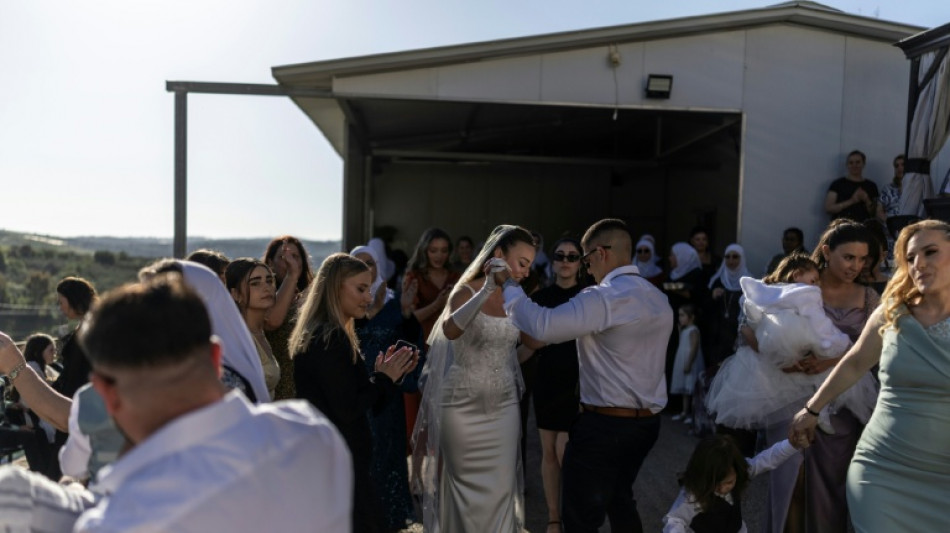
For Israel's Circassians, food and language sustain an ancient heritage / Photo: © AFP

On a sunny afternoon, Shina Shabso was busy making traditional cheese pastries for a wedding on Israel's border with Lebanon, the celebration in the Circassian village of Rehaniya a much-needed break from weeks of war.
Known as "halyuj", the fried semi-circular pastries are a staple of life in this tiny community of Circassians spread across two villages in northern Israel and are served up to honour guests at a celebration or to comfort those who mourn.
"Preserving traditional food, especially Circassian cheese, is very important because in Israel we are a minority of around 5,000," said Shabso, who filled them with her own freshly-made cheese, the tradition passed down through families for generations.
"It's important for the next generation to know where we came from, what people used to eat and how they used to produce it," said the 32-year-old artisan cheesemaker who runs Gvinot Shabso with her husband Itzik.
It is an explanation she often gave tour groups who would visit before the northern border started coming under heavy Hezbollah fire with the start of the 2023 Gaza war.
Like their Jewish and Arab neighbours, the Circassians -- Sunni Muslims who serve in the Israeli army -- have had their lives disrupted by the latest fighting between Hezbollah and Israel that began in March.
For now, though, the skies were clear with only a few distant booms echoing over the border some 4.5 kilometres (nearly three miles) away.
- Loyalty to the place -
The Circassians are an ethnic group indigenous to the North Caucasus, a mountainous region between the Black and Caspian seas, in what is today primarily southern Russia.
They were massacred and forcibly expelled from their homeland by Russian troops between 1860 and 1864 in what their descendants want recognised as genocide, its anniversary marked every May 21.
Known for their resilience to harsh conditions, fighting skills and loyalty to the place they live, the Circassians were brought to the Middle East by the Ottoman Empire in the mid-1870s and never left.
Today, they number five million worldwide, of which three million live in Turkey, 120,000 in Syria and 100,000 in Jordan, while the rest are scattered across Russia, Europe and the United States.
"When the rulers changed, the Circassians stuck with it, they're people of their word. Loyalty means you're loyal to your surroundings," said Zuher Tchaocho, 52, director of the Circassian museum in Kfar Kama, the other Circassian village.
Although he speaks Hebrew, his native tongue is Circassian -- a phonetically-rich language based on 64 letters written in Cyrillic that graces the street signs, alongside Hebrew and Arabic.
"This is the only place in the world where children are taught Circassian as part of the education system," Tchaocho said.
- A living language -
The everyday use of Circassian is what sets the community apart, according to Riyad Gosh, 80, former head of Circassian heritage at Israel's education ministry.
"We've retained our Circassian identity 100 percent.. We preserve our community in language, culture, customs and behaviour," he said, wearing a green baseball cap with the 12 gold stars and three crossed arrows of the Circassian flag.
"But we're a people that is disappearing because many don't speak the language, it's not preserved like we preserve it here. That really hurts me."
Elsewhere the mood was high as the wedding celebrations began, trays of cheese pastries handed around as the groom approached the bride's home to claim her, his entourage dancing after an accordion playing traditional songs.
In this case, both bride and groom are from the village, but the problem of not marrying out is a growing challenge with just 1,500 Circassians living in Rehaniya and 3,500 in Kfar Kama, said Tchaocho.
Bringing someone from abroad involves complex residency issues, he added.
"They want to keep marrying only Circassians and so far they've managed, but it's hard to find people from just the two villages," he said of a problem that will "become more serious later on".
- 'Inseparable part of life' -
Although the recent conflicts have been hard on everyone in the community, no one would consider leaving, least of all Shabso.
"We feel connected to the state of Israel, we're really attached to the Israelis here. It's like an inseparable part of my life," she told AFP.
Her cheese business survived thanks to loyal customers spreading the word, with orders now coming from across the country, she said.
"I don't really know the history of the Circassian people but I drive 45 minutes just to buy these delicious things," Zeev Dragobetsky, 52, a veteran customer from Kfar Vradim, said with a grin.
"Whether there's a war or not, whenever Shina starts to fry (her cheese pastries), I would come -- rockets or no rockets."
T.Gilbert--TFWP