The Fort Worth Press - Small US farm copes with fuel hikes from Mideast war

USD -
AED 3.67315
AFN 64.503991
ALL 81.825041
AMD 375.730403
AOA 917.000367
ARS 1371.22092
AUD 1.415228
AWG 1.8
AZN 1.70397
BAM 1.669184
BBD 2.013382
BDT 122.811959
BHD 0.377307
BIF 2970
BMD 1
BND 1.273779
BOB 6.907027
BRL 5.009204
BSD 0.99965
BTN 92.724325
BWP 13.418953
BYN 2.86914
BYR 19600
BZD 2.01024
CAD 1.38435
CDF 2300.000362
CHF 0.789223
CLF 0.02274
CLP 894.990396
CNY 6.828041
CNH 6.824955
COP 3648.52
CRC 462.657142
CUC 1
CUP 26.5
CVE 94.52504
CZK 20.788404
DJF 177.720393
DKK 6.372904
DOP 60.37504
DZD 132.19904
EGP 53.108563
ERN 15
ETB 156.503874
EUR 0.852704
FJD 2.211504
FKP 0.743942
GBP 0.743218
GEL 2.690391
GGP 0.743942
GHS 11.02039
GIP 0.743942
GMD 73.503851
GNF 8777.503848
GTQ 7.646943
GYD 209.113794
HKD 7.83205
HNL 26.60504
HRK 6.425904
HTG 131.073388
HUF 320.203831
IDR 17089.3
ILS 3.03421
IMP 0.743942
INR 93.10625
IQD 1310
IRR 1316125.000352
ISK 122.190386
JEP 0.743942
JMD 158.051054
JOD 0.70904
JPY 159.25504
KES 129.150385
KGS 87.450384
KHR 4015.00035
KMF 420.00035
KPW 900.013392
KRW 1484.570383
KWD 0.30869
KYD 0.832956
KZT 472.33861
LAK 21960.000349
LBP 89550.000349
LKR 315.479086
LRD 184.203772
LSL 16.440381
LTL 2.95274
LVL 0.60489
LYD 6.355039
MAD 9.282504
MDL 17.221487
MGA 4145.000347
MKD 52.551042
MMK 2100.499472
MNT 3595.336475
MOP 8.063319
MRU 39.995039
MUR 46.503741
MVR 15.460378
MWK 1736.503736
MXN 17.301804
MYR 3.965039
MZN 63.960377
NAD 16.440377
NGN 1359.503725
NIO 36.730377
NOK 9.524904
NPR 148.358578
NZD 1.713797
OMR 0.384827
PAB 0.999531
PEN 3.388039
PGK 4.311504
PHP 59.876504
PKR 278.950374
PLN 3.628288
PYG 6464.910259
QAR 3.646038
RON 4.342304
RSD 100.136038
RUB 77.104556
RWF 1460.5
SAR 3.753193
SBD 8.058149
SCR 14.033008
SDG 601.000339
SEK 9.27195
SGD 1.274104
SLE 24.625038
SOS 571.503662
SRD 37.449038
STD 20697.981008
STN 21.25
SVC 8.747045
SYP 110.548127
SZL 16.435038
THB 32.103646
TJS 9.500448
TMT 3.505
TND 2.887038
TRY 44.665038
TTD 6.784102
TWD 31.741804
TZS 2605.000335
UAH 43.431822
UGX 3698.867467
UYU 40.334212
UZS 12160.000334
VES 475.837804
VND 26336
VUV 119.210481
WST 2.744958
XAF 559.761915
XAG 0.01312
XAU 0.00021
XCD 2.70255
XCG 1.80164
XDR 0.698112
XOF 560.503593
XPF 102.250363
YER 237.150363
ZAR 16.41824
ZMK 9001.203584
ZMW 19.016086
ZWL 321.999592
  • RBGPF

    -13.5000

    69

    -19.57%

  • BCC

    -0.4100

    80.17

    -0.51%

  • NGG

    -0.0300

    90.29

    -0.03%

  • BTI

    -0.0400

    58.81

    -0.07%

  • BCE

    -0.5400

    23.35

    -2.31%

  • CMSC

    0.0400

    22.43

    +0.18%

  • RIO

    1.1300

    98.26

    +1.15%

  • RELX

    -0.0400

    33.3

    -0.12%

  • BP

    0.5400

    46.44

    +1.16%

  • GSK

    -0.1500

    58.21

    -0.26%

  • JRI

    0.0400

    13.02

    +0.31%

  • AZN

    -0.9600

    204.03

    -0.47%

  • CMSD

    0.0400

    22.63

    +0.18%

  • RYCEF

    -0.2000

    17

    -1.18%

  • VOD

    -0.1600

    15.69

    -1.02%

Small US farm copes with fuel hikes from Mideast war
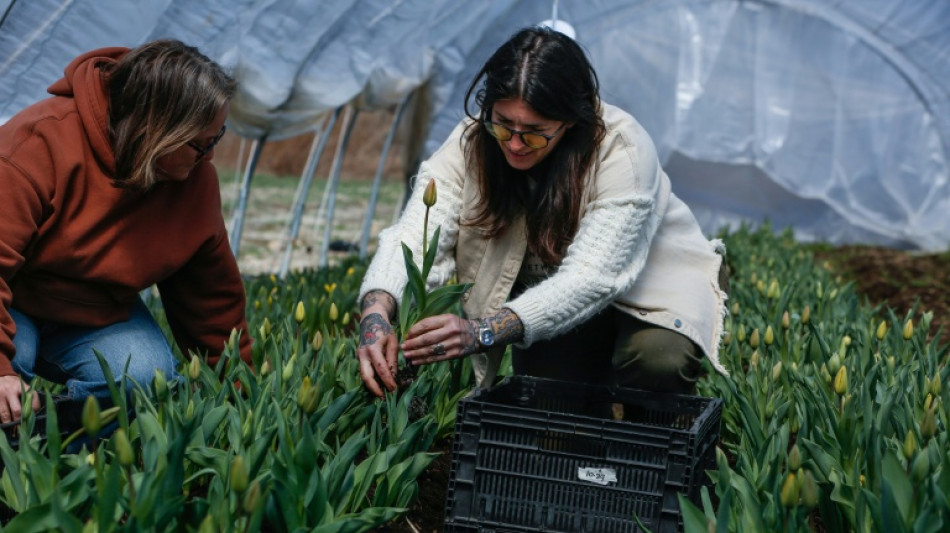
Small US farm copes with fuel hikes from Mideast war / Photo: © AFP

Small US farm copes with fuel hikes from Mideast war

An hour's drive north of New York City, the greenhouses at Cropsey Farm are seeing their first leaves of kale, spinach and arugula emerge. But the farmer who runs the outfit is obsessed with something else: the soaring price of fuel.

Text size:

Every year, Sue Ferreri typically allows a 10 percent "buffer" for production budgeting, "but it's well above that now...We're looking at 20, 25 percent, and it's mainly due to the diesel cost," she told AFP.

Fuel prices have jumped after the US-Israeli attack on Iran on February 28, which led to a blockage of shipping in the Strait of Hormuz, a key conduit of oil and fertilizer.

Earlier this week, a gallon (3.8 liters) of diesel -- the fuel most used on the farm located in New City -- rose as high as $5.70 compared with $3.70 in February.

It's essential to the entire operation here: irrigating young plants, spraying fertilizers and plowing the soil.

Shipping costs are up, too, Ferreri said, describing "insane" prices for the delivery of essential farm equipment. Recently when she wanted to order a $60 piece of equipment, the shipping cost was $200, she said.

- 'Pricey' -

Eight people grow flowers, vegetables and fruit using sustainable farming practices on the ten-hectare (25-acre) farm. Customers include restaurant owners as well as local residents who buy produce in a restored 18th-century barn.

Cropsey Farm was already hit by fuel prices hikes following the war in Ukraine and had begun adapting its methods even before the Middle East conflict broke out.

Now, that shift is accelerating.

"We've been switching more to smaller equipment just because it's more efficient on fuel and it can still do what we need it to do," said head mechanic Jonah Monahan.

For example, an ATV and walk-behind tractor are now on the farm -- both far less energy-intensive than the typical tractor.

But, added Monahan, "for big jobs, we still need the main tractor, which gets pricey."

In one greenhouse, two women lifted tulip plants out of the ground and used a hand-drawn rolling cart to transport them to a refrigerated shed to await sale.

Everything is done to squeeze fuel costs.

- 'Relief' -

Beyond the tool adaptations, Ferreri said the farm is also shifting to "regenerative" practices, such as plowing the soil less deeply and maximizing space by rotating crops or pairing plants.

The rapid adjustments at Cropsey, typical of a small operation, have not yet reached larger farms, said Ben Brown, an agriculture researcher at the University of Missouri.

"At this point, most farms are left with taking the higher prices and figuring out how to make it work financially," Brown said.

"However, if elevated prices were to continue, we would expect to see producers shift some acreage to lower energy dependent crops," he said.

Ferreri said the fragile ceasefire agreed between Washington and Tehran gave her some "relief."

"But as a farmer, you can't trust the weather," she said. "We have to just anticipate the worst, hope for the best, and that's kind of where we're at."

K.Ibarra--TFWP