War's impact on fertilisers stirs food producer fears / Photo: © AFP/File

Even as Gulf tanker traffic slowly resumes, the road back to normal food production will be long and arduous, given the war's impact on fertiliser supplies, the UN has warned.
With factories shuttered and soaring gas prices driving up production costs around the world, fertiliser prices have risen across the board and are unlikely to fall back easily.
"If the Strait of Hormuz reopened immediately, i.e. not only a ceasefire but vessels moving, the impact would be significantly positive -- but incomplete and uneven," the Food and Agriculture Organization's chief economist Maximo Torero told AFP.
"The FAO is clear that damage has already been done."
According to Argus Media, the price of urea from the Middle East has, for example, risen by 70 percent in a matter of weeks.
Gulf countries are major exporters of nitrogen fertilisers like urea -- which provides plants with nitrogen to aid green leafy growth -- as well as ammonia and phosphate.
Italy notably called last week for a "humanitarian corridor" in the Strait of Hormuz for fertiliser as Torero warned that if high prices continue, farmers would face a stark choice: "Farm the same with fewer inputs, plant less, or switch to less intensive fertiliser crops," which would reduce food supply well into 2027.
- Lasting blow to supplies -
Torero warned the bottleneck in marine traffic since the conflict began on February 28 meant even if Hormuz were to reopen immediately "infrastructure damage is not fully reversible in the short term."
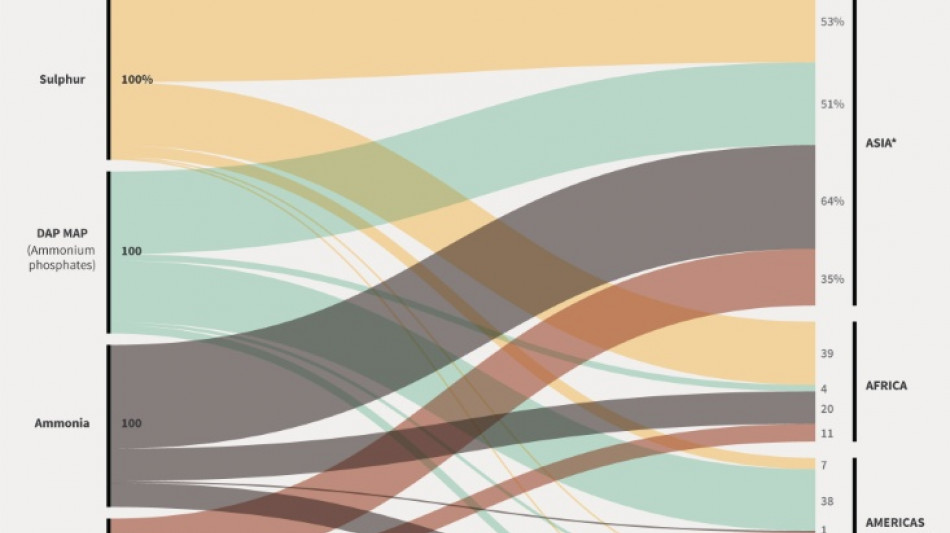
According to Kpler data, around 1.9 million tonnes of fertiliser are trapped on 41 vessels, equal to 12 percent of all produce shipped out of the strait in 2024.
On March 2, the ammonia plant at the Ras Laffan refinery in Qatar was attacked. Plants have also suspended or reduced production in the UAE, Saudi Arabia, Iran, Jordan and Qatar, whose Qafco complex accounted for 14 percent of global trade in urea.
Overall, about one third of urea trade has been choked off, says the FAO.
In India and Bangladesh, nitrogen fertiliser plants have slowed down, unable to cope with the soaring cost of the gas required to operate.
- Price breaks -
Even if production and shipping resumes in the Gulf, prices for nitrogen fertilisers will fall slowly and unevenly, warned Torero.
"Unlike oil, the fertiliser sector does not have internationally coordinated strategic reserves, making supply disruptions more difficult to manage.
"Repair timelines are measured in months, not days."
Purchasers have also been hit by the fact that many pre-war contracts governing prices have been suspended as producers cite "force majeure," forcing reliance on higher spot market prices.
The FAO forecasts global fertiliser prices could average 15–20 percent higher in the first half 2026.
"A meaningful decline would likely take four to eight weeks after reopening, as production ramps up and shipping reschedules," says Torero. "Prices are unlikely to return to February 2026 levels before the third quarter of 2026, if at all this year."
- Too late for some -
He added many crop planting decisions have already been missed with the Northern Hemisphere already in planting seasons, meaning those yields will not be recovered.
"It's too late" in India, Bangladesh, Pakistan, Sri Lanka, Sudan, Kenya, Somalia, Turkey, and Jordan, all heavily reliant on Gulf fertilizers. But perhaps not for second harvests in Asia if fertilizers arrive within 4 to 6 weeks."
He explained that "the time between a fertiliser shock and a harvest failure is measured in months. The time between a harvest failure and a food price surge is measured in months more. We are already inside that window."
- "Ripple effect" -
Prices spiked following previous disruptions during the financial crisis of 2008 and the Russian invasion of Ukraine in 2022.
"I think what makes this one potentially more critical is the number of production hubs that are involved and countries that are involved," says Sarah Marlow, global editor for fertiliser at Argus Media.
"And then the ripple effect has spread out from the Gulf to other countries, which have also been affected by a lack of raw materials, a lack of gas."
C.M.Harper--TFWP