The "Galapagos" Effect in Ad Tech: Why Japan Is the Ultimate Stress Test for Your Global Strategy

Ad fraud is the most prolific form of cybercrime. So why haven't you heard of it?
TOKYO, JP / ACCESS Newswire / March 10, 2026 / Digital advertising looks measurable, and that is a problem.
Dashboards filled with clicks, impressions, and conversion rates give the impression that growth can be managed with precision. In reality, a meaningful share of this activity is not generated by real people. This is ad fraud: invalid traffic (IVT) that blends into performance metrics so effectively that many brands optimize around it without realizing it.
In large markets like the United States, the impact is easy to miss. Budgets are large, audiences are broad, and wasted spend tends to hide inside gradual inefficiency. Growth slows and costs rise, but nothing breaks outright.
Japan, however, reveals which parts of a global digital strategy were never resilient to begin with.
Its digital ecosystem is smaller and more fragmented. When traffic quality is poor, additional spend does little to improve results; meaningful leads decline quickly regardless of budget. Assumptions that hold in global, standardized strategies begin to fail.
The Ecosystem Gap: Where Universal Settings Fail
Many international brands entering Japan assume that digital strategies that succeed in the U.S., EU, or other parts of Asia will work here too. But Japan is different. Unlike the U.S., which has quickly diversified into OTT, streaming, and retail media, Japan has developed its own "Galapagos" ecosystem, shaped by strong local players and mobile-first habits. Yahoo! Japan remains a key search engine and portal, while LINE serves functions beyond messaging, acting as a central platform for many everyday services.
This unique landscape means that inventory quality varies widely, and global optimization tools aren't built to account for these differences. What looks like a single, unified media plan on a dashboard is actually a mix of very different platforms, each with its own risks and characteristics.
The Japan Specifics: The Illusion of "Safe" Networks
In the US, advertisers might rely on a relatively standard risk profile across major "walled gardens." In Japan, the absolute volume of invalid traffic across both local and global platforms breaks global trust assumptions.
The TikTok Trap
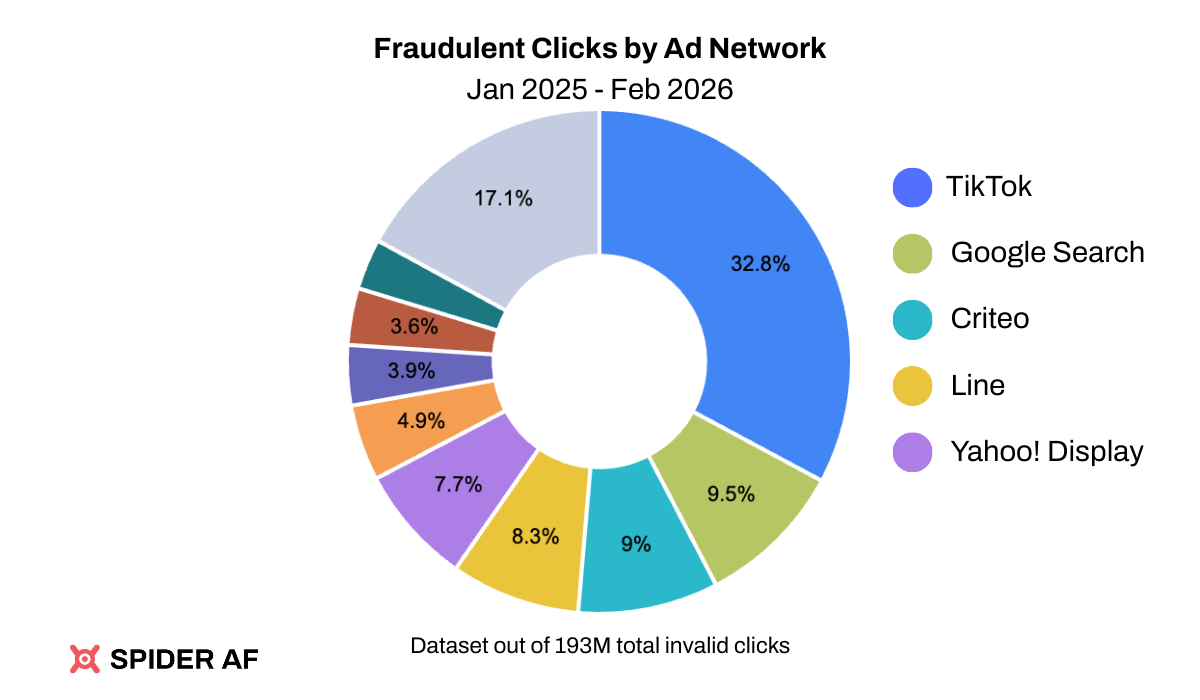
TikTok has emerged as a massive vulnerability in the Japanese ecosystem. Recent updated data reveals it is the undisputed leading source of invalid traffic by volume, exposing campaigns to over 63.2 million invalid clicks.
The Google Search "Safe Harbor" Myth
Even universally trusted environments are not immune. Because of its massive scale in Japan, Google Search is heavily targeted by sophisticated bots. It ranks as the second-highest driver of invalid traffic overall, generating over 18.3 million invalid clicks. Framing Google Search purely as a "lower-risk environment" is misleading; its sheer volume means it still exposes advertisers to massive financial leakage.
The Hidden Budget Drain: The Cost-Volume Paradox
The most damaging fraud in Japan is not always found where invalid traffic rates are highest. Instead, it hides where volume, premium costs, and opacity intersect-creating massive financial leakage disguised as performance.
This hidden drain typically occurs in two specific blind spots:
1. The Yahoo! Display Paradox: High Reach, High Risk
Optimization algorithms naturally gravitate toward Yahoo! Display because of its unrivaled volume and reach across Japan. However, this scale masks a significant structural risk. As documented in Spider AF's 2025 Ad Fraud White Paper report, these platforms often fall into a "dangerous feedback loop."
In this cycle, bots generate sophisticated fake engagement that tricks auto-optimization features. Because the algorithm "sees" engagement, it continues to bid aggressively on what is actually low-quality, fraudulent traffic.
The scale of this leakage is staggering:
Invalid Traffic: Nearly 14.8 million invalid clicks were attributed to Yahoo! Display.
Premium Waste: Because Yahoo! commands premium CPMs as Japan's primary news and services portal, this algorithmic flaw is exceptionally expensive.
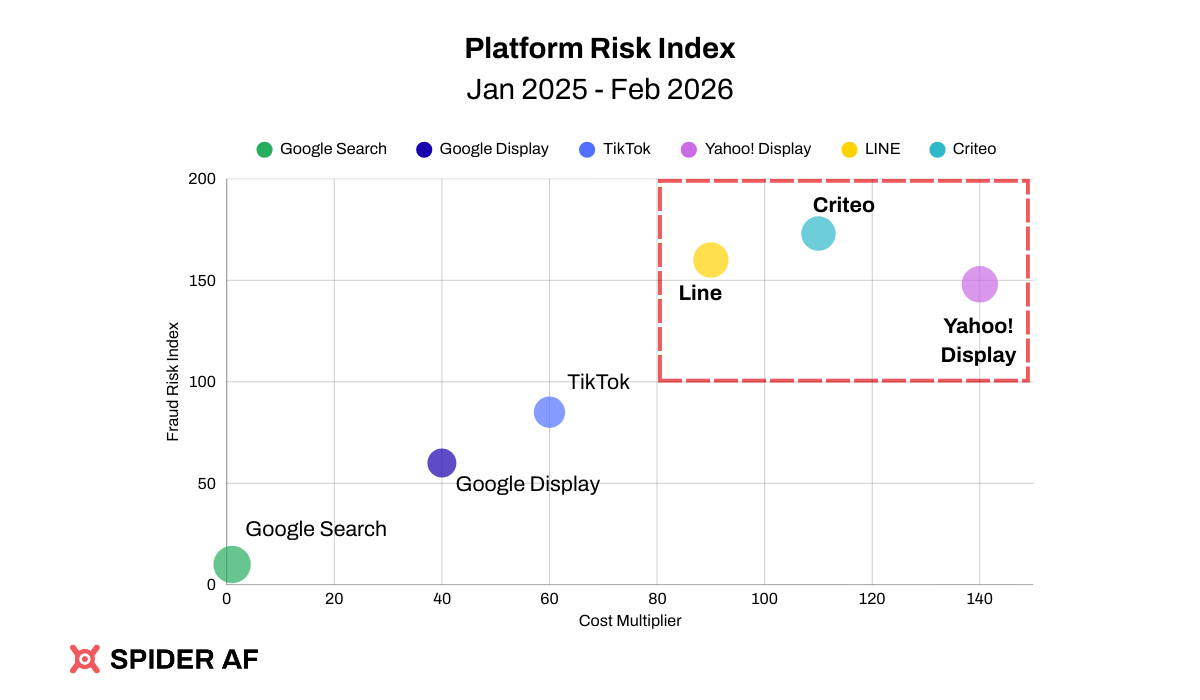
Cost Comparison: Spider AF's placement data shows that Yahoo! Display costs can be 3.5x higher than Google Display and, in high-competition segments, over 140x higher than Google Search.
Ultimately, advertisers who optimize for pure volume are unknowingly hemorrhaging their most expensive inventory budgets into non-human traffic.
2. The "Super App" and Retargeting Blind Spots
While Yahoo! Display drains budgets through sheer volume, other platforms bleed budgets through the illusion of high user intent.
You cannot effectively capture the Japanese market without LINE (Japan's essential social infrastructure) or major retargeting networks like Criteo. Because these platforms boast high-intent user bases, they naturally command higher CPA payouts. However, this makes them prime targets for sophisticated bots designed to mimic human behavior and generate fake conversions.
Global dashboards frequently obscure the scale of this localized risk. The numbers tell a sobering story: Criteo and LINE represent the third and fourth largest sources of invalid traffic in the Japanese ecosystem, accounting for 17.3 million and nearly 16 million invalid clicks, respectively.
Why This Remains Under-Reported: The Black Box Problem
If the data is this clear, why is ad fraud still treated as a niche issue? One reason is structural opacity.
The Japan Fair Trade Commission has repeatedly warned about risks associated with vertical integration, where a single platform controls the media, the supply-side platform, and the demand-side platform. This structure enables self-preferencing and limits independent verification.
In such environments, the same entity selling inventory is also reporting its performance. Fees are opaque. Traffic quality is graded internally. Advertiser budgets become trapped inside a black box where inefficiency is difficult to isolate and even harder to challenge. In essence, the fraud persists because dealing with it becomes too inconvenient.
The Feedback Loop: When Fraud Trains Your Algorithms
While we often hear of wasted ad spend, an overlooked danger of ad fraud is corrupted machine-learning.
Spider Labs' research shows that nearly 35% of invalid organic and non-paid conversions originate from sophisticated bot activity: automation designed to mimic returning, high-intent users or steal attribution from legitimate organic traffic. These behaviors trigger optimization systems, populate CRM pipelines, and shape audience models.
In practice, this contamination propagates quickly. When bot-generated leads enter CRM systems, they begin shaping audience definitions, look-alike models, and budget allocation logic. Campaigns then optimize toward behavioral patterns that never belonged to real customers in the first place.
At that point, breaking the cycle often requires manual intervention, historical data resets, and re-validation of entire acquisition funnels. The same dynamics that cause inefficiency at scale in a larger market lead to failure in Japan.
Conclusion: From Optimization to Validation
Japan demands localized execution. Creative, channel mix, and platform selection all matter.
What ultimately constrains success, however, is not tactics or spend, but whether traffic is validated independently. Ad fraud undermines digital performance globally, and Japan is where that weakness surfaces first.
About Spider Labs
Spider Labs Inc. is a leading provider of fraud detection and marketing security solutions, committed to creating a more transparent and secure digital advertising environment. By developing cutting-edge technologies, Spider Labs helps businesses protect their marketing investments and enhance operational efficiency.
To learn more about Spider Labs, visit
https://spideraf.com/about-us
Media Contact:
M. Tison | Global PR Manager
[email protected]
SOURCE: Spider Labs, Inc.
View the original press release on ACCESS Newswire
C.M.Harper--TFWP