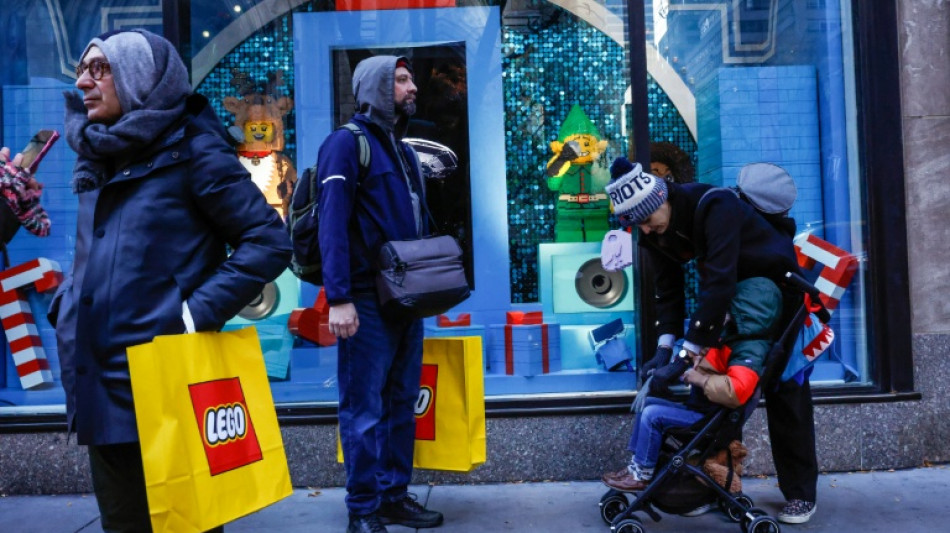
How Lego got swept up in US-Mexico trade frictions
/ Photo: © AFP/File

Manufacturing a Barbie or a Lego brick requires large quantities of plastic, much of which comes from China, the world's largest producer of the material.
So when Mexico hiked tariffs on the Asian giant at the start of 2026, its toy manufacturers, including local factories of Lego and Barbie-maker Mattel, had mixed emotions.
On the one hand, they cheered the clampdown on cheaper Asian imports but on the other were left wincing at the rising costs of their inputs.
The toy sector is one of a raft of industries impacted by a year of simmering trade tensions between US President Donald Trump's administration and Mexico, as well as China.
Mexico's car assembly industry, one of the biggest in the world, is also holding its breath, given its reliance on Chinese-produced car parts.
President Claudia Sheinbaum argues that the tariffs on China, India and other countries with which Mexico has no trade deal, aim to protect Mexican industry from cut-price competition.
Analysts see the levies, however, as an attempt to appease Trump in the run-up to a high-stakes review of Mexico's three-decade-old trilateral free trade deal with the United States and Canada, USMCA.
Trump accuses China of using Mexico as a tariff-free backdoor into the United States and complains that the USMCA, which his first administration negotiated, is weighted against Washington.
Saving the treaty is crucial for Mexico, which sends over 80 percent of its exports north of the border.
Some Mexican manufacturers say they are prepared to accept the pain of higher input costs if it leads to a positive outcome in the USMCA talks.
- Plastic and chips -
Polyethylene, the plastic used to make toys, is produced locally by the state-owned oil company Pemex.
But according to the toy industry, the company only manufactures 20 percent of what is needed, meaning the rest must be imported.
Many toys now also contain electronic chips, which also come primarily from Asia.
"If you, as a manufacturer, don't have the supply (of inputs) in the country, what do you do? You go out and find them," Miguel Angel Martin, president of the Mexican Toy Industry Association, told AFP.
He noted that the Lego sets purchased in the United States and Canada are all made in Mexico and said he hoped that the USMCA review would "be fair and benefit to all three countries."
- 'Playing both sides' -
China is the elephant in the room in the USMCA negotiations.
Canada has been working to diversify its trade relations after being walloped by Trump's tariffs offensive. In mid-January, it signed a preliminary trade agreement with Beijing.
The agreement sparked a furious reaction from Trump, who threatened to impose 100 percent tariffs on Canada if it becomes a "drop off port" for Chinese products destined for the United States.
Canadian Prime Minister Mark Carney downplayed Trump's broadside as part of the hurly burly of the USMCA negotiations.
Juan Francisco Torres Landa, a partner at the international law firm Hogan Lovells who focuses on deal making, said Sheinbaum was under pressure to stop "playing both sides" between the United States and China.
At the same time, he said, "given our economic dependence (on the United States and China), there is no other option" to working with both.
- Survival mode -
Some Mexican industries clearly stand to benefit from Sheinbaum's tariffs blitz, such as the textile and footwear sectors.
"In recent years, we have been hit hard by... unfair competition in international trade," Juan Carlos Cashat, president of a footwear manufacturers' association in central Guanajuato state, told AFP.
“We hope this can have a positive effect in the medium or long term," he said.
Toy manufacturers, by contrast, are in "survival" mode, according to the toy industry association's Martin.
He added that while the USMCA is being renegotiated, the industry will try to absorb most of the costs of its higher inputs.
But if the review, due to be completed by July 1, "does not produce a reasonably good outcome for the industry," he said, "then the consumer will be the one to pay the costs."
W.Knight--TFWP