The Fort Worth Press - Easier said than done for US to apply tariffs on single EU states

USD -
AED 3.6725
AFN 65.999946
ALL 79.268109
AMD 364.568352
ANG 1.789783
AOA 918.000219
ARS 1512.250969
AUD 1.389825
AWG 1.80125
AZN 1.70348
BAM 1.679281
BBD 2.014502
BDT 123.298316
BGN 1.696366
BHD 0.377107
BIF 2984.660694
BMD 1
BND 1.271197
BOB 11.727937
BRL 5.161697
BSD 1.00021
BTN 95.349267
BWP 13.402252
BYN 3.016542
BYR 19600
BZD 2.011669
CAD 1.38525
CDF 2274.999866
CHF 0.804165
CLF 0.023504
CLP 925.039932
CNY 6.719899
CNH 6.722165
COP 3159.15
CRC 451.378305
CUC 1
CUP 26.5
CVE 94.674074
CZK 20.73845
DJF 178.112832
DKK 6.419325
DOP 58.721252
DZD 133.140256
EGP 50.252597
ERN 15
ETB 163.378683
EUR 0.858698
FJD 2.19255
FKP 0.735368
GBP 0.736145
GEL 2.610056
GGP 0.735368
GHS 11.202459
GIP 0.735368
GMD 73.99993
GNF 8792.114572
GTQ 7.634879
GYD 209.263688
HKD 7.83964
HNL 26.830033
HRK 6.469798
HTG 130.854201
HUF 313.349007
IDR 17717.9
ILS 2.97265
IMP 0.735368
INR 95.43305
IQD 1310.333873
IRR 1374599.999757
ISK 120.920327
JEP 0.735368
JMD 158.543444
JOD 0.708953
JPY 159.669036
KES 129.360067
KGS 87.450098
KHR 4047.567939
KMF 422.999837
KPW 900.000294
KRW 1374.544998
KWD 0.30878
KYD 0.833552
KZT 463.527826
LAK 22430.676896
LBP 89569.786761
LKR 328.019886
LRD 181.040737
LSL 16.001219
LTL 2.95274
LVL 0.60489
LYD 6.339216
MAD 9.241971
MDL 17.293533
MGA 4314.58243
MKD 52.82251
MMK 2099.772007
MNT 3598.777615
MOP 8.07707
MRU 40.239384
MUR 46.870173
MVR 15.450393
MWK 1734.419206
MXN 16.94489
MYR 4.026024
MZN 63.896338
NAD 16.001082
NGN 1340.259721
NIO 36.809184
NOK 9.326365
NPR 152.558483
NZD 1.68204
OMR 0.384495
PAB 1.00021
PEN 3.351636
PGK 4.43561
PHP 62.254005
PKR 277.48638
PLN 3.72415
PYG 5927.077117
QAR 3.646058
RON 4.515705
RSD 100.738006
RUB 85.499234
RWF 1470.306657
SAR 3.752212
SBD 8.000251
SCR 13.639272
SDG 601.500338
SEK 9.523095
SGD 1.27136
SHP 0.740866
SLE 24.649567
SLL 20969.499227
SOS 571.585577
SRD 37.731973
STD 20697.981008
STN 21.036273
SVC 8.75176
SYP 13001.999906
SZL 15.989284
THB 32.950326
TJS 9.25201
TMT 3.5
TND 2.917491
TOP 2.40776
TRY 48.245102
TTD 6.788276
TWD 31.614975
TZS 2647.502966
UAH 44.565558
UGX 3771.073837
UYU 40.278022
UZS 11819.8093
VES 790.6771
VND 26072.5
VUV 118.040776
WST 2.709953
XAF 563.222427
XAG 0.01419
XAU 0.000218
XCD 2.70255
XCG 1.80268
XDR 0.707052
XOF 563.220009
XPF 102.399423
YER 236.506225
ZAR 16.00035
ZMK 9001.194956
ZMW 18.929211
ZWL 321.999592
  • BCC

    -1.2360

    77.534

    -1.59%

  • JRI

    -0.0150

    12.385

    -0.12%

  • CMSC

    0.0100

    21.32

    +0.05%

  • RELX

    0.2100

    36.51

    +0.58%

  • GSK

    -0.1700

    50.1

    -0.34%

  • BTI

    -0.1600

    56.12

    -0.29%

  • BCE

    -0.0110

    23.389

    -0.05%

  • VOD

    0.0450

    15.925

    +0.28%

  • CMSD

    0.0220

    21.202

    +0.1%

  • AZN

    -1.8100

    162.71

    -1.11%

  • BP

    -0.2900

    42.05

    -0.69%

  • RYCEF

    -0.0500

    20.7

    -0.24%

  • RBGPF

    -0.4400

    70.69

    -0.62%

  • RIO

    -0.5700

    104.21

    -0.55%

  • NGG

    0.2900

    79.72

    +0.36%

Easier said than done for US to apply tariffs on single EU states
Easier said than done for US to apply tariffs on single EU states / Photo: © AFP/File

Easier said than done for US to apply tariffs on single EU states

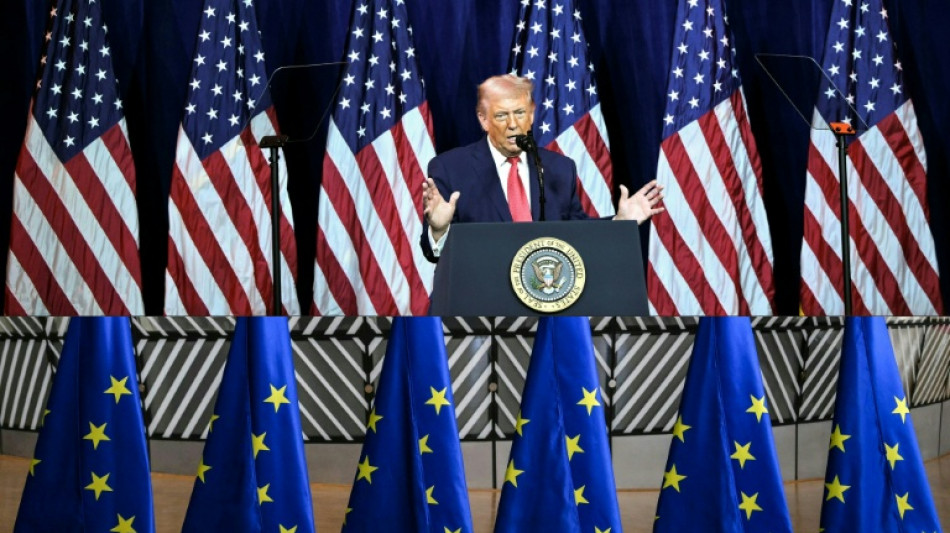
US President Donald Trump's tariff threats on eight European states, most of which are part of the EU common market, raises the question: can he really target them individually? Technically yes, but in practice -- it's not so simple.

Text size:

When asked the same question, a smiling European Commission spokesman Olof Gill urged reporters to "take a deep breath" before spelling out his explanation.

Trump stunned Europe at the weekend when he threatened levies of up to 25 percent on EU members Denmark, Finland, France, Germany, the Netherlands and Sweden, plus non-members Britain and Norway.

But because the European Union functions as a single market with a customs union, Brussels explained, while it might be technically possible for Trump to slap sanctions on each, that could mean bureaucratic hell for US importers.

- How does the single market work? -

Denmark, Finland, France, Germany, the Netherlands and Sweden are part of the EU single market with 21 other countries, and a customs union, which allows the free flow of goods from one member state to another.

This also means products made in the EU, which could be exported later to the United States, move around the union without their origin being tracked.

Because of this free movement, many companies use products made from across the bloc. For example, a car might be assembled in Germany using parts made in Slovakia.

This means any restrictions on trade aimed at one of the EU's 27 countries could in theory be circumvented by moving goods to another member state before exporting them.

"Exports of French wine, Dutch cheese and Danish pharmaceuticals from Budapest to the US might suddenly spike," quipped an EU diplomat -- in a nod to the warm ties linking Hungary's Prime Minister Viktor Orban and the White House.

"Let's see if Trump is going to punish his friend Orban with a tariff," the diplomat said.

The situation is different for Norway and the United Kingdom.

Norway is part of the European Economic Area that also includes the EU's 27 states, but there is one major difference -- it is not part of the bloc's customs union and must fulfil extra border checks.

When Britain left the EU, it opted to remain outside the single market.

- So then, are individual tariffs feasible? -

The above means that the United States would have a hard time trying to figure out where European goods actually come from.

"From a customs and operational perspective, it is practically very difficult to attribute goods exclusively to a single member state, given that production and transformation processes are often distributed across the EU," Gill said.

While nothing prevents a third country from demanding more information about national provenance, under EU rules, goods manufactured in the bloc have only to be labelled as "EU origin".

"So to summarise, it is technically possible. It is immensely bureaucratically and procedurally complex to do so," Gill said.

J.Ayala--TFWP