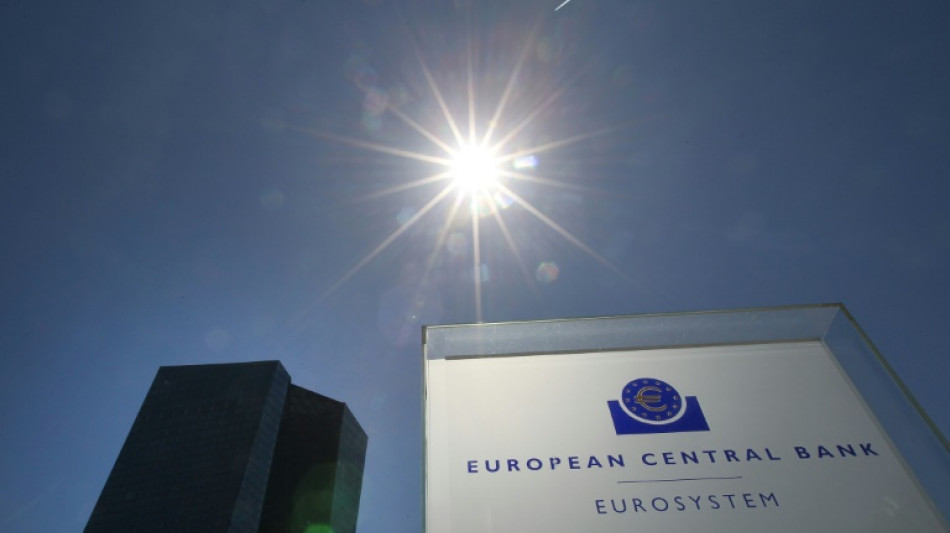
Italian political turmoil looms over key ECB meeting / Photo: © AFP/File

The European Central Bank is set to raise its interest rates for the first time in over a decade on Thursday as the collapse of the Italian government added a new dimension to the challenge facing policymakers.
With inflation soaring, the ECB is committed to raising interest rates by at least a quarter-point from their current historic lows.
Consumer prices rose at an annual pace of 8.6 percent in June, a record for the eurozone and well above the ECB's target of two percent.
The 25 members of the governing council are also set to discuss the details of a new crisis tool to tackle the rising costs that some governments in the eurozone are facing for servicing their debt.
The announcement in early June that the ECB would start hiking rates saw the costs faced by more highly indebted eurozone members such as Italy rise faster than others.
The instrument, which could be agreed on by policymakers today, would allow the ECB to intervene to reduce the stress on peripheral countries.
But the waters were muddied Thursday by the resignation of Italian Prime Minister Mario Draghi, who steered the ECB through a series of crises as its president from 2011 to 2019.
Although markets are jittery, a political crisis in Rome was a "textbook case of a situation where the ECB should not intervene", said Frederik Ducrozet, head of macroeconomic research at Pictet Wealth Management.
The turmoil made it harder to argue that rising borrowing costs were "unwarranted" and therefore should be addressed, Ducrozet said.
- Negative outlook -
Broken supply chains and the rising cost of energy following Russia's invasion of Ukraine that have driven up inflation are also weighing on economic activity in Europe.
The continent's dependence on Russian energy imports has eurozone members bracing for a difficult winter and planning to ration supplies if Moscow halts gas deliveries.
Central banks would normally hesitate before raising rates with the economy in such a delicate position, "but inflationary pressures have increased to a point where the ECB has to act whatever it breaks", said Ducrozet.
The ECB's deposit rate has been negative for the past eight year and currently stands at minus 0.5 percent.
The punitive rate, which effectively charges banks to park their money with the ECB overnight, was designed to encourage more lending, more economic activity and higher inflation rates.
ECB President Christine Lagarde has said the aim is to lift interest rates out of negative territory by the end of September as part of a "gradual but sustained" series of hikes.
But with inflation showing no signs of slowing, the ECB lagging behind its peers in Britain and the United States, and the euro looking weak against the dollar, the pressure is on the ECB to think about bigger hikes.
- Giant steps -
It would be difficult to explain why the ECB would "spend the summer with negative interest rates while inflation in the eurozone is climbing further", said Franck Dixmier, head of fixed income at Allianz Global Investors.
A problem not faced by other central banks is the question of what to do about the widening spread between the borrowing costs faced by the 19 members of the eurozone.
Limiting the divergence is "critical" to make sure monetary policy moves were felt evenly across the bloc, ECB vice-president Luis de Guindos said in early July.
Besides designing a new instrument, the ECB has said it will "flexibly" reinvest maturing bonds from its portfolio to hoover up debt from more at-risk countries and ease the pressure.
ECB policymakers could unveil more details about their planned "anti-fragmentation" tool Thursday, but the idea has been met with scepticism by some governing council members, who would see it used only under strict conditions.
J.Barnes--TFWP