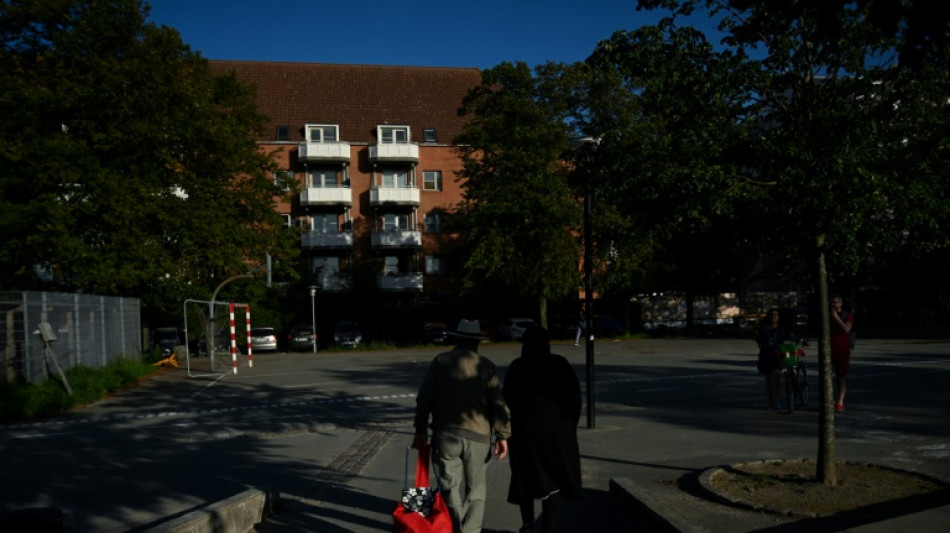
Danish 'ghetto' residents upbeat after EU court ruling / Photo: © AFP/File

The European Court of Justice on Thursday said it was up to Denmark's courts to decide whether a Danish law requiring authorities to redevelop poor urban "ghettos" with high concentrations of "non-Western immigrants and their descendants" was discriminatory.
The Danish law from 2018 states that all social housing estates where more than half of residents are "non-Western" -- previously defined as "ghettos" by the government -- must rebuild, renovate and change the social mix by renting at least 60 percent of the homes at market rates by 2030.
Danish authorities, which have for decades advocated a hard line on immigration and integration, say the law is aimed at eradicating segregation and "parallel societies" in poor neighbourhoods that often struggle with crime.
Residents in the Mjolnerparken housing estate in central Copenhagen, long associated with petty crime and delinquency, had filed suit against the law in Denmark in 2020, arguing that using their ethnicity to decide where they can live was discriminatory and illegal.
Danish courts then turned to the European court for guidance.
The court on Thursday said Danish courts would have to determine whether the "criterion establishes a difference in treatment based on the ethnic origin of the majority of the inhabitants of those areas, thus resulting in the inhabitants of those areas being treated less favourably".
The court stressed that "less favourable treatment ... may take the form of an increased risk, for the inhabitants of 'transformation areas', of having their leases terminated early and, therefore, of losing their home."
It also said Danish courts would have to determine whether the law, although worded in a "neutral manner", actually leads to "persons belonging to certain ethnic groups being placed at a particular disadvantage".
In Mjolnerparken, residents were optimistic after Thursday's ruling.
"I'm super satisfied," their lawyer Eddie Khawaja told reporters.
He said the ruling showed that the criterion of 50 percent "non-Western" residents may seem "neutral on paper, but does not prevent residents from being subjected to direct or indirect discrimination".
Muhammad Aslam, head of the social housing complex's tenants' association and a 58-year-old owner of a transport company who hails originally from Pakistan, was encouraged by Thursday's decision.
"Our fight is for each person to be treated equally, that you can't throw people out of their homes and that the courts, the rule of law and democracy are respected," he said.
Aslam has lived in the estate since it was created in 1987.
He and his wife raised four children in their four-room apartment -- now a lawyer, an engineer, a psychologist and a social worker, he said proudly.
"I who am self-employed as well as my children are all included in the negative statistics used to label our neighbourhood a 'ghetto', a parallel society," he said.
-11,000 people affected -
In Mjolnerparken, the landlord took advantage of a renovation of the four apartment blocks, decided by residents in 2015, to speed up the transformation of the complex and comply with the new legislation.
All of the residents -- a total of 1,493 in 2020 -- had to be temporarily relocated so the apartments could be refurbished, a representative of the tenants' association, Majken Felle, told AFP.
At the time, eight out of 10 people in Mjolnerparken were deemed "non-Western", with people from non-EU countries in the Balkans and Eastern Europe also falling into that category.
In order to avoid moving from one temporary apartment to another during the lengthy renovations, many residents agreed to just move to another neighbourhood.
And those who are determined to return -- like Felle and the Aslams -- are at the landlord's mercy.
"We were supposed to be temporarily relocated for four months, and now it's been more than three years. Each year, they give us four or five different dates" for when the work will be completed, Aslam sighed.
In total, 295 of Mjolnerparken's 560 homes have been replaced, with two apartment blocks sold and replaced by market-rate rentals out of reach for social housing tenants.
Experts say some 11,000 people across Denmark will have to leave their apartments and find new housing elsewhere by 2030.
X.Silva--TFWP