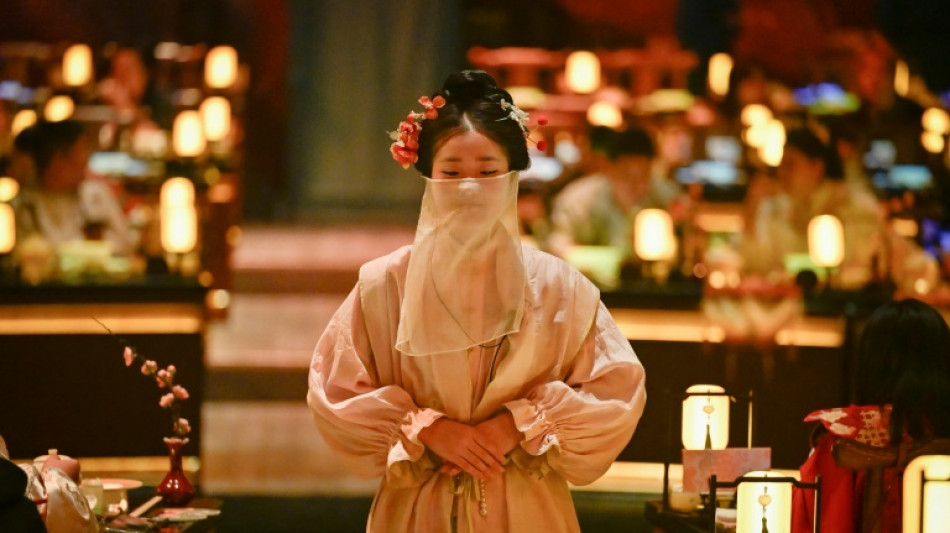
Young diners 'time travel' back to ancient China / Photo: © AFP

Women wearing long wigs and ornate traditional dresses milled around a pebbled courtyard, stopping to snap photos under a pavilion, as the melodious strumming of the Chinese zither played in the background.
These customers have paid to "time travel" back to ancient China for a few hours in an experience offered by a newly opened themed restaurant in central Beijing, which provides clothing services and an eight-course meal.
While the world's second-largest economy has been beset by sluggish domestic demand, many young people are still spending on experiences and goods that gives them satisfaction -- a trend recently dubbed in China as "emotional consumption".
Consumers born after the 1990s often buy things to "please themselves", fueling emotionally charged purchases in the country, the state-backed China Daily reported in September.
Such purchases include Labubu dolls, which have flown off the shelves in China.
"New forms of consumption... (and) new trends" such as the toothy-grinned dolls could help boost China's economy, commerce minister Wang Wentao said in July.
Before dining, customers picked out their garments from a room lined with traditional "hanfu", or Han clothing, headpieces adorned with faux jewels, and accessories.
Businessman Carey Zhuang told AFP that he paid around 1,000 yuan ($140) to dress up as one of the main characters from the famous Chinese classic novel "Dream of the Red Chamber", from which the restaurant has drawn inspiration.
Wearing a red silk top emblazoned with dragons, Zhuang said he is happy to spend money on a new experience.
"It's not about blindly being frugal, it's more about living in the moment," 27-year-old Zhuang told AFP.
- Willing to spend -
On the second floor, women sat in front of vanity desks as make-up artists powdered their faces and daintily applied blush to the apples of their cheeks.
After being made up, 22-year-old Wu Ke, dressed in a flowy, lilac "hanfu" with a matching cape, said that she was drawn to this restaurant because of her interest in ancient Chinese culture and clothing from the Song and Qing dynasties.
The broadcast host said that while people have tightened their purse strings in China, they will still be willing to spend on certain things and experiences.
"If, in our daily life, we're a bit thrifty with things like food -- for example, eating more simply -- and we choose public transportation when we go out, then the money we save will definitely find somewhere to go," Wu told AFP.
Outside, Huang Jing smiled as she watched her nine-year-old daughter pose for photos with a parasol on a small wooden bridge in the middle of a misty garden.
Huang had paid at least 900 yuan ($126) for her daughter to dress up in traditional clothing for the dinner and get her pictures professionally taken.
The restaurant was "immersive" unlike regular ones, and had a cultural element to it, Huang, a teacher, told AFP.
- Culture charm -
In recent years, Chinese people -- mostly women -- have got increasingly interested in dressing up in "hanfu" especially while visiting key tourist sites in the country.
The hashtag "hanfu" has been viewed over eleven billion times on Instagram-like Xiaohongshu, and is filled with posts of women in elaborate costumes and hairdos.
Huang said that "the charm of Chinese culture is now loved by the younger generation".
"I hope that my daughter's generation can continue to inherit, carry forward, and spread it so that more people can know about it," she added.
The revival of the "hanfu" is "a concentrated manifestation" of the "emotional economy", said Yang Jianfei from the Communication University of China.
Through immersive experiences involving the traditional clothing, young people are also engaging in a form of personal identity exploration, which connects them to "the roots of our national culture", Yang told AFP.
Diners were ushered into a grand, circular room, served by waiters dressed in "hanfu", and treated to an eight-act performance involving twirling dancers and emotive dialogue from actors.
Broadcast host Wu told AFP that as long as the reason "felt right" and "moved" her, she would be willing to fork out money.
"I won't try to save in this regard," she said, adding that she doesn't view it as "emotional spending".
"I prefer to understand it as something that's just about making ourselves happy."
J.P.Estrada--TFWP