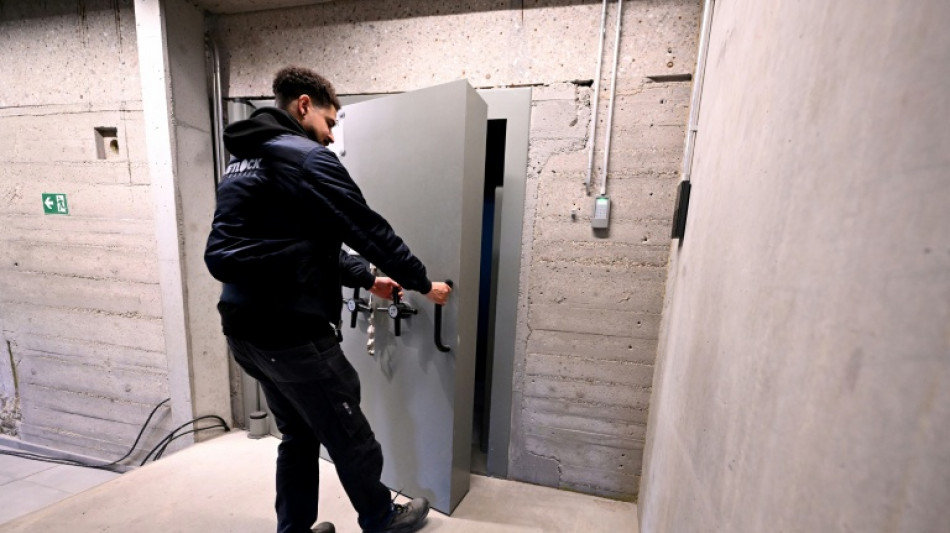
Inside Germany's rare earth treasure chest / Photo: © AFP

In a World War II bunker east of Frankfurt, a steel door weighing over four tonnes protects Germany's largest reserve of rare earths, a treasure at the heart of rising geopolitical tensions.
The exact location is confidential and the site is under close video surveillance.
This is where Tradium, a German company specialised in trading rare earths, keeps thousands of barrels of the precious materials -- almost all from China, the world's biggest producer.
The materials in the bunker -- such as dysprosium, terbium and neodymium -- are essential for the manufacture of crucial modern technology including smartphones, electric cars and wind turbines.
Tradium, which employs fewer than 40 people, expects to reach a turnover of 300 million euros ($346 million) this year.
In the midst of the US-China trade war, Beijing imposed restrictions in April on rare earth exports, making them subject to licenses with stringent conditions.
China controls over 60 percent of rare earths mining and 92 percent of refined production worldwide, according to the International Energy Agency.
Germany's flagship automotive sector is especially affected by the restrictions because it is dependent on rare earth magnets.
China's dominance in the sector has left European industry highly exposed.
Matthias Rueth, president and founder of Tradium, said that "nervousness is rising" among his clients.
For one industrial customer, any further shortage of rare earths "could go as far as halting production", he said.
"Our Chinese suppliers are naturally not very happy either" and would prefer open trade, Rueth said, adding that the Chinese government's decisions had "tied their hands".
"The rest of the world is currently in a dilemma. There's a shortage of these raw materials, prices are exploding, and no one really knows how things will turn out."
- Restrictions remain -
China's dominance of the rare earths market goes back decades.
According to Rueth, at least since the 1990s Chinese governments have looked at the materials as an asset on a par with the Middle East's oil reserves.
Europe has never created a comparable mining industry, said Martin Erdmann from the Federal Institute for Geosciences and Natural Resources (BGR).
He said Europe had preferred to "import these materials at lower cost from countries with less stringent environmental regulations".
The United States, which was the sector's global leader until the 1990s, then "abandoned production for cost and environmental reasons, leaving China to dominate the market," Erdmann told AFP.
Although US President Donald Trump claimed that his agreement with Chinese counterpart Xi Jinping in late October meant the suspension of some of the restrictions related to rare earths, the reality is far less clear.
According to Erdmann, "April's restrictions remain" in place, with Beijing still requiring "mandatory licenses, which involve disclosing industrial secrets and proving that the material will not be used in defence industries".
Few European companies are able to accept these conditions.
- 'Already too late' -
About 15 years ago, Japan faced a similar rare earths crisis caused by difficulties with supply chains from China.
In response, it developed alternative suppliers, notably in Australia, and built strategic reserves.
For Europe, "it is crucial to learn the same lessons and invest massively," said Erdmann.
In 2024 the European Union adopted legislation to secure its supplies of 17 strategic raw materials.
The Critical Raw Materials Act sets a 2030 target for at least 10 percent of rare earths consumed in the EU to be extracted within the bloc, along with 40 percent of necessary processing and 25 percent of recycling.
However, meeting these targets will be complicated given that the rare earth market remains captive to "very low prices, probably deliberately maintained at this level" by Beijing, which aims to "prevent any profitable exploitation" outside China, said Erdmann.
Rueth said that "our modern life entirely depends on these materials" but that finding an alternative when they become scarce "is very difficult".
Looking at the conundrum now faced by Europe to catch up in the race for critical rare earths, he said he has come to the gloomy conclusion that "it's already too late".
P.Grant--TFWP