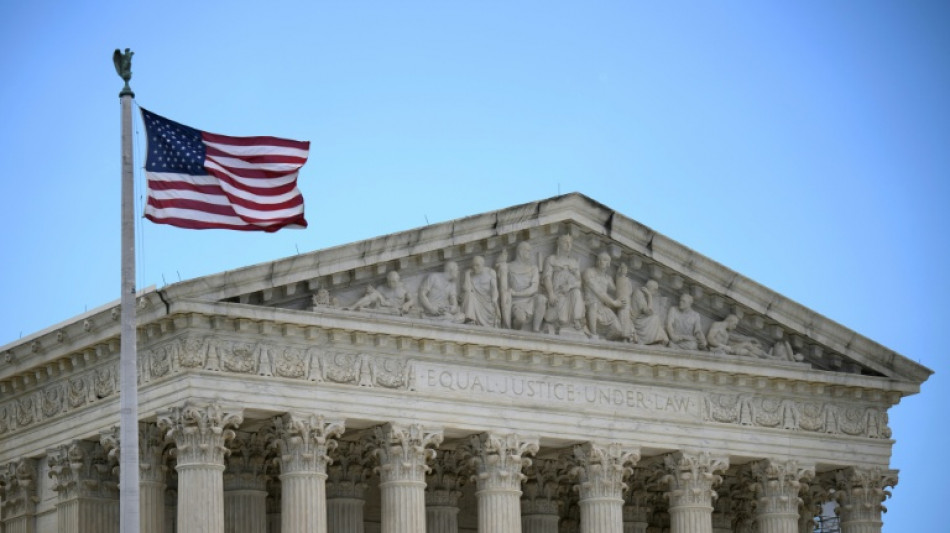
US Supreme Court debates legality of Trump's tariffs / Photo: © AFP/File

US Supreme Court justices questioned the legality behind a wide swath of Donald Trump's tariffs on Wednesday, as they began hearing a landmark case that could uphold -- or upend -- the president's economic agenda.
Billions of dollars in customs revenue and a key lever in Trump's trade wars are at stake, while the conservative-dominated court once again grapples with the Republican's attempts to expand presidential power.
The high court's nine justices are considering Trump's citing of emergency powers to impose so-called "reciprocal" tariffs on nearly every US trade partner, as well as levies targeting Mexico, Canada and China over their alleged roles in illicit drug flows.
Opponents argue that such broad tariffs are not permitted by the International Emergency Economic Powers Act (IEEPA), the law Trump cited in rolling out the levies.
An important issue before the court is whether the "major questions doctrine" applies. Under the doctrine, Congress has to give clear authorization for policies with significant economic or political consequences.
Solicitor General John Sauer, who is arguing on behalf of the Trump administration, fielded questions from several justices on the doctrine and said it did not apply given the president's inherent, broad range of authorities.
He added that one would expect Congress to confer major powers on the president to address foreign international crises.
Sauer also made a case that the issue here is not the power to tax but rather, to regulate foreign commerce. The power to impose tariffs, he said, is a "core application" of such authorities.
The court's decision, which could take months to arrive, does not concern sector-specific tariffs Trump separately imposed, including on steel, aluminum and automobiles.
Since returning to the White House, Trump has brought the average effective tariff rate to its highest since the 1930s. A lower court ruled in May that he had exceeded his authority, prompting the Supreme Court case.
Trump has hyped the case as "one of the most important" in US history and warned of calamity if his tariffs are overturned.
- 'Ringside seat' -
The president floated the provocative idea of attending Wednesday's court hearing himself but ultimately decided against it, saying he did "not want to distract" from the decision's importance.
Treasury Secretary Scott Bessent however told Fox News he planned to "have a ringside seat," while US Trade Representative Jamieson Greer was at the court as well, his office confirmed.
When Bessent was asked if his presence could be seen as an intimidation attempt, he said: "I am there to emphasize that this is an economic emergency."
"In recent years, the court has been reluctant to overrule presidential decisions of this magnitude," ING analysts said in a note Wednesday.
But they said this case is hard to predict, as "upholding Trump's tariffs would shift the balance of power from Congress to the President, further enhancing his executive power."
Trump's administration argues that under the IEEPA, the president can "regulate" trade by unilaterally setting import tax rates.
But challengers note the words "tariff" or "tax" do not appear in the statute, and that the US Constitution explicitly grants Congress the power to establish levies.
Businesses, lawmakers and former US officials have filed around 40 legal briefs against the president's global tariffs, while only a few briefs supported his actions.
Although Trump's tariffs have not sparked widespread inflation, companies and particularly small firms say they bear the brunt of higher import costs.
Lawyers note that if the top court finds Trump's global tariffs illegal, the government can tap other laws to impose up to 15 percent tariffs for 150 days, while pursuing pathways for more lasting duties.
Countries that have already struck tariff deals with Trump may therefore prefer not to reopen negotiations.
S.Jones--TFWP