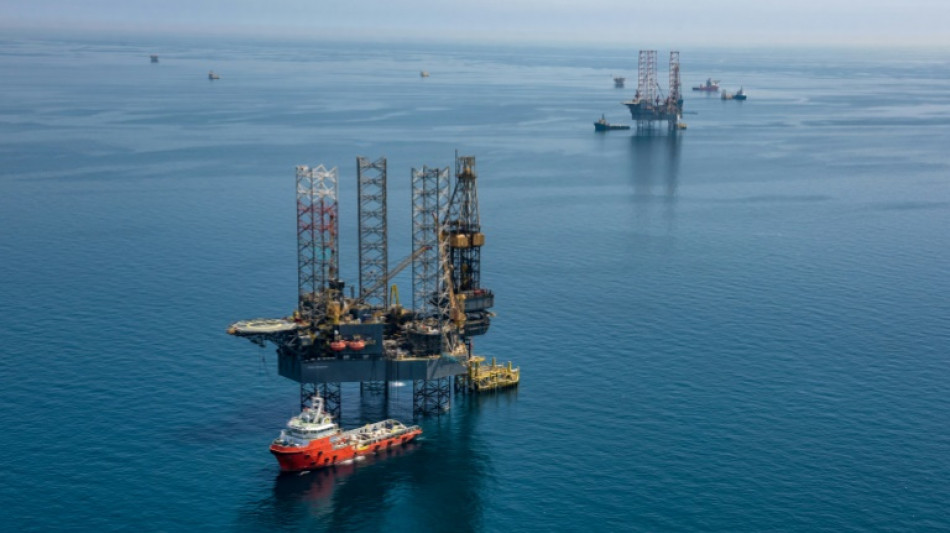
OPEC+ further hikes oil output / Photo: © Saudi Aramco/AFP/File

The eight key members of the OPEC+ alliance, including Saudi Arabia and Russia, on Sunday said they had agreed a further slight hike to their oil production.
The 137,000-barrels-per-day hike will apply from December and remain at that level for the following three months, signifying a "pause" in what had been regular increases since April this year, the group said in a statement following a virtual meeting.
The announced increase, which tallied with analyst expectations, has been seen as a bid by the key members of OPEC+ -- known as the Voluntary Eight (V8) -- to gain greater market share.
Since April, the V8 group -- comprising Saudi Arabia, Russia, Iraq, the United Arab Emirates, Kuwait, Kazakhstan, Algeria and Oman -- has boosted production by around 2.7 million barrels per day (bpd) in total.
The Organization of the Petroleum Exporting Countries and its allies (OPEC+) have sped up output increases at a pace very few had anticipated at the beginning of the year, following a long period of producers seeking to combat price erosion by implementing production cuts to make oil scarcer.
But faced with growing competition, particularly from US shale oil producers, gaining a larger share of the oil market has become the group's main priority.
The group's change in strategy "is working to a certain degree", said Ole Hvalbye, commodities analyst at SEB bank, just ahead of Sunday's announced production increase.
Supply by US shale producers "is not increasing anymore, it's going sideways", he told AFP, adding that there is "less investment in new US production".
- Price resilience -
As in previous months, the V8 group cited "low oil inventories" to justify the latest increase.
According to the US Energy Information Administration (EIA), crude oil inventories in the United States have recently recorded a sharp drop, allowing the price of a barrel of Brent, the global benchmark for crude, to remain steady at around $65.
Adding barrels to the market exposes the V8 group to a drop in prices that cuts into its profits, analysts say.
But Emily Ashford, an energy analyst at Standard Chartered bank, said an increase in OPEC+ quotas of 137,000 barrels would result in lower actual production, limiting the impact on prices.
Looking forward, some V8 members that have exceeded their output quotas in the past will need to compensate for their overproduction, and Russia in particular "is already at full capacity", Ashford told AFP.
In late October, pressure on Russian oil supplies mounted after the United States hit the country's two biggest oil producers -- Rosneft and Lukoil -- with sanctions.
Analysts say the real impact of the US measures remains unclear, since it will largely depend on how strictly Washington enforces secondary sanctions on foreign financial institutions involved in transactions with the two firms.
"The market is underestimating what it means when you have US sanctions against two large Russian companies, which are (at) the core of trading Russian oil," said Patrick Pouyanne, CEO of French oil and gas giant TotalEnergies on Thursday, suggesting that a significant reduction in Russian supply would support prices.
But many analysts are cautious, arguing that Russia has been successful at circumventing Western sanctions.
Furthermore, the United States may not take any action against purchases by China, the main importer of Russian oil, with which it has just signed an agreement to reduce trade tensions.
W.Matthews--TFWP