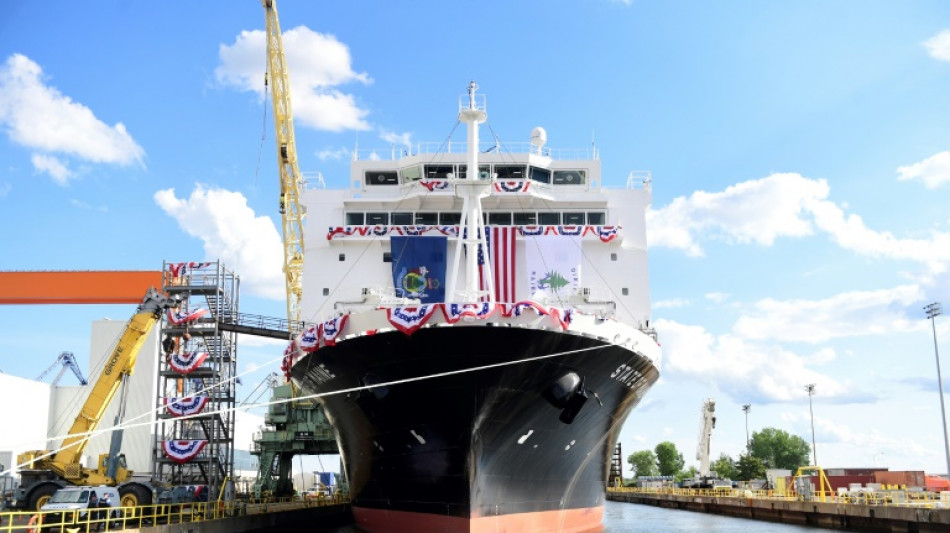
In bid to save shipyards, US set to charge fees on Chinese ships / Photo: © AFP/File

An escalating trade war between China and the United States faces another flashpoint Tuesday when Chinese ships will be required to start paying a special fee to dock at US ports.
The move announced by the US Trade Representative (USTR) in April triggered reciprocal measures from Beijing, which will impose similar costs on US ships starting the same day.
The tit-for-tat levies are just the latest in a series of disputes between the world’s two largest economic powers that have roiled financial markets and heightened fears of major disruption to the global economy.
President Donald Trump massively upped the ante last week when he announced an additional 100 percent tariff on China and threatened to cancel a summit with Xi Jinping in retaliation for Chinese export curbs on rare earth minerals.
The stated purpose of the US port fees is to address Chinese dominance of the global shipping sector and provide an incentive for building more ships in the United States.
The non-partisan Alliance for American Manufacturing has called for the funds raised through the fees to be used in building up a new Maritime Security Fund.
"The unfair economic practices of China present a sizeable obstacle to revitalizing shipbuilding in the United States," the alliance said in a petition supporting proposed legislation aimed at developing the sector.
- A fading industry -
According to the USTR, the port fee will be charged for each visit to the United States, a maximum of five times per ship per year.
Chinese-made ships will pay $18 per net ton -- or $120 per container -- with an increase of $5 per year for the following three years.
Vessels owned or operated by Chinese citizens, but not manufactured in China, will be charged $50 per net ton, with an annual increase of an additional $30 for the next three years.
The United States is trying to boost a domestic industry that now represents only 0.1 percent of global shipbuilding.
The Trump administration also sees US shipbuilding as tied to national security, given that China leads the world in ship manufacturing.
In 2024, former president Joe Biden had tasked the USTR with an investigation to identify "China's unfair practices in the shipbuilding, shipping, and logistics sectors."
His successor has kept up that focus. In March, Trump announced the creation of a White House Office of Shipbuilding with the aim of reviving that sector of US manufacturing.
- Blow for blow -
On Friday, Beijing fired back. As of Tuesday, the Chinese government announced, all ships manufactured in the United States or linked to an American company would have to pay "special" duties to dock at ports in China.
They would be required to pay 400 yuan (56 dollars) per net ton, then 640 yuan (90 dollars) in April 2026, before further annual increases.
"That's a problem when you're beholden to a global supply chain that you have no control over, that's a national security risk," Matt Paxton, president of the Shipbuilders Council of America (SCA), which represents more than 150 US shipbuilding companies, told AFP.
"We don't want to be wholly dependent on communist-controlled state enterprises," Paxton said, alluding to China.
Since returning to the White House in January, Trump has been working to recreate a thriving industrial base in the United States, notably by imposing sometimes prohibitive tariffs.
As a result, many foreign and American companies have announced astronomical investments -- worth trillions, according to the White House -- in their factories and other sites on American soil.
Paxton mentioned "a strong interest" in US-built ships, citing contacts from South Korea, China, Japan, Canada, and others.
Many US shipyards are not operating at full capacity and have disabled dry docks, he said.
In addition to increased foreign demand, the shipbuilding industry is also happy about the Trump administration's goal of building 250 ships for the commercial fleet and the $50 billion budget for the Coast Guard and the Navy.
"It's very encouraging," said Paxton. "It's a historical moment."
D.Ford--TFWP