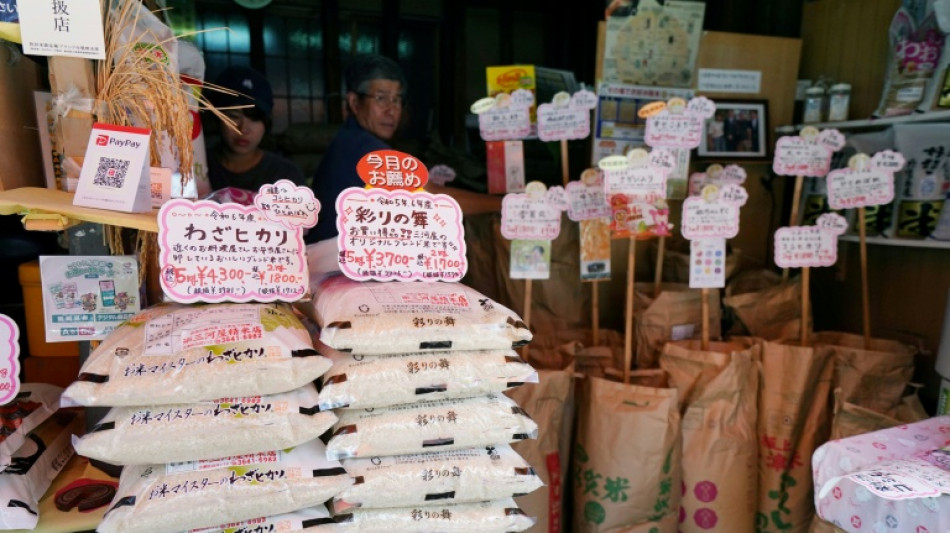
BoJ holds interest rates but to sell funds in shift from easing policy / Photo: © AFP/File

The Bank of Japan kept interest rates on hold Friday amid lingering political uncertainty and economic concerns but said it would start offloading funds bought as part of its earlier monetary easing campaign.
The announcement came hours after official data showed inflation in the fourth-largest economy slowed to 2.7 percent in August, with rice price rises slowing following a sharp spike that rattled the government.
In a widely expected decision the central bank decided against hiking borrowing costs, keeping them at 0.5 percent, but said it would begin reducing its exchange-traded fund and real estate investment trust holdings.
The BoJ began buying the funds -- in a bid to boost liquidity and reduce the cost of capital for firms, among other things -- more than a decade ago as part of its campaign to kickstart the torpid economy and end years of almost non-existent inflation.
Officials began hiking rates from below zero in March last year figures signalled an end to the country's "lost decades" of stagnation, with inflation surging.
However, with worries about the global outlook and US tariffs growing, the bank paused its tightening measures at the start of 2025, with the last increase in January, taking rates to their highest level in 17 years.
The yen rose against the dollar but Tokyo's Nikkei 225 index fell around 0.5 percent.
In a statement following Friday's announcement, the BoJ said: "Japan's economic growth is likely to moderate, as trade and other policies in each jurisdiction lead to a slowdown in overseas economies and to a decline in domestic corporate profits and other factors."
The decision was carried by seven votes to two, with the dissent described as "a bit of surprise" by Tsuyoshi Ueno of NLI Research Institute.
"Governor (Kazuo) Ueda has said he wants to see the impact of Trump tariffs, but maybe there is a division in their opinions, as inflation continues," he told AFP.
The move comes as the ruling Liberal Democratic Party (LDP) prepares for an election for a new leader following the resignation of Prime Minister Shigeru Ishiba.
The government has come under pressure from voters angry about the rising cost of rice and Ishiba's coalition lost its majority in both chambers. A race for his successor will be decided on October 4.
Figures Friday showed core inflation -- stripping out food costs --hit 2.7 percent in August.
While that was down on July's 3.1 percent, it is still well above the BoJ's target of two percent, and analysts have said the bank will likely announce another hike this year or in early 2026.
Rice prices had skyrocketed because of supply problems linked to a very hot summer in 2023 and panic-buying after a "megaquake" warning last year, amongst other factors.
Abhijit Surya of Capital Economics said the main factor behind the fall in inflation was "a deepening of energy price deflation... due to the resumption of electricity and gas subsidies".
But Taro Kimura, an analyst with Bloomberg Economics, said a pullback in inflation "won't change the big picture".
"Consumer prices will remain warm enough to keep the Bank of Japan on track to pare stimulus, likely as soon as October," he added.
Data last month showed the economy grew at an annualised pace of 1.0 percent in the second quarter, suggesting it was suffering less than feared from US tariffs.
But figures this week revealed exports to the United States plunged nearly 14 percent in August, with auto shipments -- a key driver of Japan's growth -- down 28.4 percent.
L.Coleman--TFWP