The Fort Worth Press - UK startup looks to cut shipping's carbon emissions

USD -
AED 3.6725
AFN 64.497463
ALL 80.927638
AMD 360.25116
ANG 1.789785
AOA 916.999933
ARS 1523.408897
AUD 1.42367
AWG 1.8025
AZN 1.697874
BAM 1.743153
BBD 2.009733
BDT 123.405734
BGN 1.747831
BHD 0.376563
BIF 2990.864935
BMD 1
BND 1.275344
BOB 11.749607
BRL 4.977401
BSD 0.99787
BTN 94.679988
BWP 13.746112
BYN 2.929884
BYR 19600
BZD 2.006792
CAD 1.40144
CDF 2316.000448
CHF 0.8243
CLF 0.025136
CLP 992.520334
CNY 6.67805
CNH 6.668145
COP 3160.53
CRC 455.351652
CUC 1
CUP 23.947629
CVE 98.275839
CZK 21.711797
DJF 177.684293
DKK 6.664135
DOP 61.203754
DZD 134.139342
EGP 55.5007
ERN 15
ETB 162.300644
EUR 0.891598
FJD 2.237199
FKP 0.747708
GBP 0.747925
GEL 2.590254
GGP 0.747708
GHS 11.56957
GIP 0.747708
GMD 73.999969
GNF 8830.266031
GTQ 7.627485
GYD 208.984889
HKD 7.84424
HNL 26.789009
HRK 6.716898
HTG 130.769574
HUF 327.075495
IDR 18121
ILS 3.11755
IMP 0.747708
INR 95.135404
IQD 1512.669453
IRR 1832375.000369
ISK 121.609805
JEP 0.747708
JMD 158.361483
JOD 0.708989
JPY 157.0915
KES 129.880336
KGS 87.448603
KHR 4076.467181
KMF 439.502755
KPW 899.999961
KRW 1323.310269
KWD 0.31069
KYD 0.831558
KZT 453.052166
LAK 22453.75425
LBP 89355.252721
LKR 331.329462
LRD 170.126293
LSL 16.531803
LTL 2.95274
LVL 0.60489
LYD 6.390431
MAD 9.801113
MDL 18.010775
MGA 4512.517937
MKD 54.906662
MMK 2099.851486
MNT 3598.994658
MOP 8.061391
MRU 39.878252
MUR 47.139877
MVR 15.459805
MWK 1730.229325
MXN 18.719965
MYR 4.084028
MZN 63.897889
NAD 16.531876
NGN 1346.46017
NIO 36.718506
NOK 9.32605
NPR 151.487981
NZD 1.75498
OMR 0.38241
PAB 0.997776
PEN 3.426858
PGK 4.468607
PHP 63.89499
PKR 276.123227
PLN 3.926695
PYG 5770.996176
QAR 3.637271
RON 4.767802
RSD 104.724641
RUB 81.526027
RWF 1474.255564
SAR 3.744837
SBD 8.07458
SCR 14.037053
SDG 601.500123
SEK 9.930199
SGD 1.27876
SHP 0.7473
SLE 22.950164
SLL 20969.504398
SOS 570.236811
SRD 37.628019
STD 20697.981008
STN 21.835034
SVC 8.730916
SYP 13001.999685
SZL 16.531342
THB 33.780292
TJS 9.195002
TMT 3.51
TND 2.979603
TOP 2.40776
TRY 49.762203
TTD 6.779918
TWD 32.578505
TZS 2644.982997
UAH 45.173665
UGX 4395.741514
UYU 40.018004
UZS 11941.282899
VES 879.788896
VND 25855.5
VUV 118.791596
WST 2.767791
XAF 584.849913
XAG 0.018501
XAU 0.000249393973
XCD 2.70255
XCG 1.798323
XDR 0.707052
XOF 584.849913
XPF 106.293282
YER 236.09911
ZAR 16.625745
ZMK 9001.201353
ZMW 20.061676
ZWL 321.999592
SSP 5745.299755
MXV 2.112001
  • RIO

    -0.3300

    97.04

    -0.34%

  • CMSC

    -0.0400

    20.67

    -0.19%

  • RELX

    0.0000

    33.41

    0%

  • RBGPF

    0.0000

    67.95

    0%

  • BCE

    -0.0700

    21.99

    -0.32%

  • BCC

    -0.0300

    75.66

    -0.04%

  • GSK

    0.8600

    51.08

    +1.68%

  • JRI

    -0.0300

    11.52

    -0.26%

  • NGG

    -0.1200

    76.68

    -0.16%

  • CMSD

    0.0900

    20.54

    +0.44%

  • BTI

    -0.0800

    55.75

    -0.14%

  • AZN

    2.0200

    168.1

    +1.2%

  • BP

    -1.4200

    43.16

    -3.29%

  • RYCEF

    0.4600

    19.7

    +2.34%

  • VOD

    0.0700

    17.02

    +0.41%

UK startup looks to cut shipping's carbon emissions
UK startup looks to cut shipping's carbon emissions / Photo: © AFP

UK startup looks to cut shipping's carbon emissions

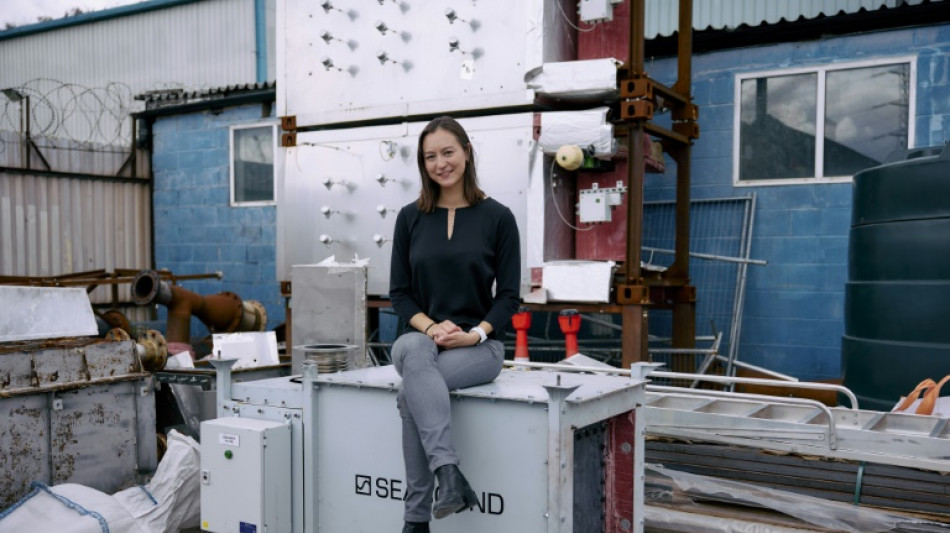
In a small London workshop, a prototype mimics the process of capturing carbon emissions from a cargo ship's engine.

Text size:

For two celebrated young designers, it is the beginning of a journey aimed at helping the maritime sector decarbonise.

"We're simulating what happens on a ship," Alisha Fredriksson told AFP of the technology she developed alongside her friend Roujia Wen.

The women, both aged in their early thirties, met at university and have since founded the company Seabound.

Its work on "ocean-ready carbon capture" has seen the friends shortlisted for this year's Young Inventor Prize, which rewards technology contributing to sustainable development goals put forward by the United Nations.

Winning the award on Wednesday "would be an extra boost to the team... a validation that the world cares about the shipping industry and its decarbonisation journey", said Fredriksson.

Shipping accounts for three percent of global emissions, while the International Maritime Organization (IMO) recently voted in favour of a pricing system to help tackle excess carbon.

At Seabound's miniature courtyard factory, Fredriksson showed off the prototype, which is fitted with a generator.

"We're burning fuel, and that creates CO2," she explained, as exhaust gas was routed through a complex system of pipes into various containers.

The carbon pollution was captured by lime pebbles, while the other elements were released into the atmosphere.

The white-coloured lime acts "like a sponge", said chemical engineer Glexer Corrales, wearing a navy laboratory coat as he tested the quality of the granular-like substance that "is readily available" and "cheap".

Once absorbed, the carbon was transformed into limestone through a chemical process.

Seabound claims that minimal customisation is necessary for its system to work across many types of vessel.

- Shipping transformation -

Technology for carbon capture, utilisation and storage (CCUS) has so far been used primarily on land by heavy industry, for example in the production of cement, glass and steel.

Potential safety risks of using CCUS at sea have yet to be set out by the IMO.

And for the process to be truly beneficial, the amount of carbon captured "must be greater than the carbon produced" through the energy use incurred in installing the system, including on land, IMO official Camille Bourgeon told AFP.

This objective was largely achieved during an initial test in 2023, when Seabound's system captured 78 percent of CO2 emitted aboard a ship run by Lomar Labs.

From 2028, all ships will be required to use a less carbon-intensive fuel, the IMO recently ruled, while a penalty of $380 will be imposed for each tonne of CO2 emitted beyond allowances permitted by the UN shipping body.

The IMO move has created "a big tailwind for our system", said Fredriksson, whose company aims to charge $150 for each tonne of captured CO2, before selling it on to companies requiring it for the production of certain types of fuel.

Seabound plans also to recycle the limestone.

W.Knight--TFWP