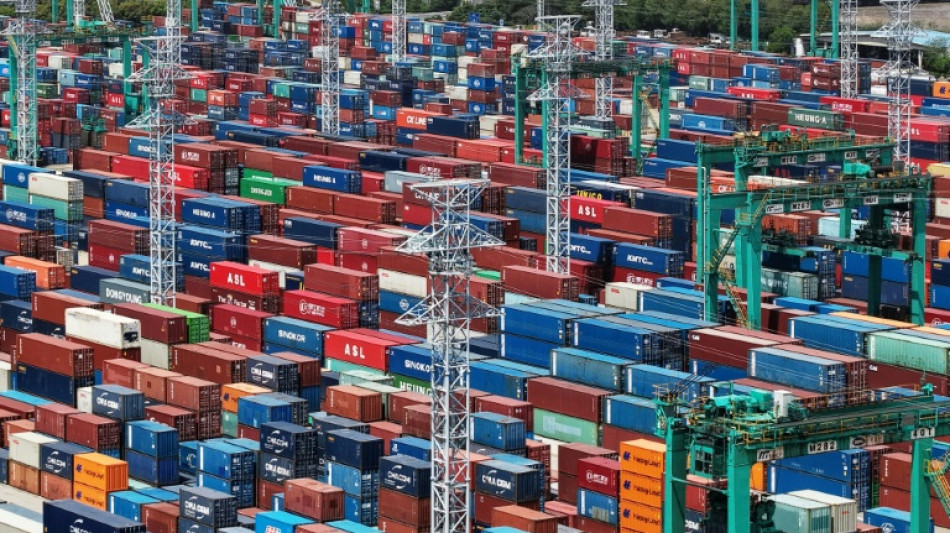
China's economy likely grew 5.1% in Q1 on export surge: AFP poll / Photo: © AFP

China is expected to post first-quarter growth of around five percent on Wednesday, buoyed by exporters rushing to stave off higher US tariffs but still weighed by sluggish domestic consumption, analysts say.
Beijing and Washington are locked in a fast-moving, high-stakes game of brinkmanship since US President Donald Trump launched a global tariff assault that has particularly targeted Chinese imports.
Tit-for-tat exchanges have seen US levies imposed on China rise to 145 percent, and Beijing setting a retaliatory 125 percent toll on US imports.
Official data Wednesday will offer a first glimpse into how those trade war fears are affecting the Asian giant's fragile economic recovery, which was already feeling the pressure of persistently low consumption and a property market debt crisis.
Analysts polled by AFP forecast the world's number two economy to have grown 5.1 percent from January to March -- down from 5.4 the previous quarter.
Figures released Monday showed Beijing's exports soared more than 12 percent on-year in March, smashing expectations, with analysts attributed it to a "frontloading" of orders ahead of Trump's so-called "Liberation Day" tariffs on April 2.
They also expect that to have boosted economic growth in the first quarter.
However, they warned the GDP reading may prove to be a rare bright spot in a year that promises more woe for the world's second-largest economy.
"China's economy is facing pressure on multiple fronts," Sarah Tan, an economist at Moody's Analytics, said.
"The export bright spot is fading as tariff hikes from the US took effect," she added.
"Domestic demand remains sluggish amid elevated unemployment and a property market stuck in correction," Tan said.
The first quarter was likely "quite good", Alicia Garcia-Herrero, Asia Pacific chief economist at Natixis, told AFP, but the second "will be much worse".
She pointed to "lots of additional exports to the US to avoid additional tariffs".
Also helping to prop up results during the period was the increased consumption during Lunar New Year celebrations when millions of people travelled back to their hometowns, she said.
- Help wanted -
Beijing announced a string of aggressive measures to reignite the economy last year, including interest rate cuts, cancelling restrictions on homebuying, hiking the debt ceiling for local governments and bolstering support for financial markets.
But after a blistering market rally last year fuelled by hopes for a long-awaited "bazooka stimulus", optimism waned as authorities refrained from providing a specific figure for the bailout or fleshing out any of the pledges.
And analysts expect Beijing to jump in with extra support to cushion the tariff pain.
Key to that will be stabilising the long-suffering real estate services sector, which now makes up six percent of GDP, according to analyst Guo Shan.
"If China could withstand its real estate adjustment in the past three years, it should be able to manage the US tariffs, especially if it can stabilise the real estate sector this year," Guo, a partner with Chinese consultancy firm Hutong Research, told AFP.
Tan at Moody's Analytics also said she expected Beijing to pull fiscal and monetary levers this year.
"The government will roll out more stimulus targeted towards households, and the People's Bank of China will likely slash key lending rates," she added.
China is trying to tariff-proof its economy by boosting consumption and investing in key industries.
But the escalating rift between the two countries could hit hundreds of billions of dollars in trade and batter a key economic pillar made even more vital in the absence of vigorous domestic demand.
"Against this backdrop, we consider significant downside risk to China's GDP growth," ANZ analysts wrote in a note.
An "extreme scenario" would be China experiencing another external shock like it did in the 2008 financial crisis, analysts said.
Growth in the second quarter would likely be worse given the tariff dynamics, Guo told AFP.
"Exports will decline, and investment may also slow as uncertainties affect companies' decision making," Guo said.
China's top leaders last month set an ambitious annual growth target of around five percent, vowing to make domestic demand its main economic driver.
Many economists consider that goal to be ambitious given the problems facing the economy.
S.Rocha--TFWP