The Fort Worth Press - GM leads first quarter US auto sales as tariffs loom

USD -
AED 3.672498
AFN 64.501353
ALL 80.797017
AMD 360.929885
ANG 1.789785
AOA 917.999823
ARS 1538.269797
AUD 1.42106
AWG 1.8025
AZN 1.70296
BAM 1.75401
BBD 2.012923
BDT 123.983804
BGN 1.747831
BHD 0.377306
BIF 2997.5
BMD 1
BND 1.280463
BOB 11.889313
BRL 5.352698
BSD 0.999466
BTN 94.999372
BWP 13.826286
BYN 2.940367
BYR 19600
BZD 2.010116
CAD 1.404275
CDF 2314.999871
CHF 0.828545
CLF 0.024979
CLP 986.302768
CNY 6.66835
CNH 6.664845
COP 3151.38
CRC 454.490425
CUC 1
CUP 23.987373
CVE 98.750015
CZK 21.852992
DJF 177.719653
DKK 6.71562
DOP 60.349916
DZD 135.338933
EGP 56.017202
ERN 15
ETB 161.050415
EUR 0.89848
FJD 2.238695
FKP 0.749223
GBP 0.75135
GEL 2.570498
GGP 0.749223
GHS 11.624999
GIP 0.749223
GMD 74.000246
GNF 8799.999875
GTQ 7.638188
GYD 209.445401
HKD 7.84465
HNL 27.000054
HRK 6.76901
HTG 130.928626
HUF 329.441962
IDR 18161.45
ILS 3.02401
IMP 0.749223
INR 95.17805
IQD 1514
IRR 1856999.999772
ISK 122.560119
JEP 0.749223
JMD 159.024972
JOD 0.709045
JPY 157.8775
KES 129.83981
KGS 87.4492
KHR 4075.000189
KMF 440.999748
KPW 899.999961
KRW 1327.739895
KWD 0.31121
KYD 0.832885
KZT 456.816419
LAK 22506.497808
LBP 89550.00032
LKR 332.273585
LRD 170.250216
LSL 16.66002
LTL 2.95274
LVL 0.60489
LYD 6.415003
MAD 9.848494
MDL 18.050231
MGA 4589.999714
MKD 55.320716
MMK 2099.77173
MNT 3599.40728
MOP 8.076123
MRU 40.198421
MUR 47.349802
MVR 15.450348
MWK 1741.000062
MXN 18.695855
MYR 4.08902
MZN 63.910391
NAD 16.659866
NGN 1340.659814
NIO 36.844966
NOK 9.327135
NPR 151.999677
NZD 1.759435
OMR 0.384472
PAB 0.999498
PEN 3.442502
PGK 4.488103
PHP 64.075497
PKR 277.000141
PLN 3.952497
PYG 5815.01195
QAR 3.645016
RON 4.807696
RSD 105.586978
RUB 80.548206
RWF 1478.5
SAR 3.750364
SBD 8.064647
SCR 13.944377
SDG 601.510149
SEK 9.94615
SGD 1.28119
SHP 0.749344
SLE 22.875022
SLL 20969.504398
SOS 571.498309
SRD 37.6505
STD 20697.981008
STN 22
SVC 8.745835
SYP 13001.999685
SZL 16.660014
THB 33.785993
TJS 9.19474
TMT 3.5
TND 3.007498
TOP 2.40776
TRY 49.8366
TTD 6.784327
TWD 32.436096
TZS 2644.862988
UAH 45.626679
UGX 4382.704147
UYU 40.070132
UZS 11970.000395
VES 886.72915
VND 25834
VUV 118.743227
WST 2.764729
XAF 589.364192
XAG 0.018344
XAU 0.000245713528
XCD 2.70255
XCG 1.801256
XDR 0.707052
XOF 589.364192
XPF 107.149656
YER 236.15032
ZAR 16.637035
ZMK 9001.196346
ZMW 20.155866
ZWL 321.999592
SSP 5745.701932
MXV 2.108742
  • RIO

    -0.3300

    97.04

    -0.34%

  • CMSC

    -0.0400

    20.67

    -0.19%

  • RELX

    0.0000

    33.41

    0%

  • RBGPF

    0.0000

    67.95

    0%

  • BCE

    -0.0700

    21.99

    -0.32%

  • BCC

    -0.0300

    75.66

    -0.04%

  • GSK

    0.8600

    51.08

    +1.68%

  • JRI

    -0.0300

    11.52

    -0.26%

  • NGG

    -0.1200

    76.68

    -0.16%

  • CMSD

    0.0900

    20.54

    +0.44%

  • BTI

    -0.0800

    55.75

    -0.14%

  • AZN

    2.0200

    168.1

    +1.2%

  • BP

    -1.4200

    43.16

    -3.29%

  • RYCEF

    0.4600

    19.7

    +2.34%

  • VOD

    0.0700

    17.02

    +0.41%

GM leads first quarter US auto sales as tariffs loom
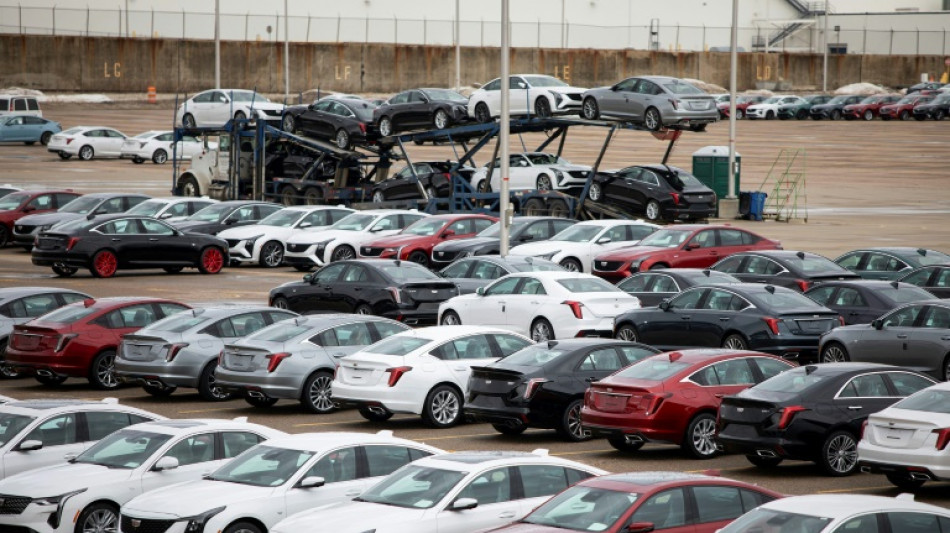
GM leads first quarter US auto sales as tariffs loom / Photo: © GETTY IMAGES NORTH AMERICA/AFP/File

GM leads first quarter US auto sales as tariffs loom

General Motors led US vehicle sales in the first quarter, according to company reports Tuesday, as the industry braces for President Donald Trump's incoming tariffs this week.

Text size:

GM said its US sales jumped 17 percent in the quarter from the same period a year ago, reporting 693,363 deliveries.

Fellow major automakers Toyota, Honda, Hyundai and Kia also reported sales increases, while Ford logged a small decline.

Tariffs of 25 percent on imported vehicles and certain parts are set to kick in Thursday, and economists warn that the charges could cause average auto prices to surge by thousands of dollars over time.

Trump is also due to announce "reciprocal" levies midweek -- which could hit imports from various countries -- on a slew of other goods to address trade practices that his administration deems unfair.

The tariffs could further affect US neighbors Canada and Mexico, both key players in North American vehicle manufacturing supply chains.

"GM's sales growth outpaced every other major automaker, and the driving force is our portfolio," said Rory Harvey, GM's president of global markets.

The company pointed to sales growth in its Chevrolet and Cadillac brands, with increases seen among electric vehicle models as well.

Meanwhile, Toyota Motor North America reported 0.9 percent growth in vehicle sales to 570,269 units for the quarter.

Its executive vice president Mark Templin said the company continued to "see steady sales from our Toyota and Lexus brands due in part to improved inventory levels and new models."

"We're also seeing our sales mix of electrified vehicles increasing," Templin said in a statement.

Honda's sales were up 5.3 percent from a year ago in the first quarter, those of Hyundai were up 10 percent, and Kia sales rose around 11 percent.

But US auto giant Ford reported a 1.3-percent drop in US sales -- to 501,291 vehicles -- from the same period in 2024.

The decline was mainly due to the discontinuation of certain models and the timing of rental fleet sales, the company said.

But its first quarter figures were better than a forecast by automotive research firm Edmunds.

Ford maintained in a statement that it saw "strong retail sales in March," thanks to sales of its best-selling F-Series pickup trucks and the Ranger and Maverick models.

Upcoming tariffs cast a pall over the auto industry, however, given that car parts will be targeted along with imported cars.

JPMorgan analysts recently estimated that over 80 percent of Ford's US sales are produced domestically. The corresponding figure for Honda was around 68 percent, Toyota about 57 percent and GM, 53 percent.

But many of the components going into building those cars are imported.

The American Automotive Policy Council representing the big three automakers -- Ford, GM and Jeep-maker Stellantis -- have warned that tariffs should be implemented in a way that avoids increasing costs for consumers and preserves the industry's competitiveness.

K.Ibarra--TFWP