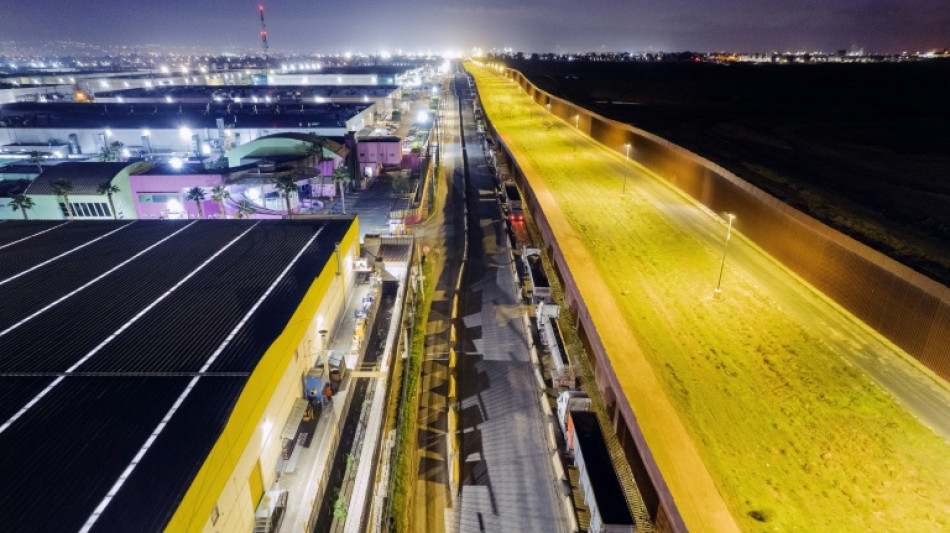
Trump tariffs reverberate through Mexico's industrial belt / Photo: © AFP

For decades, Mexico's industrial borderlands boomed thanks to growing trade with the world's largest economy next door. Today, US tariffs cast a long shadow over a region home to thousands of factories employing armies of workers.
Lower labor costs, tax incentives and a North American free trade pact dating back more than 30 years have long lured companies south of the US border.
But President Donald Trump's 25-percent duties on Mexican goods have heaped doubt on the future of the trade agreement, which was renegotiated during his 2017-2021 first term.
Manufacturers of goods ranging from medical supplies to semiconductors and other electronic components will be hit by the tariffs, said Jose Luis Contreras, president of the Mesa de Otay Industrial Association in Tijuana, just south of California.
Some products like car parts cross the Mexican-US border several times during production.
In the Tijuana region, whose industrial parks are home to around 400 companies, a million cargo border crossings are made each year, according to official figures.
Following Trump's imposition of tariffs, Mexico's "domestic market must be reoriented," Contreras told AFP in an interview.
He said that could mean replicating the production chains of the USMCA free trade deal between the United States, Mexico and Canada in the Latin American nation, home to 130 million people.
It also requires offering tax incentives and seeking new markets, he added.
"Action must be taken quickly" given the high stakes, notably 80,000 factory jobs just along the stretch of the border near Tijuana, said Contreras, a metalworking businessman.
The tariffs have dealt a heavy blow to Mexico's hopes of attracting US-owned factories from Asia to its industrial north, a trend known as "nearshoring."
President Claudia Sheinbaum warned Wednesday that Mexico would seek other trading partners besides the United States if needed.
She has vowed to respond to Trump's tariffs with retaliatory duties, calling on supporters to mass in Mexico City's main square on Sunday to hear details.
Sheinbaum has previously hailed the USMCA as "one of the best trade agreements in history" and "the only way we can compete with Asian countries, particularly China."
She has proposed replacing Chinese imports with domestically produced goods -- an apparent bid to ease Washington's concerns that Chinese companies want to use Mexico as a backdoor into the United States.
US Treasury Secretary Scott Bessent said Friday that Mexico had also proposed matching Washington's tariff hikes on China.
- 'Unfair trade practices' -
In Mexico's northeastern state of Nuevo Leon, business leaders who favor maintaining close ties with Washington pointed the finger at China as the trade tension culprit.
"The common problem that we have in the United States and Mexico is the position of China," said Maximo Vedoya, president of CAINTRA, an organization that represents several thousand companies.
"China is the one that disrupts all world trade," he told reporters Tuesday, accusing the Asian giant of "unfair trade practices."
The answer was not US-Mexico trade barriers but "strengthening the North American region" to make it more competitive, added Vedoya, chief executive of a steel products maker.
The United States is Mexico's top trading partner, buying more than 80 percent of its exports.
Analysts have warned the US duties could push Mexico's economy, the second largest in Latin America, into recession.
Sheinbaum has accused Trump of violating the USMCA, which replaced the previous NAFTA accord in 2020 and is due for review next year.
"Are we to blame for companies deciding to come to Mexico to export to the United States? No, it's the result of a good relationship since President Trump's first term and the trade agreement that came before," she said.
Contreras doubts the United States can quickly replace the labor and skills developed in Mexico during decades of trade.
"We may be less competitive, but in the end we will still be competitive," he said.
W.Lane--TFWP