The Fort Worth Press - EU targets Apple Pay in latest Big Tech antitrust case

USD -
AED 3.672501
AFN 65.000085
ALL 80.969857
AMD 361.202166
ANG 1.789785
AOA 916.99994
ARS 1517.770275
AUD 1.431465
AWG 1.80125
AZN 1.697857
BAM 1.74212
BBD 2.012426
BDT 123.598208
BGN 1.747831
BHD 0.377416
BIF 2999.585803
BMD 1
BND 1.278237
BOB 11.675159
BRL 5.044397
BSD 0.999132
BTN 94.798398
BWP 13.69985
BYN 2.981094
BYR 19600
BZD 2.009486
CAD 1.40746
CDF 2313.501384
CHF 0.82493
CLF 0.02496
CLP 982.370214
CNY 6.691203
CNH 6.68043
COP 3177.26
CRC 453.826798
CUC 1
CUP 23.980333
CVE 98.217189
CZK 21.684396
DJF 177.929603
DKK 6.65824
DOP 61.451444
DZD 134.431561
EGP 53.996599
ERN 15
ETB 163.206182
EUR 0.89079
FJD 2.25945
FKP 0.750648
GBP 0.750085
GEL 2.589735
GGP 0.750648
GHS 11.676049
GIP 0.750648
GMD 73.504011
GNF 8844.094881
GTQ 7.639034
GYD 209.00734
HKD 7.848225
HNL 26.820882
HRK 6.712503
HTG 130.705681
HUF 323.743499
IDR 18042.25
ILS 3.108555
IMP 0.750648
INR 94.902601
IQD 1514.774979
IRR 1795877.501265
ISK 121.501546
JEP 0.750648
JMD 158.78431
JOD 0.709022
JPY 158.241497
KES 129.860163
KGS 87.449893
KHR 4068.089503
KMF 439.999816
KPW 899.999961
KRW 1329.945003
KWD 0.31076
KYD 0.83268
KZT 451.722955
LAK 22482.018394
LBP 89478.016105
LKR 331.122819
LRD 170.366279
LSL 16.42449
LTL 2.95274
LVL 0.60489
LYD 6.412478
MAD 9.77184
MDL 17.816041
MGA 4529.360679
MKD 54.914955
MMK 2099.513869
MNT 3596.411813
MOP 8.077478
MRU 40.003029
MUR 47.249721
MVR 15.460101
MWK 1732.62013
MXN 18.487535
MYR 4.0825
MZN 63.896828
NAD 16.424417
NGN 1333.580338
NIO 36.770142
NOK 9.403595
NPR 151.676406
NZD 1.763245
OMR 0.38451
PAB 0.999132
PEN 3.447023
PGK 4.544503
PHP 62.999989
PKR 276.59385
PLN 3.893715
PYG 5763.047022
QAR 3.642032
RON 4.744801
RSD 104.598965
RUB 82.653667
RWF 1476.78686
SAR 3.763551
SBD 8.064647
SCR 13.894729
SDG 601.503045
SEK 9.89174
SGD 1.27907
SHP 0.754745
SLE 24.680197
SLL 20969.504398
SOS 571.064633
SRD 37.794503
STD 20697.981008
STN 21.822878
SVC 8.742551
SYP 13001.999685
SZL 16.419114
THB 33.5625
TJS 9.202594
TMT 3.51
TND 2.982711
TOP 2.40776
TRY 49.55262
TTD 6.778453
TWD 32.462604
TZS 2644.967981
UAH 45.052265
UGX 4156.255985
UYU 40.119539
UZS 12034.649387
VES 878.910601
VND 25894.5
VUV 118.97233
WST 2.787823
XAF 584.319798
XAG 0.01734
XAU 0.000239871141
XCD 2.702549
XCG 1.80082
XDR 0.707052
XOF 584.319798
XPF 106.228901
YER 236.149836
ZAR 16.43589
ZMK 9001.200838
ZMW 19.959203
ZWL 321.999592
SSP 5750.775019
MXV 2.087054
  • RIO

    -0.3300

    97.04

    -0.34%

  • CMSC

    -0.0400

    20.67

    -0.19%

  • RELX

    0.0000

    33.41

    0%

  • RBGPF

    0.0000

    67.95

    0%

  • BCE

    -0.0700

    21.99

    -0.32%

  • BCC

    -0.0300

    75.66

    -0.04%

  • GSK

    0.8600

    51.08

    +1.68%

  • JRI

    -0.0300

    11.52

    -0.26%

  • NGG

    -0.1200

    76.68

    -0.16%

  • CMSD

    0.0900

    20.54

    +0.44%

  • BTI

    -0.0800

    55.75

    -0.14%

  • AZN

    2.0200

    168.1

    +1.2%

  • BP

    -1.4200

    43.16

    -3.29%

  • RYCEF

    0.4600

    19.7

    +2.34%

  • VOD

    0.0700

    17.02

    +0.41%

EU targets Apple Pay in latest Big Tech antitrust case
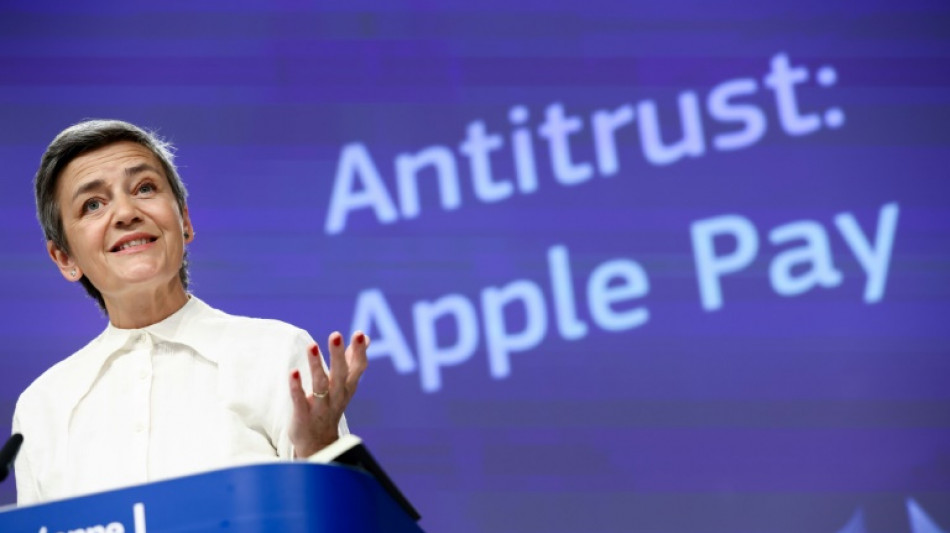
EU targets Apple Pay in latest Big Tech antitrust case / Photo: © AFP

EU targets Apple Pay in latest Big Tech antitrust case

The EU accused Apple on Monday of blocking rivals from its popular "tap-as-you-go" iPhone payment system, opening a fresh battlefront between the US tech giant and Brussels.

Text size:

"The preliminary conclusion that we reached today relates to mobile payments in shops, by excluding others from the game," said Margrethe Vestager, the EU's antitrust chief.

"Apple has unfairly shielded its Apple Pay wallets from competition. If proven this behaviour would amount to abuse of a dominant position, which is illegal under our rules," Vestager told reporters.

The European Commission, the bloc's competition watchdog, specifically charged the iPhone maker with preventing competitors trying to enter the contact-less market "from accessing the necessary hardware and software ... to the benefit of its own solution, Apple Pay".

The accusation is the latest salvo against US tech giants by EU regulators, who have also taken aim at Apple's music streaming and e-book businesses.

The company is also a main target of the Digital Markets Act, a landmark EU law that will prohibit Apple and other US tech giants from privileging their own services in its products and platforms.

The EU's outline of the case came after the commission launched an investigation in 2020 that was fuelled by complaints from European banks that resist paying a fee to Apple in order to reach their customers via apps.

The battle comes as tech giants eye personal finance as a new moneymaker, with Google, Amazon and Facebook owner Meta also seeking ways to replace credit cards or the need of carrying a wallet.

Launched in 2014, Apple Pay allows iPhone or Apple Watch users to make payments at retailers by touching their devices to the same terminals currently used for credit and debit cards.

- 'Many options' -

The technology at the heart of concerns in the Apple Pay case is "near-field communication", or NFC, which permits devices to communicate within a very short range of each other, usually less than 10 centimetres (four inches).

On iPhones, the use of NFC is blocked for payments except by Apple Pay and any company wanting to use the technology must pass through Apple for a fee.

Vestager said that by restricting the access to the NFC to themselves, "this market is really not developed because it's not possible for other app developers to get access to the NFC."

Apple said that its first priority was security and that the Apple Pay system offered a level playing field between all actors using its products.

"Apple Pay is only one of many options available to European consumers for making payments, and has ensured equal access to NFC while setting industry-leading standards for privacy and security," the company said.

"We will continue to engage with the commission to ensure European consumers have access to the payment option of their choice in a safe and secure environment," it added.

There is no deadline for the EU's continued investigation. If found guilty, Apple would have to remedy its practices or face fines that could reach as high as 10 percent of annual sales.

C.Rojas--TFWP