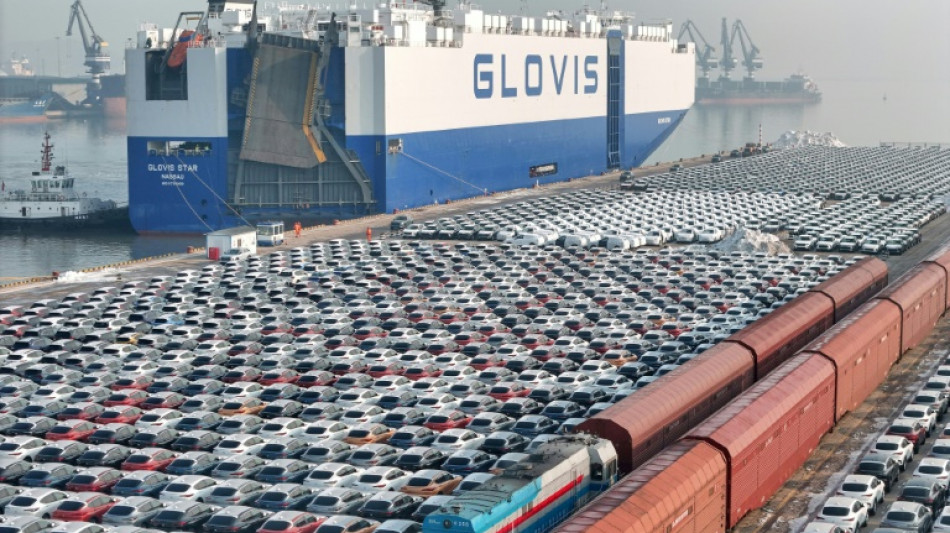
China 2023 economic growth tipped to be weakest in decades / Photo: © AFP

China's economy likely grew at its weakest annual rate for more than three decades in 2023, data is expected to show Wednesday, as it was battered by a crippling property crisis, sluggish consumption and global uncertainties.
A group of ten experts interviewed by AFP forecast China's gross domestic product (GDP) to have expanded 5.2 percent, which would represent the lowest rate since 1990, outside of the Covid-19 pandemic.
The reading would be an improvement on the three percent seen in 2022, though that year saw business activity hammered by tight health curbs designed to contain the virus.
After lifting the measures, Beijing set itself a growth target of "around five percent" for 2023.
The return of normal life initially sparked a recovery at the start of last year but the long-awaited rebound soon ran out of steam as a lack of confidence among households and businesses battered consumption.
An intractable real estate crisis, record youth unemployment and a global slowdown are also gumming the gears of the Chinese growth engine.
"The main challenge for China's economic recovery still stems from the property sector," said Jing Liu, chief economist for Greater China at HSBC.
The property sector has long accounted for around a quarter of China's economy.
It experienced dazzling growth for two decades, but financial woes at major firms such as Evergrande and Country Garden are now fuelling buyer mistrust, against a backdrop of unfinished housing developments and falling prices.
Purchasing property has long been seen by many Chinese as a safe haven for parking savings, but the price drop has hit their wallets hard.
- Uneven recovery -
"Real estate investment, dwelling prices and new dwelling sales are set to fall throughout 2024 before returning as a modest driver of growth in 2025," said Harry Murphy Cruise, an economist at Moody's ratings agency.
That crisis, alongside "sluggish labour market conditions", are dampening consumer confidence, said Helen Qiao, head of Asia Economic Research at Bank of America.
A record of more than one in five people aged 16 to 24 in China were unemployed in May, according to officials, the monthly publication of which has since been suspended.
The uneven recovery has largely benefitted services, as customers have returned to restaurants, transport and tourist sites.
But the level of spending is often lower than 2019, before the pandemic took hold.
A rare bright spark is the state-subsidised auto sector, where a wave of electrification has buttressed domestic manufacturers such as BYD, which dethroned Elon Musk's Tesla as the world's best-selling EV maker in the fourth quarter.
However, other areas are struggling, notably industry, which has been weakened by ailing demand at home and abroad.
Chinese exports -- historically a key growth lever -- fell last year for the first time since 2016, according to figures published by the country's customs agency on Friday.
The decline is partly explained by geopolitical tensions with the United States and efforts by some Western nations to reduce dependence on Beijing or diversify their supply chains.
"More (Western) companies (are) reducing or maintaining current levels of investments" in China but diversifying elsewhere, said Teeuwe Mevissen, an analyst at Rabobank.
"China saw significant capital outflows" as a result, but also due to increasing its own investments abroad, he told AFP.
All of these challenges "will continue to play an important role in 2024", Mevissen warned.
This year, China's growth is expected to slow to 4.5 percent, according to World Bank forecasts.
The average prediction by AFP's pool of experts was 4.7 percent. Beijing is expected to announce its new growth target in March.
W.Matthews--TFWP