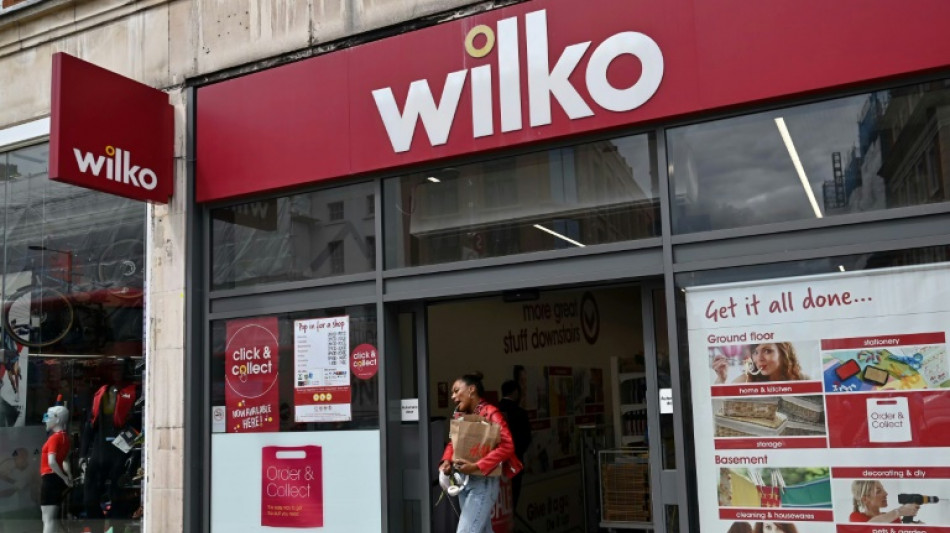
Economy and management blamed for demise of UK retailer Wilko / Photo: © AFP/File

The imminent demise of household goods seller Wilko highlights the challenges UK retailers currently face amid decades-high inflation and anaemic economic growth, but experts argue it also stems from bad management.
With nearly 12,500 job losses looming, Wilko's downfall is the biggest bankruptcy in the sector since Woolworths shuttered in 2008, according to the Centre for Retail Research.
The chain's red-and-white logo has been a familiar sight for decades on shopping streets across the country, but will soon disappear following Monday's liquidation announcement.
Wilko was synonymous with bargains in household and garden items, from small electrical appliances and cleaning products to suitcases and gardening tools.
The chain, which filed for bankruptcy in August, prided itself on being a family business -- founded 93 years ago by JK and Mary Wilkinson in Leicester, central England -- before expanding nationwide.
But it ultimately found itself ensnared by Britain's worst cost-of-living crisis in a generation, as increasingly cash-strapped customers curbed their spending in the face of rising bills and went elsewhere.
Inflation, supply chain problems and so-called "business rates" taxes also ate into profit margins.
Its 400 stores will close over the coming weeks, but around 50 will be resurrected by B&M European Value Retail, under their brand, while a further 71 have been snapped up by Poundland, another discount retailer.
Despite the difficult sector-wide conditions, analysts and the GMB union have taken aim at Wilko's management.
The chain traditionally had a reputation for good value, but failed to keep its prices and product range competitive with rival discounters such as budget-conscious supermarkets like Aldi or cut-price chains like Poundland, they said.
- 'Siphoned out' -
Susannah Streeter, an analyst at Hargreaves Lansdown, told AFP that Wilko "hadn't invested enough into keeping prices lower and couldn't stop customers drifting away to cheaper competitors".
One social media user described its offerings as "a lot of overpriced rubbish".
Meanwhile, the GMB union mirrored the UK press in noting the millions of pounds in dividends that Wilko's shareholders, and in particular the founders' heirs, had awarded themselves.
"This isn't a tragedy without cause. Wilko should have thrived in a bargain retail sector that is otherwise strong, but it was run into the ground by the business owners," the union said in a statement Monday.
"Money was siphoned out of the business for dividends, warnings about what needed to be done to save the business were not heeded and advice around what the business (needed) to do to thrive was not listened to."
Lisa Wilkinson, one of the founders' heirs and one of the group's former managers, has argued that not taking dividends would only have given the company a few months' reprieve.
Analysts felt that Wilko had simply failed to adapt sufficiently well to changing consumer habits.
Streeter noted that rivals have successfully focused on "more popular retail park sites and had diversified product ranges more into food".
Russ Mould, an analyst at AJ Bell, told AFP that "competition was the problem" eventually for the storied brand.
"Retail is all about providing the right product in the right format at the right price, and ultimately it looks like its rivals did that better than Wilko," he said.
P.Grant--TFWP