'Heating or eating': Britons struggle with rising costs

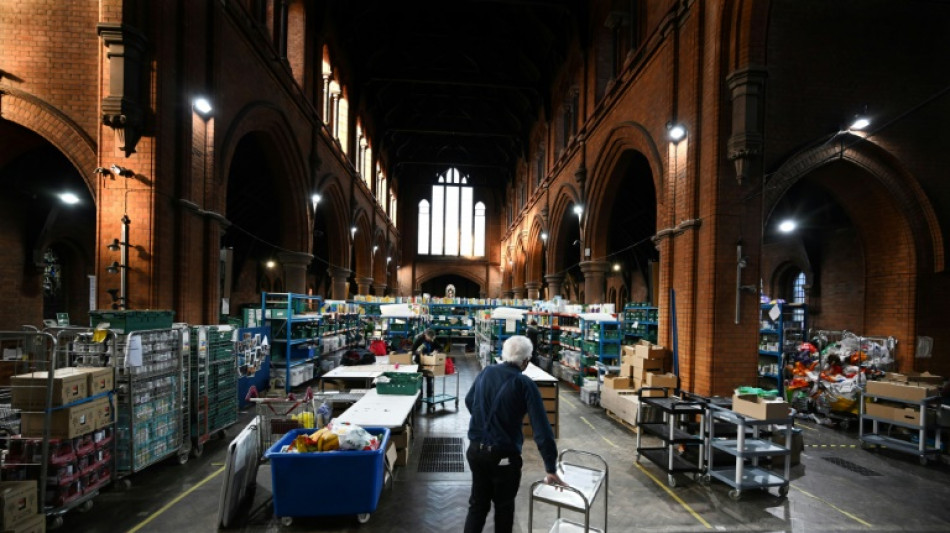
Nestled amid superstores at a retail park, the Colchester Foodbank in eastern England last year gave out a total of 165 tonnes of food -- enough to feed 17,000 people.
But that could be surpassed this year, as British annual inflation hits a 30-year high of 5.4 percent in December, as real wages fall, and food and energy costs rise.
"We think we're likely to feed 20,000 people in 2022," said foodbank manager Mike Beckett. "If there is a slowdown, and things get worse, it might be as many as 25,000 people.
"That is certainly a bit of a nightmare. Our worst case scenario is maybe 30,000 people."
About 95 percent of the produce at the foodbank, run by the Trussell Trust charity, comes from members of the public donating at collection points at local supermarkets.
But the current economic climate has forced many who wouldn't normally need food parcels to seek assistance.
"I normally put something in the foodbank trolley but now it's my turn to have some help," said Heidi, 45, who said she was struggling with price rises on "just everything".
"I'm struggling big time, basically. Bills have got really high, that's why I'm here," she said.
Like many in Britain, this winter she will have to make the tough choice between "heating or eating".
"My electricity is going up. I'm putting in probably about £80 (95 euros/110 dollars) a month now, as opposed to 40 or 50 last year," she said.
- 'Fundamentally flawed' -
The Trust says the number of people receiving three days worth of emergency food from its centres across Britain has risen from some 26,000 in 2009 to over 2.5 million in 2021.
British food writer and anti-poverty campaigner Jack Monroe noted after the latest inflation rise this week that the actual cost of many food staples has gone up by much more.
The cheapest pasta at her local supermarket a year ago cost £0.29 for 500 grams (around one pound) while today it is £0.70 -- a hike of 141 percent.
The cheapest rice was £0.45 for one kilogram but now costs £1.00 for 500g.
"That's a 344 percent price increase as it hits the poorest and most vulnerable households," she wrote in a viral Twitter thread read by millions.
"The system by which we measure the impact of inflation is fundamentally flawed -- it completely ignores the reality and the REAL price rises for people on minimum wages, zero hour contracts, food bank clients, and millions more."
Manager Beckett agrees that "however you measure inflation doesn't really account for the cheap food going up, and it's going up by hundreds of percent."
Low-income families are under extra pressure after the government returned welfare benefit payments to pre-pandemic levels, having increased them temporarily during lockdowns.
Beckett says that in 2020 -- "a bumper year" -- 42 percent of the food bank's clients were children.
"People come and report that it's taken them 20 minutes or an hour in their car to get up the courage to come in," he said.
"They didn't think they'd ever need to, they don't want to use the food bank, but they don't have a choice because they love their kids.
"The question is, when things are cold, people have to choose between eating or heating."
- Chronic health problems -
In a report published this month, the Joseph Rowntree Foundation noted that "for children, severe food insecurity has been linked to chronic health conditions like asthma and depression".
A poor diet "will impede a child's physical, cognitive and emotional development. Adults in food-insecure households have higher rate of developing chronic diseases such as arthritis, asthma, diabetes and mental health issues," said the report on UK poverty in 2022.
The anti-poverty charity noted "key design features of the social security system that directly lead to higher food insecurity and have contributed to the rise in food bank use".
They include having to wait a minimum of five weeks before getting initial benefit payments such as Universal Credit.
Others point to the fact that child benefits are capped at two children.
The cost of living in Britain is forecast to soar even higher in April owing to a tax hike and further planned increases of around 50 percent to domestic energy bills.
More painful tax increases are expected to foot the vast bill for Covid.
As a result, even more households across Britain will face fuel poverty, spending more than 10 percent of their total income on fuel.
"There's a lot of people in this situation who have never been in it before," says foodbank client Heidi.
"Everyone should put something in (at collection points). Because you never know when you're going to be in this situation. And I certainly didn't think I'd be in it."
F.Garcia--TFWP