Israeli firm develops body cams with facial recognition

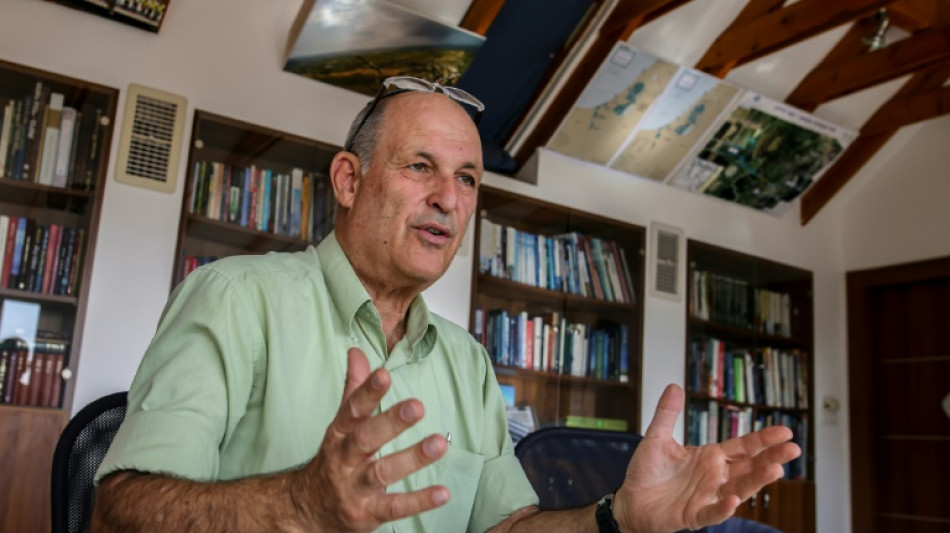
Twenty years after he planned the controversial barrier between Israel and Palestinians, Dany Tirza is developing a security tool that requires no cement: body cameras with facial recognition technology.
Tirza, a former Israeli army colonel, says his company Yozmot Ltd aims to produce a body-worn camera enabling police to scan crowds and detect suspects in real time, even if their faces are obscured.
Facial recognition in law enforcement has sparked global criticism, with US tech giants backing away from providing the technology to police, citing privacy risks.
Proponents including Tirza, however, tout its ability to track down criminals or missing persons.
"The policeman will know who he is facing," he said.
- 'It's easy' -
Tirza, 63, spoke to AFP from his home in Kfar Adumim, a Jewish settlement in the occupied West Bank.
He said he partnered with Tel Aviv-based Corsight AI to develop a body-worn police camera that could instantly identify people in a crowd, even if they wear masks, make-up or camouflage, and could match them to photographs dating back decades.
Corsight CEO Rob Watts did not confirm the collaboration but said his company was working with some 230 "integrators" worldwide who incorporated facial recognition software into cameras.
The technology allows clients to build databases, whether of company employees allowed into a building, ticket holders permitted into a stadium, or suspects wanted by the police, Watts said.
He said Australian and British police were already piloting the technology.
The facial recognition industry was worth about $3.7 billion in 2020, according to market research firm Mordor Intelligence, which projected growth to $11.6 billion by 2026.
Facebook, Microsoft, Amazon and IBM have all declared temporary or permanent freezes on selling facial recognition programmes to law enforcement.
France last month ordered the US-based Clearview AI to delete data on its citizens, saying the company violated privacy when it built a facial recognition database using images "scraped" from the internet.
Watts called Clearview's actions "abhorrent" and said Corsight AI did not sell to China, Russia or Myanmar because of "human rights and ethics".
"What we want to do is promote facial recognition as a force for good," he said.
He said Corsight had hired Tony Porter, the United Kingdom's former surveillance camera commissioner, as chief privacy officer, and that the software would blur or delete faces deemed not of interest within seconds.
Corsight AI was valued at about $55 million in a recent funding round, Watts said, estimating this would grow to $250 million by year's end and noting the technology's potential.
"Why do I need a credit card? I don't, I've got a face," he said. "The consumer will very, very quickly and readily adopt facial recognition because it's easy."
- Controversial history -
Surveillance technology developed in Israel has a chequered history.
The NSO Group, founded by Israeli military intelligence veterans, makes the Pegasus software that can spy on mobile phones.
US authorities blacklisted NSO in November, and Facebook and Apple have sued the company after the spyware was discovered on devices belonging to dissidents and journalists.
NSO says Pegasus meets the Israeli defence ministry's export rules.
Israeli facial recognition software, too, has encountered criticism.
In November, former Israeli soldiers revealed they had photographed thousands of Palestinians to build a database for a sweeping facial recognition surveillance programme in the West Bank city of Hebron.
In 2020, Microsoft divested from Israeli facial recognition firm AnyVision, now renamed Oosto, over the company's alleged involvement in surveilling Palestinians.
Oosto works with law enforcement agencies and private companies worldwide, and its software is used at checkpoints where Palestinian labourers cross into Israel.
Corsight CEO Watts said his company has "a number of contracts in Israel -- governmental contracts and agencies", but declined to elaborate, citing non-disclosure agreements.
- 'Control' -
Palestinian digital rights activist Nadim Nashif said the use of facial recognition technology entrenched Israel's "control" over Palestinians and added to a "domination" of physical spaces.
But Tirza praised its use at checkpoints, saying the main aim was to reduce "friction" between soldiers and residents.
Tirza was a colonel in the Israeli military in 2002 when he was tasked with designing a barrier in response to attacks during the second Palestinian intifada, or uprising.
Part towering concrete slabs, part fence, it now snakes for more than 500 kilometres (310 miles) along the Israel-West Bank border.
Palestinians say the barrier's construction grabbed nearly 10 percent of the West Bank, and the International Court of Justice ruled it illegal.
But Tirza said it also reshaped the conflict.
Until it was built, "a lot of people thought you cannot separate" Israelis and Palestinians, he said.
Tirza said he expected to have the body camera finished within a year, and hopes to market it to US and Mexican law enforcement -- though he acknowledged some reluctance.
"They were very interested, but everyone says we have to check the laws" to see whether it goes too far, he said.
"But I believe it is not too far."
N.Patterson--TFWP