The Fort Worth Press - Shanghai tailors keep qipao dress tradition alive

USD -
AED 3.672504
AFN 65.000368
ALL 81.216919
AMD 362.051328
ANG 1.789785
AOA 917.000367
ARS 1515.25437
AUD 1.435956
AWG 1.80125
AZN 1.70397
BAM 1.739803
BBD 2.01708
BDT 123.195303
BGN 1.747831
BHD 0.378775
BIF 2997.464751
BMD 1
BND 1.281146
BOB 11.69239
BRL 5.065104
BSD 1.001468
BTN 95.050483
BWP 13.720589
BYN 3.015879
BYR 19600
BZD 2.014233
CAD 1.41575
CDF 2313.50392
CHF 0.825932
CLF 0.024881
CLP 979.255437
CNY 6.691204
CNH 6.686704
COP 3173.953654
CRC 455.099408
CUC 1
CUP 24.035938
CVE 98.087444
CZK 21.645304
DJF 178.33919
DKK 6.651204
DOP 61.433083
DZD 133.824668
EGP 53.529689
ERN 15
ETB 163.585998
EUR 0.889904
FJD 2.26765
FKP 0.750253
GBP 0.752078
GEL 2.590391
GGP 0.750253
GHS 11.695058
GIP 0.750253
GMD 73.503851
GNF 8810.21216
GTQ 7.652004
GYD 209.527198
HKD 7.84815
HNL 26.885202
HRK 6.703804
HTG 131.147978
HUF 323.310388
IDR 18053
ILS 3.09465
IMP 0.750253
INR 94.965504
IQD 1518.213762
IRR 1795877.503816
ISK 121.180386
JEP 0.750253
JMD 159.195837
JOD 0.70904
JPY 158.01504
KES 130.098296
KGS 87.450384
KHR 4070.631144
KMF 440.00035
KPW 899.999961
KRW 1334.740383
KWD 0.31082
KYD 0.834586
KZT 453.195748
LAK 22534.359294
LBP 89683.40524
LKR 331.690611
LRD 170.751234
LSL 16.462394
LTL 2.95274
LVL 0.60489
LYD 6.431526
MAD 9.729662
MDL 17.966464
MGA 4507.405595
MKD 54.836988
MMK 2100.071343
MNT 3596.488264
MOP 8.096339
MRU 40.037362
MUR 47.230378
MVR 15.460378
MWK 1736.600987
MXN 18.492904
MYR 4.083204
MZN 63.903729
NAD 16.462394
NGN 1331.210377
NIO 36.854512
NOK 9.427704
NPR 152.081128
NZD 1.767253
OMR 0.382413
PAB 1.001468
PEN 3.444825
PGK 4.547436
PHP 62.986038
PKR 277.237468
PLN 3.88825
PYG 5719.877241
QAR 3.660721
RON 4.730604
RSD 104.461148
RUB 84.13468
RWF 1478.183516
SAR 3.752837
SBD 8.064647
SCR 13.905529
SDG 601.503676
SEK 9.912404
SGD 1.282104
SHP 0.754745
SLE 24.680371
SLL 20969.504398
SOS 572.343548
SRD 37.794504
STD 20697.981008
STN 21.794245
SVC 8.763065
SYP 13001.999685
SZL 16.455989
THB 33.445038
TJS 9.228751
TMT 3.51
TND 2.98768
TOP 2.40776
TRY 49.513804
TTD 6.798915
TWD 32.453604
TZS 2646.44398
UAH 44.920874
UGX 4136.458658
UYU 40.314905
UZS 12073.121914
VES 878.910604
VND 25894.5
VUV 119.385856
WST 2.787824
XAF 583.738825
XAG 0.017551
XAU 0.000240063761
XCD 2.70255
XCG 1.804919
XDR 0.707052
XOF 583.738825
XPF 106.089045
YER 236.150363
ZAR 16.494037
ZMK 9001.203584
ZMW 20.049815
ZWL 321.999592
SSP 5750.775019
MXV 2.088032
  • RIO

    -0.3300

    97.04

    -0.34%

  • CMSC

    -0.0400

    20.67

    -0.19%

  • RELX

    0.0000

    33.41

    0%

  • RBGPF

    0.0000

    67.95

    0%

  • BCE

    -0.0700

    21.99

    -0.32%

  • BCC

    -0.0300

    75.66

    -0.04%

  • GSK

    0.8600

    51.08

    +1.68%

  • JRI

    -0.0300

    11.52

    -0.26%

  • NGG

    -0.1200

    76.68

    -0.16%

  • CMSD

    0.0900

    20.54

    +0.44%

  • BTI

    -0.0800

    55.75

    -0.14%

  • AZN

    2.0200

    168.1

    +1.2%

  • BP

    -1.4200

    43.16

    -3.29%

  • RYCEF

    0.4600

    19.7

    +2.34%

  • VOD

    0.0700

    17.02

    +0.41%

Shanghai tailors keep qipao dress tradition alive


Shanghai tailors keep qipao dress tradition alive

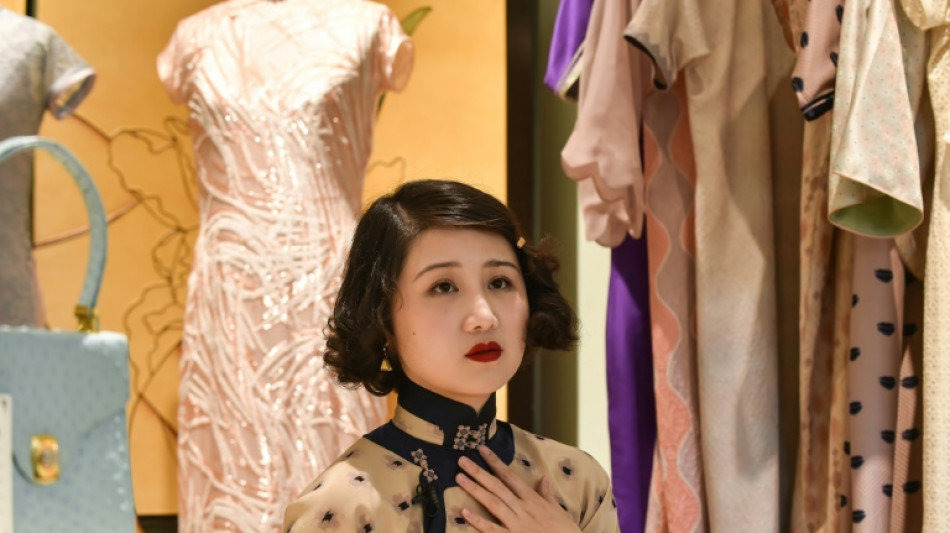
Zhou Zhuguang surveys his Shanghai workshop and rows of workers meticulously stitching high-collared Chinese dresses known as qipao, some of which sell for nearly $5,000.

Text size:

"It's a highly skilled craft," said Zhou, co-founder of Hanart, one of China's most well-known qipao makers.

"Some of our tailors spend a lifetime learning to make qipao."

The price tag also reflects enduring demand for the qipao, known as a cheongsam in Hong Kong and overseas Chinese communities.

Drawing on traditional design elements, the dress was popularised in 1920s Shanghai, its form-fitting cut capturing the glamour of that free-wheeling pre-communist era and the desire of Chinese women to liberate themselves from traditionally subservient roles.

The qipao disappeared after the Communist Party -- which considered it decadent and bourgeois -- took power in 1949.

The dress's comeback is due in part to producers like Zhou.

A mass-produced qipao, sometimes seen at weddings or other formal occasions, can be bought today for as little as 100 yuan ($16).

But Zhou, 59, has found a market for higher-end designs among well-heeled Chinese fashionistas.

Zhou previously dealt in lower-priced qipao before founding Hanart in 1998 in partnership with Chu Hongsheng, a legendary qipao designer who fitted Chinese film actresses and the wives and daughters of Shanghai mafia bosses. Chu died in 2017 at the age of 99.

- Cultural value -

"(Low price) isn't the true essence of the qipao," said Zhou, who feels that such an iconic Chinese fashion staple requires more luxurious materials, bolder designs and hand-crafted precision, which inevitably push prices up.

Zhou displayed these at a Shanghai show late last year which featured "modern, altered qipao" designs combining the classic Mandarin collar and body-hugging fit with less traditional elements such as lace, fringes, velvet, sequins and rich embroidery.

"We want more young people to wear qipao," Zhou said of his design re-boot.

To Yang Zhenzhen, who owns a Shanghai qipao shop and is an online influencer of the dress style, cracking the youth market is essential to keeping the tradition alive.

Her shop targets buyers aged 25-45 with qipao starting at around $600.

"Young people bring new life and energy" to the qipao, said Yang, 28, who has been smitten with the dress since childhood and began collecting them five years ago.

"If young people don't wear them, then by the time they grow old there won't be anyone wearing them," she said.

Yang admitted that youth acceptance suffers from a stereotype that qipao are for elderly women, or the belief that pop culture uses the dress to objectify Chinese women.

"These are deep misconceptions... so I want to popularise it as best I can and let people know the real meaning of qipao," she said.

That includes the dress's role in breaking down gender norms for women during the 1920s. The sense of freedom associated with that will never go out of style, she adds.

For Zhou, selling qipao is about perpetuating an element of China's intangible cultural heritage.

"We are small, but we are carrying on a piece of culture," he said.

"That's where our biggest value is."

W.Matthews--TFWP