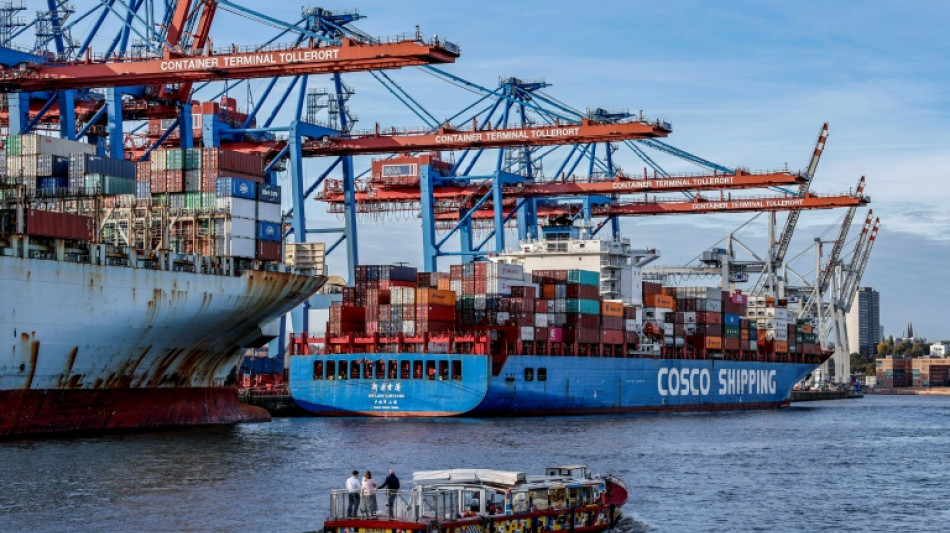
Maritime sector seals carbon-cutting deal but sparks criticism / Photo: © AFP/File

The International Maritime Organization, which oversees the highly polluting shipping industry, clinched a landmark deal on Friday to improve its target to cut carbon emissions -- but green campaigners said it fell far too short to tackle climate change.
The London-based IMO said its Marine Environment Protection Commission has adopted a "historic... strategy to reduce greenhouse gas emissions from international shipping".
Compared with 2008 levels, the United Nations' global shipping regulator said nations had agreed to cut total annual emissions of greenhouse gases "by at least 20 percent, striving for 30 percent, by 2030" and "by at least 70 percent, striving for 80 percent, by 2040".
That compared with the prior target for a 50-percent reduction by mid-century.
The deal came at the end of a five-day meeting at the IMO's headquarters in London, attended by representatives from 100 countries involved in the shipping industry -- which emits roughly the same level of greenhouse gases as aviation.
- Urgency -
The gathering pitted climate-vulnerable nations -- particularly islands in the Pacific -- and richer countries against big exporters like China.
The vast majority of the world's 100,000 cargo ships -- which carry 90 percent of the world's goods -- are powered by highly-polluting diesel.
Shipping is responsible for around three percent of global greenhouse gas emissions according to the UN.
The IMO added it "remains committed to reducing greenhouse gas emissions from international shipping and, as a matter of urgency, aims to phase them out as soon as possible".
The "carbon intensity" of ships was expected to decline over time with "further improvement of energy efficiency" of new vessels, it insisted.
However, environmental non-governmental organisations slammed the agreement, arguing it was insufficient under the framework of the landmark Paris climate accord.
The green lobby instead wants the shipping sector to implement a 50-percent reduction by 2030 and deliver carbon neutrality by 2040.
- 'Vague' deal -
"They knew what the science required, and that a 50-percent cut in emissions by 2030 was both possible and affordable," said John Maggs, president of the Clean Shipping Coalition.
"Instead the level of ambition agreed is far short of what is needed to be sure of keeping global heating below 1.5 Celsius, and the language seemingly contrived to be vague and non-committal."
Harjeet Singh, head of global political strategy for Climate Action Network International, concurred that the strategy "charts a course towards emission reduction -- but unfortunately falls short of expectations".
"There is a clear disparity between its goals and those set by the Paris agreement."
Greenpeace UK welcomed the deal also declared it was "still too weak" to fight pollution in a sector which "has operated out of sight" for too long.
Under the 2015 Paris deal, nations pledged to reach net-zero carbon emissions by the middle of the century with the aim of limiting the increase in global temperatures to 1.5 degrees Celsius above pre-industrial levels.
Argentina, Brazil and China, in particular, had strongly resisted tougher IMO targets, arguing they cost poor, developing countries the most.
They are also strongly opposed to a flagship proposal for a global levy, or carbon tax, on shipping emissions.
French President Emmanuel Macron backed the idea at a recent climate finance summit in Paris, but said it would need backing from China, the United States and other European nations to work.
- Inadequate -
Green campaigners had protested Monday outside the IMO in central London.
Several dozen activists, including some dressed as jellyfish, urged greener freight to help tackle climate change and protect the oceans.
The Clean Shipping Coalition argued Friday that the regulator was simply not doing enough.
"This agreement is the latest example of a pattern of behaviour at the IMO, where climate and environment issues are addressed but not adequately responded to," the coalition said.
It "raises further questions about the institution's suitability as a venue for tackling shipping's serious impact on the climate and oceans", the NGO added.
P.McDonald--TFWP