'Chemical recycling' of plastic slammed by environmental group

Most plastic "advanced recycling" plants in the United States aren't actually recycling plastic but instead converting it into a dirty fuel, while producing toxic waste in low-income communities, a study by a leading environmental group said Monday.
Advanced recycling, also known as chemical recycling, is a relatively new technique touted by industry groups that breaks plastic down to its molecular building blocks.
It is said to be able to recapture more than traditional "mechanical" recycling that involves chopping plastic up and processing it into pellets to make new products.
But a research report by the Natural Resources Defense Council (NRDC), a non-profit that has helped influence key legislation since it was founded in 1970, accused the plastics industry of misleading the public through "greenwashing."
"There has been a lot of energy and enthusiasm around this idea of chemical recycling as a potential part of the solution for the plastics waste crisis," Veena Singla, a senior scientist at the NRDC who authored the brief, told AFP.
"We felt it was very important to understand, what are these technologies actually doing?"
The NRDC found that of hundreds of announced plants, just eight were either operational or soon-to-be operational, based on official federal and state documents.
Five of the eight were engaged in plastic-to-fuel conversion, to create a new low-grade fuel. One was converting carpets to nylon and two were converting plastic to chemical components.
The report said that producing fuel from plastic waste does not qualify as recycling under international definitions and that it creates harmful air pollution and greenhouse gasses when burned.
One of the plastic-to-chemical plants, run by the company Agilyx, in Oregon, theoretically takes waste polystyrene and converts it into styrene, which can then be used to make new polystyrene.
But according to the company's own figures, it is shipping hundreds of thousands of pounds of styrene oil to be burned for energy rather than converted back to plastic.
Singla told AFP it was not clear why the company would go through the "wasteful and inefficient" process of converting polystyrene to styrene, only to then burn the styrene, though one potential reason was that the styrene produced was of very low quality.
The plant also generated nearly 500,000 pounds of hazardous waste in 2019 alone, sending most of it offsite to be burned, according to official figures.
Reached for comment, Agilyx told AFP: "We share the view that the world has a plastic waste problem, that not enough plastic is recycled, that too many plastics end up in landfills and our oceans, and that many types of plastics are not (today) being recycled into useful products.
"These are the issues that Agilyx is working to solve."
It added that the amount of hazardous waste produced by chemical recycling was not "significant."
The NRDC also found "six of the facilities are in communities that are disproportionately Black or brown," and five are in communities where a disproportionate percentage of households have an income below $25,000, relative to the national average.
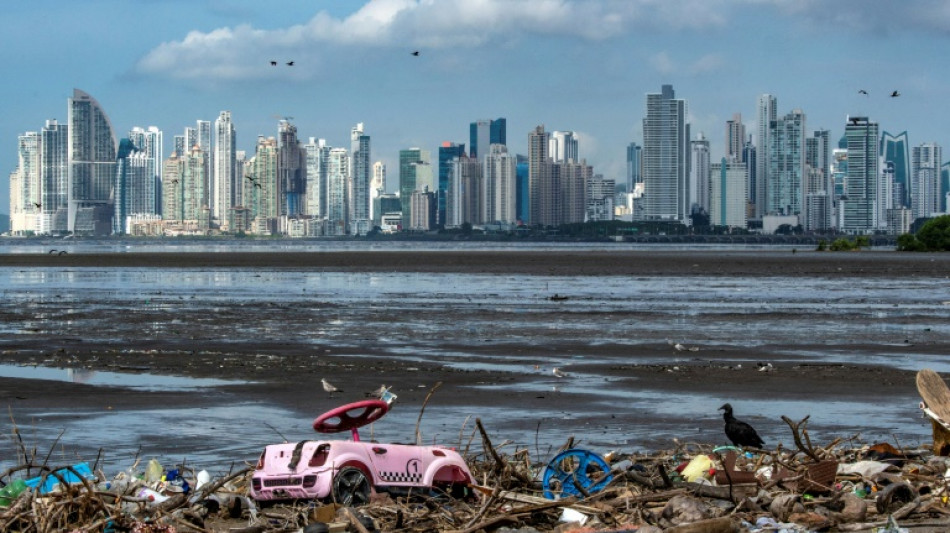
An estimated 242 million metric tons of plastic waste is generated globally every year, polluting cities and clogging oceans.
Despite being a leading producer, the United States recycles just 8.7 percent of its plastic waste.
"What we need is to focus on solutions that address the root of the problem: we need less plastic, period," said Singla, calling for bans on single-use items.
S.Weaver--TFWP